Facts
The plaintiffs, three brothers, sought partition of two properties, claiming that the family had remained joint until 1990, that Item No. 2 was ancestral property, and that Item No. 1 had been purchased in Kariappan’s name in 1978 using income from the ancestral property.
Source reference: para. 3–4Kariappan was their brother and the husband and father of the first and second defendants, respectively.
Source reference: para. 3–4The defendants maintained that Item No. 1 was Kariappan’s self-acquired property and that no property corresponding to Item No. 2 existed.
Source reference: para. 3–4The trial court dismissed the suit, finding that Item No. 1 belonged to Kariappan and that the plaintiffs had not established the existence of Item No. 2; the first appellate court affirmed.
Source reference: para. 6–7The plaintiffs’ second appeal challenged those concurrent findings.
Source reference: para. 8Issues
1. Whether the plaintiffs proved that Item No. 1 was joint family property, rather than Kariappan’s separate property, so as to be available for partition.
Source reference: para. 13–182. Whether the plaintiffs established the existence of Item No. 2 and their entitlement to a share in it.
Source reference: para. 173. Whether the concurrent findings of the courts below disclosed a basis for interference in a second appeal under Section 100 CPC.
Source reference: para. 19–21Law Applied
Under Section 100 of the Code of Civil Procedure, interference with concurrent findings of fact is limited; reappreciation is not warranted unless, for example, the findings are perverse, based on no evidence, or reached without considering vital evidence, and the matter involves a substantial question of law.
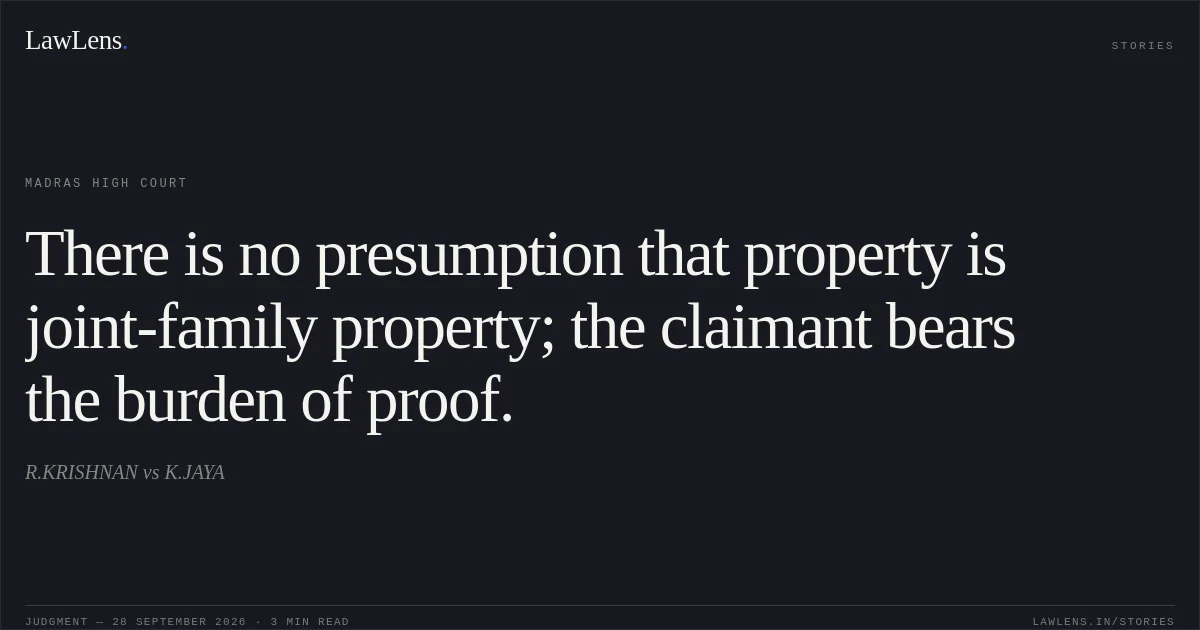
Source reference: para. 20–21The plaintiffs bear the burden of proving their claim, and there is no presumption that property is joint family property; the party asserting that character must establish it (Markhan Singh (Dead) by LRs. v. Kulwant Singh, (2007) 10 SCC 602).
Source reference: para. 18A document affecting relinquishment of rights in immovable property requires compulsory registration, as discussed in Yellapu Uma Maheshwari v. Buddha Jagadheeswararao, (2015) 16 SCC 787.
Source reference: para. 12The Court also stated that documentary evidence would prevail over oral evidence in the circumstances of this case.
Source reference: para. 18Reasoning
The Court found that Ex. A1, the sale deed for Item No. 1, contained no recital indicating joint-family ownership, and the plaintiffs had not examined the vendors or their legal heirs to establish that the consideration came from joint-family income.
Source reference: para. 14Ex. A2, said to be Kariappan’s notarised affidavit acknowledging joint-family status, was not proved by establishing his signature or otherwise corroborating its contents; the remaining plaintiffs’ exhibits also did not establish that status.
Source reference: para. 15The evidence of exclusive possession and the plaintiffs’ own testimony concerning separately held properties supported the concurrent finding that the parties acquired and held properties separately.
Source reference: para. 16–18The plaintiffs also failed to prove that Item No. 2 existed.
Source reference: para. 17The Court held that the asserted inconsistencies in DW1’s evidence about Kariappan’s age at the time of the purchase did not discharge the plaintiffs’ burden or justify disturbing the factual findings.
Source reference: para. 18It found no perversity, legal infirmity, or other ground for second-appeal interference.
Source reference: para. 19–20Holding
The Court held that no substantial question of law arose for determination and dismissed the second appeal, leaving in place the dismissal of the partition suit.
It awarded costs to the defendants throughout and closed the connected miscellaneous petition.
Source reference: para. 22Acts & Sections Cited
1 provisions across 1 statute referred to in this judgment. Each provision opens on LawLens.
Code of Civil Procedure, 19081
Original Court PDF
R.KRISHNANvsK.JAYA
Click to open original judgment
Original judgment, available to read, download and summarize on LawLens.in