Facts
The appellants had filed Consumer Complaint No. 13 of 2006 before the State Consumer Disputes Redressal Commission, Uttar Pradesh, which allowed the complaint by order dated 4 December 2012 and awarded compensation of ₹95 lakh with 15% interest.
Source reference: para. 3The first respondent preferred First Appeal No. 156 of 2013 before the National Consumer Disputes Redressal Commission (NCDRC). The two-member referring Bench differed: the Presiding Member allowed the appeal and dismissed the complaint, whereas the companion Member reduced the compensation to ₹93 lakh and the interest to 12%.
Source reference: para. 4A reference was made under Section 58(3) of the Consumer Protection Act, 2019. The third Member answered five questions concerning the evidence and merits of the complaint, disagreed with the Presiding Member, agreed with the companion Member, and proceeded to dispose of the appeal by granting modified compensation and interest.
Source reference: paras. 5, 9–10The first respondent challenged this procedure under Article 227 of the Constitution. The Allahabad High Court held that the third Member had exceeded jurisdiction by deciding the appeal instead of merely answering the questions referred and remanding the matter to the referring Bench.
Source reference: paras. 2, 6, 10Issues
Whether, in a reference under Section 58(3) of the Consumer Protection Act, 2019, the third Member was required only to answer the points or questions referred and return the matter to the referring Bench, or could decide the appeal itself on the basis of the resulting majority opinion.
Source reference: para. 7Whether the third Member’s decision to dispose of the appeal on merits constituted such an illegality or jurisdictional error as to warrant interference by the High Court under Article 227 of the Constitution.
Source reference: paras. 19–22Law Applied
Section 58(3) of the Consumer Protection Act, 2019 provides that where Members of an NCDRC Bench are equally divided, they must state the points of difference and refer them to the President or another Member; the referred points are to be decided according to the majority opinion of the Members who heard the case, including the original Members.
Source reference: para. 16Ordinarily, a referee or larger Bench must answer only the questions referred and return the matter to the original Bench for disposal, as recognised in Kesho Nath Khurana v. Union of India, Kerala State Science & Technology Museum v. Rambal Co., T.A. Hameed v. M. Viswanathan and Saquib Abdul Hameed Nachan v. State of Maharashtra.
Source reference: para. 13However, State of Punjab v. Salil Sabhlok recognises that a larger or referee Bench may answer a subsidiary question that logically and unavoidably arises, by adopting a common-sense approach; the scope of the reference depends on the terms in which it was made.
Source reference: para. 13The Court also noted that, unlike the CPC, the relevant statutory framework does not contain a provision analogous to Section 392 of the Code of Criminal Procedure, 1973 or Section 433 of the Bharatiya Nagarik Suraksha Sanhita, 2023.
Source reference: para. 15Reasoning
The Supreme Court accepted that the normal procedure would have required the third Member to confine the decision to the points of difference and return the reference to the original Bench.
Source reference: paras. 14, 16However, the referring Members had not clearly stated the precise points on which they differed; instead, they formulated five questions that went to the root of the complaint and required an assessment of the evidence, pleadings and rival contentions on merits.
Source reference: para. 17In those circumstances, the third Member necessarily had to examine the entire factual and evidentiary record. Since the third Member’s view coincided with that of the companion Member, the resulting majority opinion supported the disposal of the appeal in accordance with Section 58(3).
Source reference: para. 18The Court treated the objection concerning the scope of the reference as technical and held that the third Member’s approach fell within the exceptional, common-sense approach recognised in Salil Sabhlok.
Source reference: paras. 18–20Consequently, the procedural departure did not constitute such an illegality or jurisdictional excess as to justify the High Court’s interference under Article 227.
Source reference: para. 19Holding
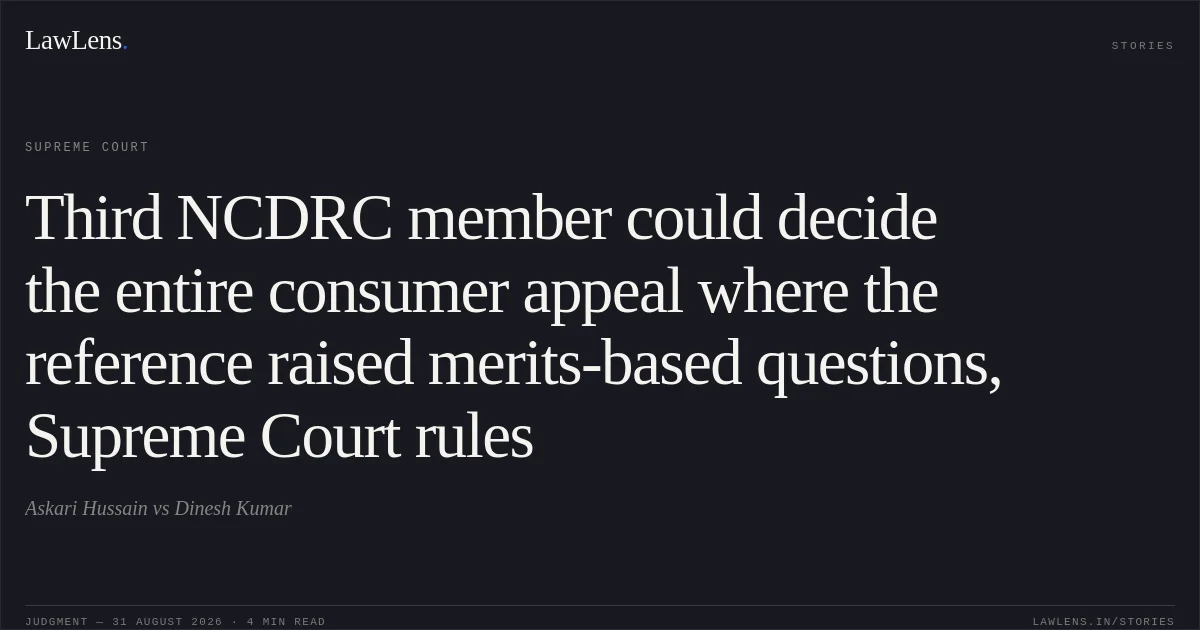
The Supreme Court held that, although the ordinary course is for the referee Member to answer the referred questions and remit the matter to the original Bench, the third Member did not commit a legally actionable jurisdictional error in deciding the appeal in the present case because the reference was inadequately framed and the questions required determination of the complaint on merits.
The High Court’s order was set aside, and the Article 227 application was remanded for fresh consideration on its own merits. All questions of fact and law were left open to the parties before the roster Bench.
Source reference: para. 23The NCDRC was directed not to proceed further until the High Court finally decided the Article 227 proceedings.
Source reference: para. 25Acts & Sections Cited
2 provisions across 2 statutes referred to in this judgment. Each provision opens on LawLens.
Consumer Protection Act, 20191
Code of Civil Procedure, 19081
Original Court PDF
Askari HussainvsDinesh Kumar
Click to open original judgment
Original judgment, available to read, download and summarize on LawLens.in