Facts
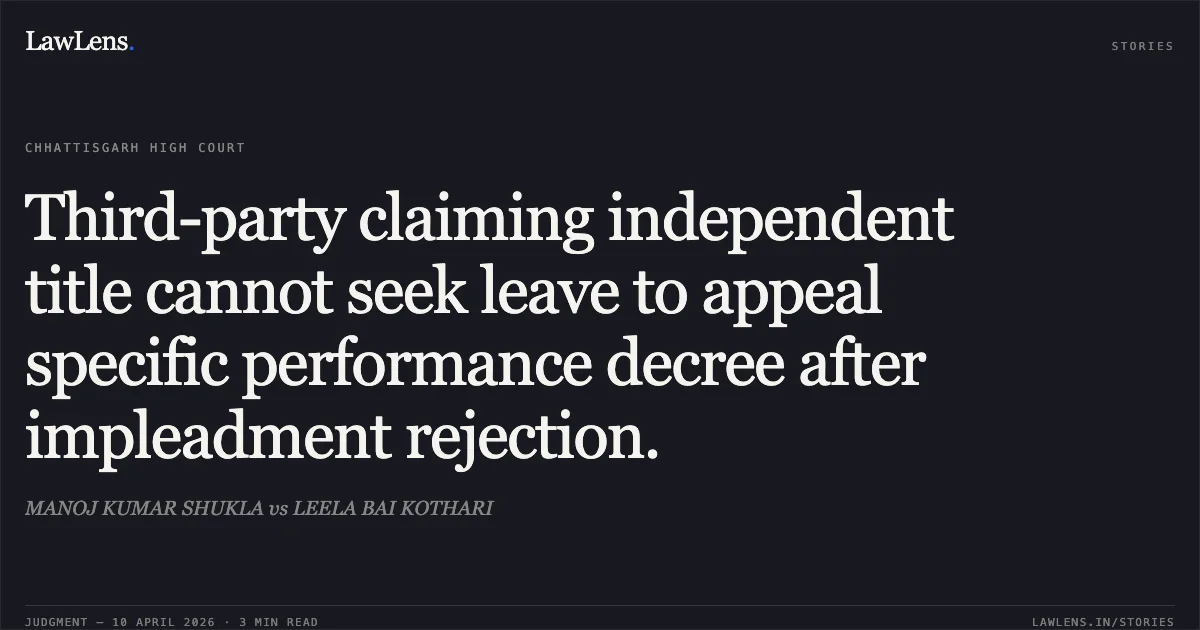
The appellant, Manoj Kumar Shukla, filed an application (I.A. No. 1/2021) seeking leave to appeal against a judgment and decree dated 25/02/2020 passed by the District Judge, Rajnandgaon.
Source reference: para 1The trial court had decreed a suit for specific performance of a contract for the sale of a shop in favor of the original plaintiff, Phool Chand Kothari.
Source reference: para 1, 4The appellant is the brother of the deceased vendor (Santosh Shukla) and claims to be a co-owner of the suit property.
Source reference: para 2, 5During the original suit, the appellant’s application for impleadment under Order 1 Rule 10 of the CPC was rejected on 07/01/2009, a decision affirmed by the High Court in W.P.(227) No. 798/2009 on 30/06/2017.
Source reference: para 6The appellant contended that as a co-owner, he is an "aggrieved person" whose rights are prejudiced by the decree.
Source reference: para 2The respondents opposed the application, citing the suppression of the previous impleadment rejection and arguing that the appellant is not a party to the agreement.
Source reference: para 3Issues
1. Whether a third party claiming co-ownership, who was not a party to the agreement to sell and whose impleadment was previously rejected, is entitled to "leave to appeal" as an "aggrieved person" in a suit for specific performance.
Source reference: para 1-32. Whether a decree for specific performance involving only the share of a co-vendor prejudicially affects the rights of another co-owner who claims an independent title.
Source reference: para 5, 12Law Applied
Section 19 of the Specific Relief Act, 1963, which limits the enforcement of specific performance to parties to the contract and those claiming under them by subsequent title.
Source reference: para 6Supreme Court precedent in Kasturi v. Iyyamperumal and others (2005) 6 SCC 733, which established that a person not party to an agreement who claims an independent/adverse title is not a "necessary party" in a specific performance suit, as adding them would improperly convert the case into a title suit.
Source reference: para 6-7Full Bench decision in Panna and another v. Jeevanlal and another (1976 JLJ 84), which held that a third party claiming rights by birth or co-ownership is not a necessary party in such suits.
Source reference: para 8Reasoning
The Court observed that the appellant sought leave to appeal while suppressing the fact that his prior attempt to be impleaded in the suit had been rejected by both the trial court and the High Court.
Source reference: para 3, 10Applying the Kasturi principle, the Court reasoned that the scope of a specific performance suit is limited to the enforceability of the contract between the signatories; including the appellant would expand the litigation into a suit for title.
Source reference: para 7, 9The Court noted that the trial court's decree specifically considered only the share of the appellant’s brother, Santosh Shukla, thereby ensuring the appellant’s independent interests were not legally compromised.
Source reference: para 3, 12The Court distinguished the appellant’s reliance on H. Anjanappa v. A. Prabhakar (2025), noting that the cited case dealt with pendente lite transfers during an active injunction, which did not apply to the appellant’s claim of pre-existing co-ownership.
Source reference: para 10-11Consequently, since the appellant’s legal status relative to the suit had already attained finality through the rejection of his impleadment, he could not be classified as an "aggrieved person".
Source reference: para 12Holding
The High Court rejected I.A. No. 1/2021 seeking leave to prefer an appeal.
The Court held that the appellant's rights were not prejudicially affected by the decree for specific performance of a contract to which he was not a party, especially since the impleadment rejection had attained finality.
Source reference: para 12No order as to costs was made.
Source reference: para 13Acts & Sections Cited
3 provisions across 2 statutes referred to in this judgment. Each provision opens on LawLens.
Code of Civil Procedure, 19082
Specific Relief Act, 19631
Original Court PDF
MANOJ KUMAR SHUKLAvsLEELA BAI KOTHARI
Click to open original judgment
Original judgment, available to read, download and summarize on LawLens.in