Facts
The respondent, S. Senthilnathan, retired from Southern Railway service on 30 June 2020. His annual increment was due on 1 July 2020, but the Railway authorities denied it on the ground that he was no longer in service on the date on which the increment fell due.
Source reference: p.2The respondent challenged the denial before the Central Administrative Tribunal, Chennai, in O.A. No.413 of 2024. The Tribunal allowed his application, following the judicial principle that an employee who completes the requisite one year of service is entitled to the increment notwithstanding retirement before the increment date.
Source reference: p.2The Union of India challenged the Tribunal’s order before the Madras High Court under Article 226 of the Constitution.
Source reference: p.1Issues
Whether an employee who completes one year of qualifying service before retirement is entitled to a notional annual increment falling due on the day immediately after retirement, despite not being in service on that date?
Source reference: pp.2–3Whether the monetary and pensionary benefits arising from the notional increment should be granted from the date of retirement or only from the date prescribed by the Supreme Court in Union of India v. M. Siddaraj?
Source reference: p.3Law Applied
The Court applied the principle that an employee who has completed one year of service becomes eligible for the annual increment earned through such service, and the fact that the employee is not in service on the following day does not defeat that entitlement.
Source reference: pp.2–3The Court relied on the Supreme Court’s decision in Union of India v. M. Siddaraj, Civil Appeal No.3933 of 2023, decided on 19 May 2023, concerning entitlement to a notional increment on retirement.
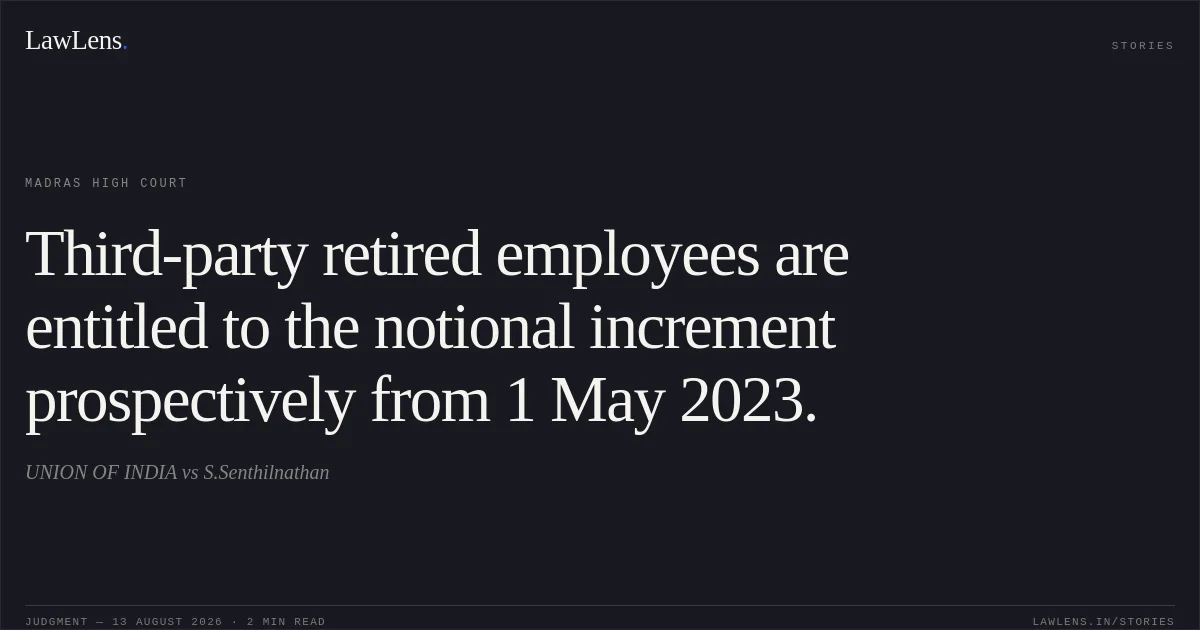
Source reference: p.3It also relied on the Supreme Court’s clarification in Miscellaneous Application Diary No.2400 of 2024, decided on 20 February 2025, that third-party retired employees are entitled to the benefit prospectively from the date of the judgment in M. Siddaraj, rather than from their individual dates of retirement.
Source reference: p.3Reasoning
The respondent had completed the requisite year of service before retiring on 30 June 2020; therefore, his absence from service on 1 July 2020 was immaterial to his entitlement to the notional increment.
Source reference: pp.2–3However, because he was a third-party retired employee who approached the Tribunal only on 6 March 2024, the benefit could not be granted retrospectively from his date of retirement. Applying the Supreme Court’s clarification in M. Siddaraj, the High Court held that the increment and consequential benefits were payable from 1 May 2023, as directed in the judgment.
Source reference: p.3The respondent’s counsel also accepted this limited date of entitlement.
Source reference: p.4Holding
The High Court held that the respondent was entitled to one notional annual increment, but only with effect from 1 May 2023, and not from his retirement date of 30 June 2020.
The authorities were directed to grant the increment, revise the respondent’s pension and pensionary benefits, and pay the consequential arrears and other admissible monetary benefits within four weeks from receipt of the order.
Source reference: p.4The writ petition was accordingly disposed of, with no order as to costs; the connected miscellaneous petition was closed.
Source reference: p.4Original Court PDF
UNION OF INDIAvsS.Senthilnathan
Click to open original judgment
Original judgment, available to read, download and summarize on LawLens.in