01Facts
On 21 December 2013, the claimant was a pillion rider on a motorcycle that collided with the rear of a KSRTC bus stopped on a National Highway.
pp. 4–7He sustained fractures and claimed compensation under Section 166 of the Motor Vehicles Act, 1988.
pp. 4–7The Motor Accident Claims Tribunal assessed compensation at Rs.7,42,598, attributed 75% negligence to the motorcycle rider and 25% to the bus driver, and dismissed the claim against the motorcycle’s insurer because the rider lacked a valid driving licence.
pp. 4–7KSRTC appealed, and the claimant cross-objected, challenging negligence, liability and quantum.
pp. 4–702Issues
i.1. Whether the Tribunal’s apportionment of negligence required modification.
¶ 12 · p. 9ii.2. Whether dismissal of the claim against the motorcycle’s insurer required modification.
¶ 12 · p. 9iii.3. Whether the Tribunal’s assessment of compensation required modification.
¶ 12 · p. 903Law Applied
Under Section 166 of the Motor Vehicles Act, a claimant may seek compensation for injury caused by actionable negligence; Section 173 provides for an appeal against a Tribunal’s award.
Regulation 15 of the Road Safety Regulations prohibits stopping or parking a vehicle in a manner that creates an unsafe obstruction to road users.
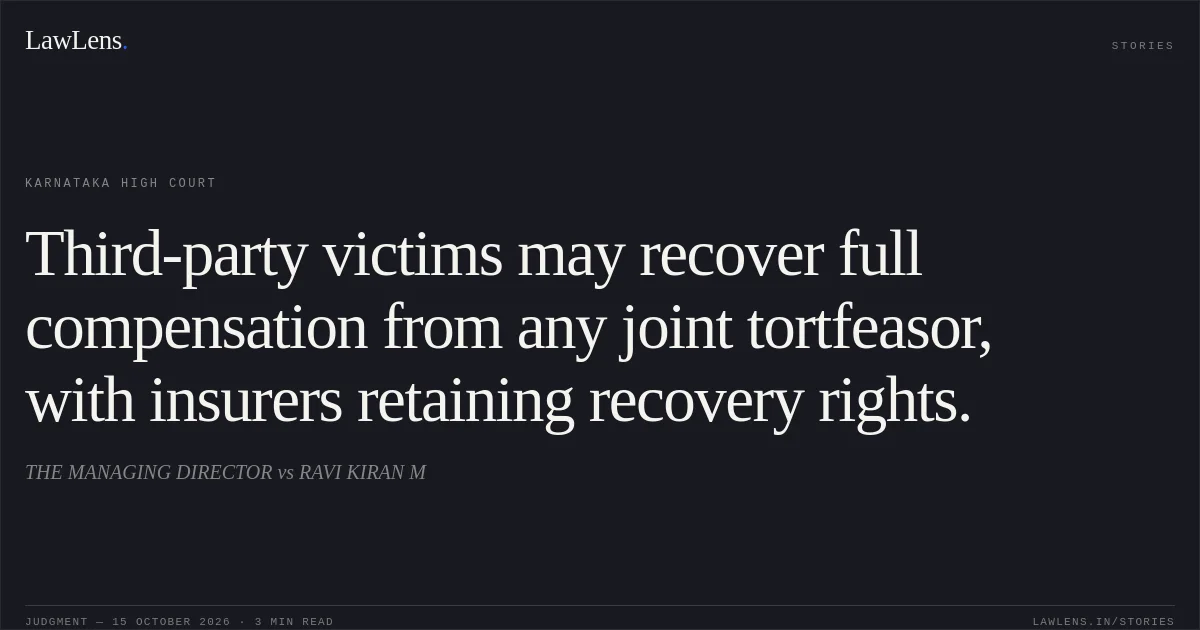
¶ 15 · p. 11Under Khenyei v. New India Assurance Co. Ltd., (2015) 9 SCC 273, an innocent third-party victim injured by the composite negligence of multiple vehicles may recover the entire compensation from any joint tortfeasor.
¶ 18 · p. 13The court also applied Erudhaya Priya v. State Express Transport Corporation Ltd., 2020 SCC OnLine SC 601, on adding future prospects in personal-injury claims, and National Insurance Co. Ltd. v. Pranay Sethi, AIR 2017 SC 5157, for the applicable future-prospects percentage.
¶ 22 · p. 15In assessing the insurer’s liability, the court held that the insurer had not established that the absence of a driving licence caused the accident or that the insured knowingly permitted an unlicensed rider to drive; it directed payment to the third-party claimant with liberty to recover from the insured.
¶ 19–20 · pp. 13–14Provisions in the judgment · 6 · Linked ones open on LawLens
Motor Vehicles Act, 1988 Section 173Section 166Section 3Section 181
Indian Penal Code, 1860 Section 279Section 338
04Reasoning
The bus was stopped on the right side of a National Highway, and the record did not establish that it had been properly barricaded or otherwise marked to warn approaching traffic.
¶ 14–17 · pp. 10–12The motorcycle rider, however, lacked a valid driving licence.
¶ 14–17 · pp. 10–12In light of both circumstances, the court reduced the bus driver’s share of negligence from 25% to 15%.
¶ 14–17 · pp. 10–12Applying Khenyei, it held that the claimant, as a third-party pillion rider, could recover the full compensation from a joint tortfeasor; the insurer’s licence-related defence did not justify dismissing the claim absent proof of the relevant breach or its connection to the accident.
¶ 18–20 · pp. 13–14For quantum, the court assessed notional monthly income at Rs.8,000, whole-body disability at 15%, future prospects at 40%, and multiplier 18, resulting in Rs.3,62,880 for future loss of income.
¶ 21–24 · pp. 14–16It also adjusted loss during the laid-up period and loss of amenities, while affirming the other specified heads.
¶ 21–24 · pp. 14–1605Holding
The appeal and cross-objection were allowed in part.
¶ 25 · pp. 16–18The court reduced KSRTC’s negligence/liability from 25% to 15%, set aside dismissal of the claim against the insurer, and held the insurer jointly and severally liable to pay, with liberty to recover from the insured without separate proceedings.
¶ 25 · pp. 16–18Total compensation was enhanced from Rs.7,42,598 to Rs.10,83,638, with interest at 6% per annum, excluding the 639-day delay in filing the cross-objection.
¶ 25 · pp. 16–18KSRTC/the insurer were directed to deposit the enhanced amount within eight weeks, and the full compensation was ordered released to the claimant.
¶ 25 · pp. 16–18Original Court PDF
THE MANAGING DIRECTORvsRAVI KIRAN M
Click to open original judgment
Original judgment, available to read, download and summarize on LawLens.in