Facts
The Appellant (Department) challenged the CESTAT Kolkata order dated 08.02.2024, which set aside a Service Tax demand of ₹2,60,99,364/-.
Source reference: p. 2The demand was issued via a composite show-cause notice dated 31.12.2020 covering four assessment years (2014-15 to 2017-18).
Source reference: para. 19The Adjudicating Authority confirmed the demand based on Form 26-AS and financial statements, alleging suppression of facts to invoke the extended five-year limitation period.
Source reference: paras. 5-6, 20The Respondent (Assessee) raised a preliminary objection regarding the maintainability of the appeal before the High Court, citing the Ministry of Finance Notification dated 06.08.2024, which raised the monetary limit for filing appeals to ₹2 Crores.
Source reference: paras. 10-11Issues
1. Whether the Department can raise a Service Tax demand solely based on entries in Form 26-AS.
Source reference: para. 3(i)2. Whether the invocation of the extended period of limitation under Section 73 of the Finance Act, 1994, was permissible.
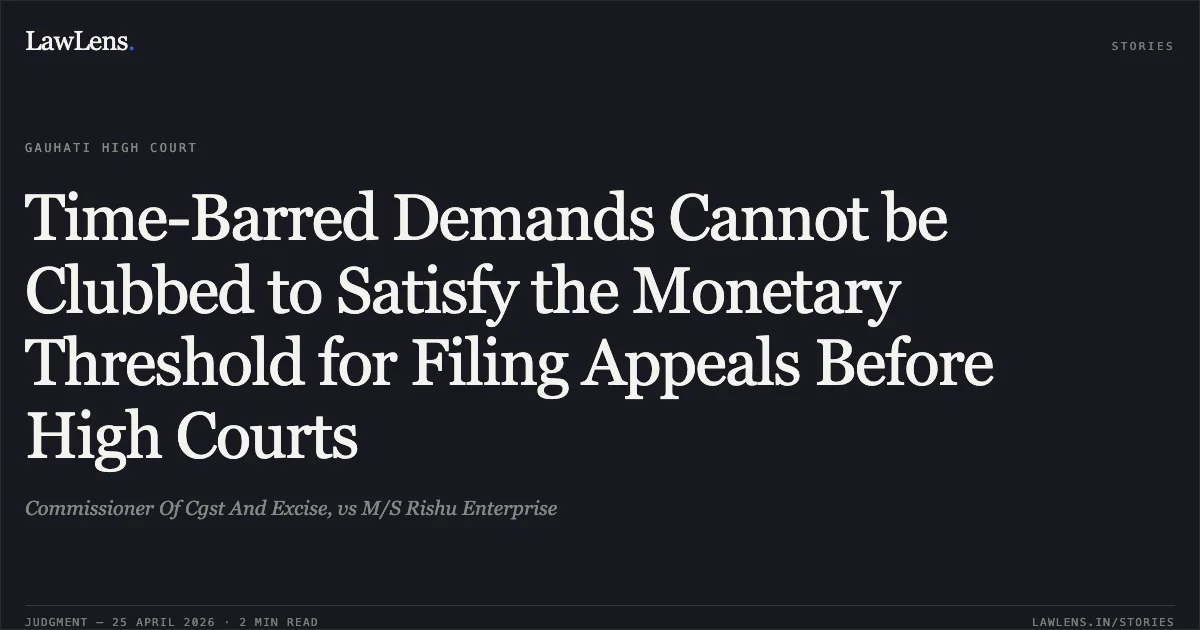
Source reference: para. 3(ii)3. Whether the appeal is maintainable when the individual assessment year demands are below ₹2 Crores, but the composite total exceeds it.
Source reference: para. 3(iii)4. Whether the demand for the assessment year 2014-15 was barred by the five-year limitation period under Section 73(1) of the Finance Act, 1994.
Source reference: para. 46Law Applied
CBIC Instruction No. CBIC/160390/20/2024-JC-CBEC dated 06.08.2024, which mandates a minimum monetary limit of ₹2 Crores for Departmental appeals to High Courts.
Source reference: para. 24Section 73(1) of the Finance Act, 1994, which provides a 30-month limitation for normal demands and a 5-year extended period for cases involving fraud or suppression of facts.
Source reference: paras. 38, 40Circular No. 207/1/2024-GST, which provides that for composite orders, limits apply to the total tax amount.
Source reference: para. 33Reasoning
While noting different High Court views on composite notices (Milroc Good Earth Developers vs. Ambika Traders), the court observed that even if clubbing were permissible, time-barred claims must be excluded first.
Source reference: paras. 41-45Upon reviewing the specific demand for 2014-15, the court found it was barred by the 5-year extended limitation period, even when accounting for the show-cause notice date of 31.12.2020.
Source reference: para. 47Deducting the time-barred amount of ₹61,99,462/- from the total demand reduced the valid appeal value to ₹1,98,99,902/-, which falls below the ₹2 Crore mandatory threshold.
Source reference: para. 47The court reasoned that a time-barred claim cannot be used to artificially reach the monetary limit for maintaining an appeal.
Source reference: para. 45Holding
The court held that the appeal is not maintainable as the valid demand amount (excluding the time-barred claim for 2014-15) was below the ₹2 Crore ceiling prescribed by the Notification dated 06.08.2024.
The court dismissed the appeal on the ground of non-maintainability without deciding whether valid demands may be aggregated to meet the threshold, leaving that question for a future case.
Source reference: paras. 48-49Acts & Sections Cited
7 provisions across 3 statutes referred to in this judgment. Each provision opens on LawLens.
Central Excise Act, 19441
Central Goods and Services Tax Act, 20174
ASSAM GOODS AND SERVICES TAX ACT, 20172
Original Court PDF
Commissioner Of Cgst And Excise,vsM/S Rishu Enterprise
Click to open original judgment
Original judgment, available to read, download and summarize on LawLens.in