Facts
The plaintiff sought specific performance of an agreement of sale dated 25 February 1990.
Source reference: pp. 6–7The defendants resisted, asserting that the plaintiff had failed to complete the transaction within the stipulated period, including after extensions.
Source reference: pp. 6–7The trial court found that the plaintiff had not established readiness and willingness and granted the alternative relief of refund of the advance; the first appellate court affirmed.
Source reference: pp. 6–7The plaintiff appealed under Section 100 CPC, arguing, among other things, that time was not the essence of a contract concerning immovable property and that delay was attributable to the defendants.
Source reference: pp. 6–7The order dated 29 September 2026 corrected the appearance entry for counsel for respondents 9–11; it did not revisit the merits.
Source reference: pp. 1–3Issues
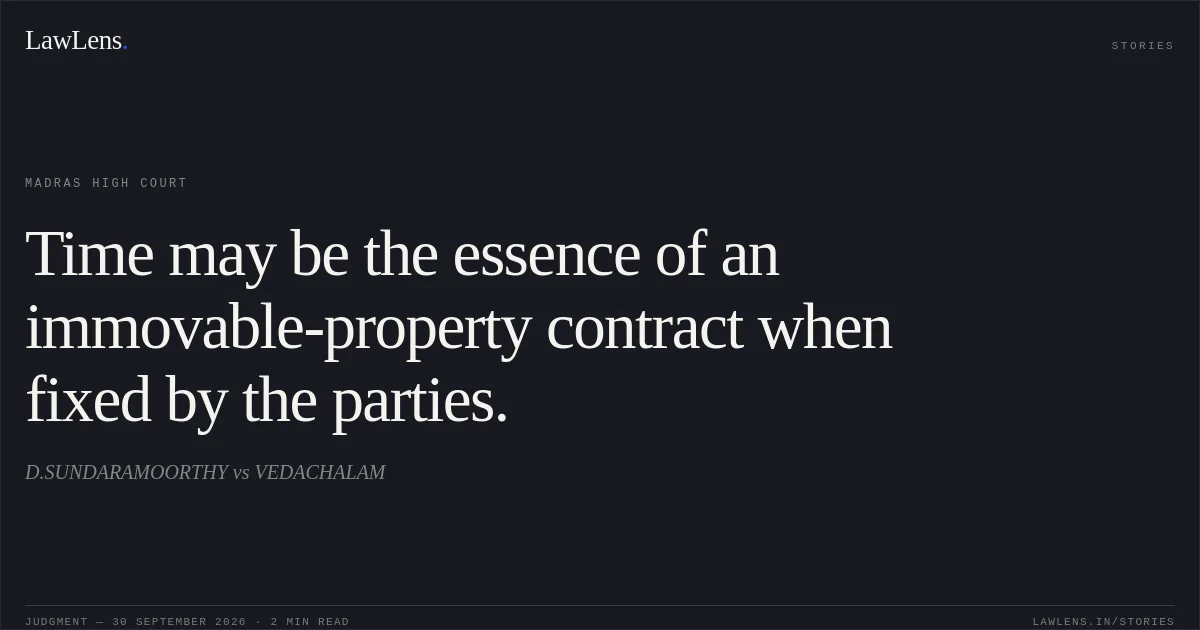
Whether time could be treated as the essence of the agreement for sale of immovable property where the agreement fixed a time limit.
Source reference: pp. 7–8Whether the concurrent findings of the courts below disclosed a substantial question of law warranting interference under Section 100 CPC.
Source reference: p. 9Law Applied
Under Section 100 CPC, a second appeal lies only where a substantial question of law is involved.
Source reference: p. 8The Court relied on Saradamani Kandappan v. S. Rajalakshmi, 2011 (4) CTC 640, and Padmakumari v. Dasayyan, 2015 (6) CTC 545, for the principle that time may be of the essence in a contract for sale of immovable property where the parties have agreed to a time limit.
Source reference: p. 8The Court also applied the requirement that a purchaser seeking specific performance establish readiness and willingness to perform the contract.
Source reference: pp. 6, 8Reasoning
The agreement fixed a time for performance, and the courts below had found that the plaintiff failed to complete his obligations despite extensions on two occasions.
Source reference: pp. 6, 8–9Applying the cited authorities, the Court rejected the contention that time could not be essential merely because the contract concerned immovable property.
Source reference: p. 8It accepted the concurrent assessment that the plaintiff had not demonstrated readiness and willingness and found no substantial question of law justifying appellate intervention.
Source reference: pp. 8–9Holding
The Court held that time could be of the essence under the agreement and that no substantial question of law arose.
It dismissed the second appeal, left the concurrent decrees—including the alternative relief of refund—undisturbed, made no order as to costs, and closed the connected miscellaneous petition.
Source reference: p. 9Acts & Sections Cited
1 provisions across 1 statute referred to in this judgment. Each provision opens on LawLens.
Code of Civil Procedure, 19081
Original Court PDF
D.SUNDARAMOORTHYvsVEDACHALAM
Click to open original judgment
Original judgment, available to read, download and summarize on LawLens.in