Facts
The Petitioner, owner of plot No. D-48/140-141 (Arazi Nos. 2404 and 2402) in Varanasi, applied for a No-Objection Certificate (NOC) from Nagar Nigam, Varanasi, to construct a hotel following a Memorandum of Understanding with the State of U.P.
Source reference: para. 8, 12The Respondent refused the NOC on 24.01.2026, claiming Arazi No. 2404 was recorded as a pond in the revenue records of Fasli year 1291 (1884 CE).
Source reference: para. 2Historically, the Municipal Board had sold the land with structures to the Petitioner's predecessor via a registered sale deed in 1913.
Source reference: para. 3Revenue records from Fasli 1361 (1954 CE) to 1425 (present) consistently record the land as abadi (settlement).
Source reference: para. 29, 31Following the court's intervention, the Respondent sought an IIT-BHU report which confirmed the area is densely populated and lacks an existing water body.
Source reference: para. 26, 27Issues
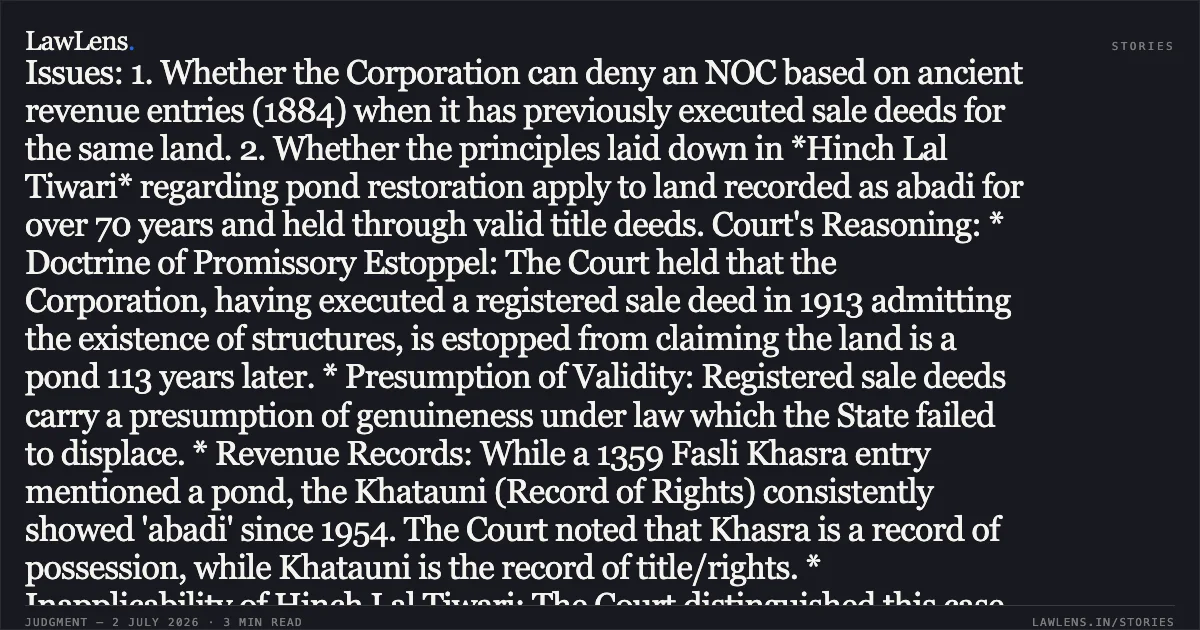
1. Whether the Respondent could deny an NOC based on a revenue entry from 1884 CE despite a 1913 registered sale deed and current abadi status.
Source reference: para. 2, 532. Whether the provisions of the U.P. Zamindari Abolition and Land Reforms (UPZA & LR) Act, 1950, and U.P. Revenue Code, 2006, regarding the protection of water bodies, are applicable to land included in municipal limits prior to 1949.
Source reference: para. 35, 393. Whether the principles laid down in Hinch Lal Tiwari regarding the restoration of ponds apply to the facts of the present case.
Source reference: para. 13, 46Law Applied
The Court applied the doctrine of Promissory Estoppel, preventing a party from departing from an assumption of fact/law adopted by another to their detriment.
Source reference: para. 50Section 1(2) of the UPZA & LR Act, 1950, which excludes areas included in a municipality as of 07.07.1949.
Source reference: para. 35The Court cited Prem Singh v. Birbal regarding the legal presumption of validity of registered sale deeds.
Source reference: para. 49The Court distinguished Hinch Lal Tiwari v. State of U.P. (2001) and Jagpal Singh v. State of Punjab (2011), which mandate the restoration of water bodies, by applying the balancing test from State of Rajasthan v. Ultra Tech Cement Limited (2022), where revenue corrections are permitted if no physical pond exists.
Source reference: para. 43-47Reasoning
The Court reasoned that the 1913 sale deed executed by the Municipal Board itself proved the land had structures and was not a pond over a century ago.
Source reference: para. 32, 49Since the land was part of the municipality before 1949, the UPZA & LR Act and certain chapters of the U.P. Revenue Code 2006 (specifically those managing village ponds) do not apply.
Source reference: para. 35-39The Court found the Respondent's reliance on a single Khasra entry from 1359 Fasli (1952 CE) insufficient to override 74 years of Khatauni entries recording the land as abadi.
Source reference: para. 31, 33The IIT-BHU report corroborated that the site is dry, filled with debris, and surrounded by dense urban construction, making the restoration of a pond ecologically and physically unfeasible.
Source reference: para. 27, 46The Court held the Respondent was estopped from claiming the land was a pond after treating it as private taxable property since 1927.
Source reference: para. 24, 50Holding
The Court held that the Respondent’s action was arbitrary and discriminatory as it singled out the Petitioner’s plot while ignoring the rest of the alleged pond area.
The Court allowed the writ petition and quashed the refusal letter dated 24.01.2026. A writ of mandamus was issued directing Nagar Nigam, Varanasi, to reconsider the Petitioner's NOC application for the hotel construction within four weeks, in light of the Petitioner's valid title and the non-existence of a pond at the site.
Source reference: para. 54Acts & Sections Cited
7 provisions across 4 statutes referred to in this judgment. Linked provisions open on LawLens.
United Provinces Tenancy Act, 19392
U.P. Zamindari Abolition and Land Reforms Act, 19501
U.P. Revenue Code, 20062
United Provinces Municipalities Act, 19162
Original Court PDF
M/S Knots India Carpets Private LimitedvsState Of Uttar Pradesh And 2 Others
Click to open original judgment
Original judgment, available to read, download and summarize on LawLens.in


