Facts
The appellant, an Assistant in the office of the Inspector General of Registration, was subjected to disciplinary proceedings under Rule 17(a) of the Tamil Nadu Civil Services (Discipline and Appeal) Rules via a charge memorandum dated 07.10.2011.
Source reference: p. 2Following a summary procedure where the appellant submitted an explanation, the disciplinary authority imposed a punishment of stoppage of increment for one year without cumulative effect on 20.01.2012.
Source reference: p. 2The appellant’s subsequent appeal to the Government was rejected on 28.05.2014.
Source reference: p. 2The appellant challenged this via a writ petition (W.P.No.41848 of 2016), which was dismissed on 17.11.2025.
Source reference: p. 2The present intra-court appeal was filed challenging that dismissal.
Source reference: p. 2Issues
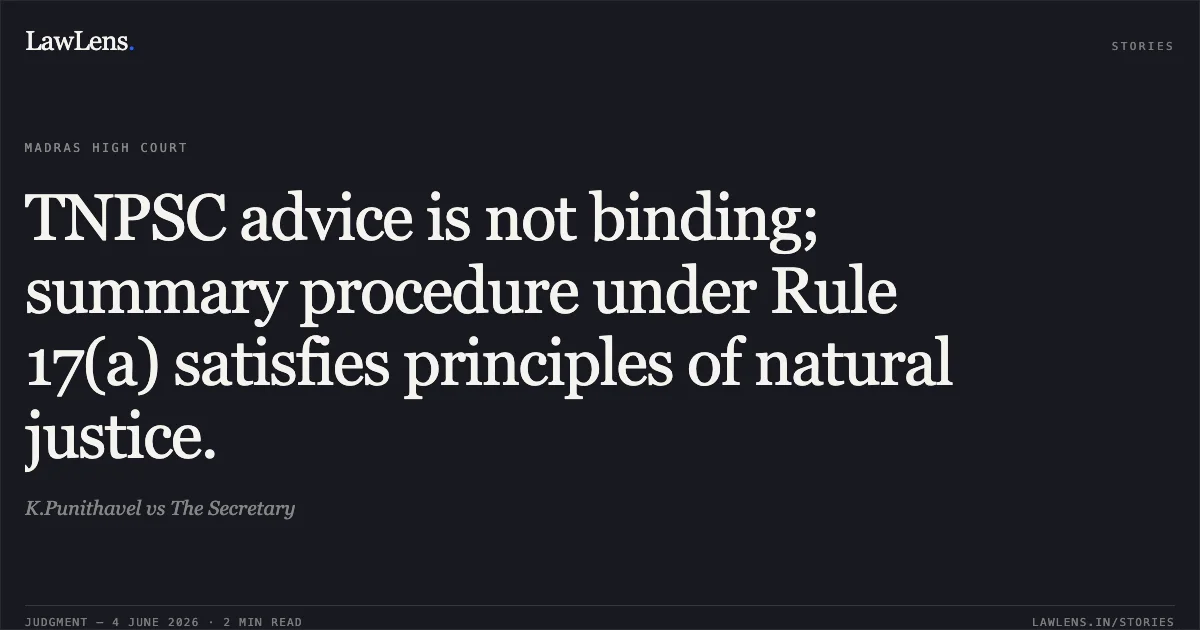
1. Whether the summary procedure adopted under Rule 17(a) for minor penalties requires a formal oral enquiry or a second opportunity for explanation at the appellate stage.
Source reference: p. 4-52. Whether an internal advisory opinion from the Tamil Nadu Public Service Commission (TNPSC) recommending exoneration is binding upon the Government.
Source reference: p. 5Law Applied
Rule 17(a) of the Tamil Nadu Civil Services (Discipline and Appeal) Rules, which prescribes the procedure for imposing minor penalties. The rule mandates that the delinquent employee be given a "reasonable opportunity of making any representation," which must be considered before passing an order.
Source reference: p. 4Principles of natural justice in summary proceedings were also applied, establishing that if the procedure under Rule 17(a) is followed, additional formalities like a personal hearing at the appellate stage are not mandatory unless specifically provided for by the Rules.
Source reference: p. 5Reasoning
The Court observed that since the charges were framed under Rule 17(a), which governs minor penalties, the authorities were only required to provide an opportunity for representation/explanation, which the appellant indeed utilized.
Source reference: p. 4The Court rejected the appellant's contention regarding the lack of opportunity at the appellate level, noting that the Government is entitled to decide an appeal by reviewing the existing disciplinary files and the original explanation.
Source reference: p. 4-5Regarding the TNPSC's opinion suggesting the setting aside of punishment, the Court held that such inter-departmental communications are advisory, confidential, and not binding on the Government, which retains the power to take an independent decision in disciplinary matters.
Source reference: p. 5-6Holding
The Court answered both issues in the negative. It held that the procedures contemplated under Rule 17(a) were strictly followed and that the principles of natural justice were satisfied by the initial opportunity to explain the charges.
The TNPSC’s opinion created no legal right for the appellant to seek exoneration. Consequently, the High Court dismissed the Writ Appeal, confirming the order of the Writ Court and upholding the punishment.
Source reference: p. 6Acts & Sections Cited
1 provisions across 1 statute referred to in this judgment. Linked provisions open on LawLens.
Letters Patent1
Original Court PDF
K.PunithavelvsThe Secretary
Click to open original judgment
Original judgment, available to read, download and summarize on LawLens.in