Facts
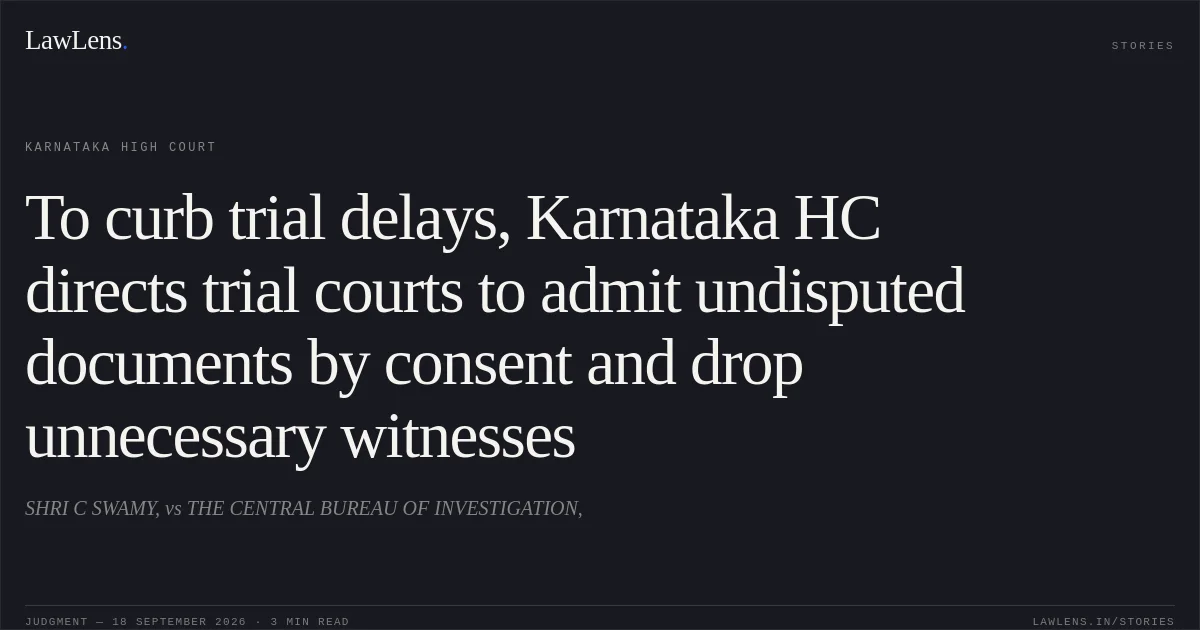
The petitioner, a Port Officer, challenged the charge sheet dated 16 November 2013 in Spl.C.C. No. 268/2013 pending before the 32nd Additional City Civil and Special Judge, CBI, Bengaluru.
Source reference: p.2, para. 2He invoked Articles 226 and 227 of the Constitution and Section 482 of the Cr.P.C., principally contending that the prolonged pendency of the criminal trial violated his fundamental right to a speedy trial and seeking quashing of the proceedings insofar as they concerned him.
Source reference: p.3, para. 3The CBI opposed the petition, submitting that the delay was not attributable solely to the prosecution.
Source reference: p.3, para. 4It also informed the Court that 54 witnesses had already been examined and that the trial could be concluded within three months, subject to the petitioner’s cooperation.
Source reference: p.3, paras. 4–6Issues
1. Whether the prolonged pendency of Spl.C.C. No. 268/2013, instituted pursuant to the 2013 charge sheet, warranted quashing of the charge sheet or criminal proceedings against the petitioner on the ground of violation of the right to speedy trial?
Source reference: p.3, para. 3; p.4, para. 52. Whether directions should be issued to facilitate expeditious completion of the trial, including admission and marking by consent of documents whose genuineness was not disputed under Section 294(3) of the Cr.P.C.?
Source reference: p.4, para. 7; p.6, paras. 10–12Law Applied
The Court exercised its constitutional and inherent jurisdiction under Articles 226 and 227 of the Constitution and Section 482 of the Cr.P.C. in considering the petitioner’s challenge to the pending criminal proceedings.
Source reference: p.2, para. 2The right to speedy trial was treated as a constitutionally protected fundamental right, forming the basis of the petitioner’s grievance.
Source reference: p.3, para. 3; p.6, para. 12Section 294(3) of the Cr.P.C. permits documents whose genuineness is not disputed to be read in evidence without formal proof; the Court noted its corresponding provision as Section 330(3) of the BNSS, 2023.
Source reference: p.4, para. 7; p.6, para. 10The Court also referred to the mandatory supply of documents under Sections 207 and 208 of the Cr.P.C., corresponding to Sections 230 and 231 of the BNSS, as procedural mechanisms relevant to efficient criminal trials.
Source reference: p.5, para. 9Reasoning
The Court acknowledged that the case had remained pending since 2013 and that the petitioner asserted continuous readiness to cooperate, thereby raising a legitimate concern regarding speedy trial.
Source reference: p.3, para. 3; p.4, para. 5However, instead of quashing the charge sheet, the Court considered the CBI’s submission that 54 witnesses had already been examined and accepted that the delay was not attributable exclusively to the prosecution.
Source reference: p.3–4, paras. 4–6To reduce avoidable delay in a document-intensive CBI trial, the Court emphasized the use of Section 294(3) Cr.P.C., enabling undisputed documents to be marked by consent and unnecessary formal witnesses to be dropped.
Source reference: p.4, para. 7; p.6, paras. 10–12Applying this approach, the Court granted the trial court time up to the end of December 2026 to conclude the proceedings, subject to cooperation by the parties.
Source reference: p.6–7, para. 13Holding
The Court did not quash the charge sheet or the criminal proceedings against the petitioner.
Instead, it disposed of the writ petition and granted the trial court time until the end of December 2026 to conclude Spl.C.C. No. 268/2013.
Source reference: p.7, para. 14(i)–(ii)The parties were directed to cooperate in the early disposal of the case, including admitting and marking undisputed documents by consent and enabling the dropping of unnecessary witnesses.
Source reference: p.7–8, para. 14(iii)The Court further directed that a copy of the order be circulated to the District Judiciary and the Karnataka Judicial Academy, subject to approval of the Chief Justice, to encourage adherence to Section 294(3) Cr.P.C. in pending trials.
Source reference: p.8, para. 14(iv)Acts & Sections Cited
7 provisions across 2 statutes referred to in this judgment. Each provision opens on LawLens.
Code of Criminal Procedure, 19734
Bharatiya Nagarik Suraksha Sanhita, 20233
Original Court PDF
SHRI C SWAMY,vsTHE CENTRAL BUREAU OF INVESTIGATION,
Click to open original judgment
Original judgment, available to read, download and summarize on LawLens.in