Facts
K. Mariappan and V. Pechimuthu claimed to have worked from 5 February 2005 as a plumber and gate-valve opener, respectively, under the Seithur Selection Grade Town Panchayat.
Source reference: p.4They asserted that they had completed 480 days of continuous employment within a period of 24 months and applied for conferment of permanent status under the Tamil Nadu Industrial Establishments (Conferment of Permanent Status to Workmen) Act, 1981 (“1981 Act”).
Source reference: p.4The Assistant Commissioner of Labour, acting under the 1981 Act, allowed their applications and conferred permanent status by orders dated 12 October 2022.
Source reference: p.4The Executive Officer of the Town Panchayat challenged those orders in W.P. (MD) Nos. 12823 and 12824 of 2023.
Source reference: p.5The learned Single Judge held that the appellants had been engaged through the Bharathi Self-Help Group and that there was no direct employer–employee relationship with the Town Panchayat.
Source reference: p.5They were consequently treated as contract labourers, and the orders granting permanent status were quashed.
Source reference: p.5The appellants filed the present writ appeals.
Source reference: no citationIssues
Whether the appellants established a direct employer–employee relationship with the Town Panchayat and continuous employment for 480 days within a period of 24 months so as to claim permanent status under the 1981 Act.
Source reference: pp.9–10; para. 8Whether the Seithur Town Panchayat constituted an “industrial establishment” under Section 2(3) of the 1981 Act and whether the appellants were “workmen” entitled to invoke the Act.
Source reference: pp.10–12; paras. 8–9Whether the Assistant Commissioner of Labour was justified in conferring permanent status despite the Town Panchayat’s denial of direct employment and the appellants’ alleged engagement through the Bharathi Self-Help Group.
Source reference: pp.7–8; paras. 6–9Law Applied
The Court applied the Tamil Nadu Industrial Establishments (Conferment of Permanent Status to Workmen) Act, 1981, particularly the requirement that the claimant must be a workman employed in an industrial establishment and must satisfy the statutory service requirement of 480 days within 24 months.
Source reference: pp.4, 10–12The Court relied on the definition of “industrial establishment” under Section 2(3) of the 1981 Act and the concept of “workman” under Section 2(s) of the Industrial Disputes Act, 1947, holding that a person engaged through a contract for service, rather than under a direct contract of service, cannot claim statutory permanent status.
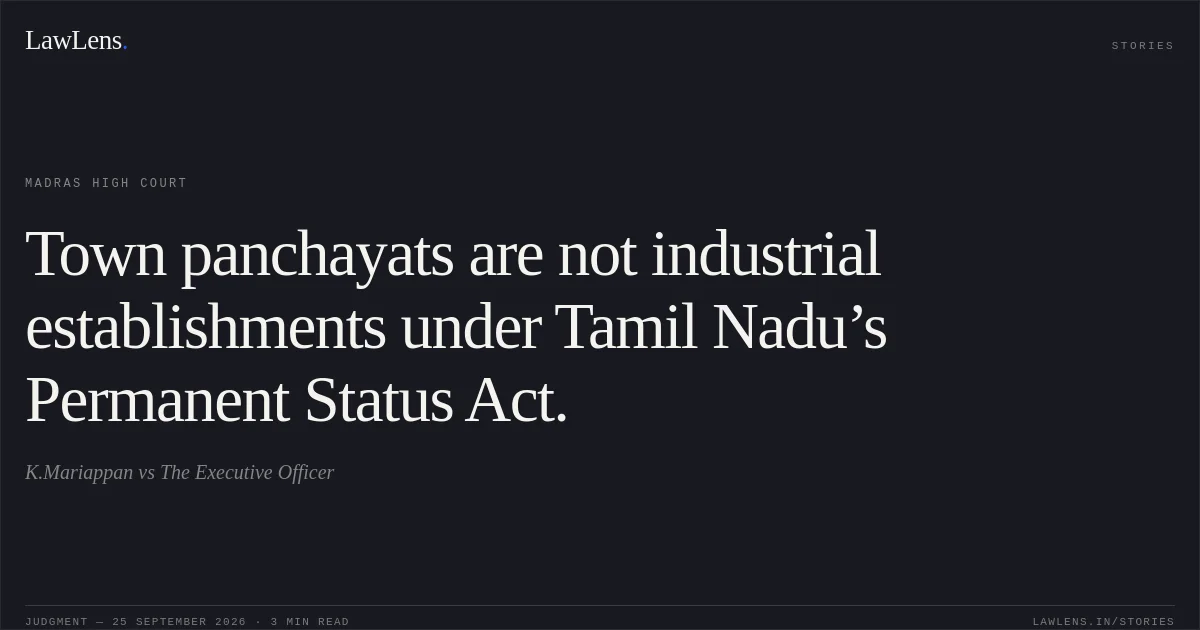
Source reference: pp.10–12It followed the principle stated in Executive Officer, Eriyodu Town Panchayat v. Inspector of Labour, 2025 SCC OnLine Mad 3151, that a Town Panchayat is not an industrial establishment under the 1981 Act and that a contractor or person engaged through a contract for service is not a “workman” for purposes of the Act.
Source reference: pp.10–12The Court also referred to Steel Authority of India Ltd. v. National Union Waterfront Workers, (2001) 7 SCC 1, and Superintending Engineer, Erode Electricity Distribution Circle, Tamil Nadu Electricity Board v. Inspector of Labour, 2022 SCC OnLine Mad 1003.
Source reference: pp.7–8Reasoning
The Court found that the appellants had not produced reliable evidence establishing direct employment under the Town Panchayat for 480 days within a continuous period of 24 months.
Source reference: pp.9–10; paras. 6–7Their bank statements showed intermittent payments from the Bharathi Self-Help Group, the Town Panchayat, and unidentified sources, and therefore did not prove the requisite continuity or direct employment.
Source reference: pp.9–10; paras. 6–7The Court further held that the Town Panchayat, being a local self-government body, did not fall within the definition of an “industrial establishment” under Section 2(3) of the 1981 Act.
Source reference: p.10; para. 8Since the appellants were supplied or engaged through the Bharathi Self-Help Group and the employer–employee relationship with the Town Panchayat was not established, they could not be treated as workmen employed under a contract of service.
Source reference: pp.10–12; paras. 8–9The Assistant Commissioner of Labour therefore had no basis to confer permanent status, and the learned Single Judge correctly quashed the orders.
Source reference: pp.10–12; paras. 8–9The decision in Sukhendu Bhattacharjee v. State of Assam, 2026 INSC 523, was held inapplicable because the appellants failed to establish the foundational employer–employee relationship.
Source reference: p.13; para. 10Holding
The Division Bench dismissed both writ appeals, holding that the appellants neither proved direct employment with the Town Panchayat for the statutory period nor established entitlement under the 1981 Act.
It affirmed the learned Single Judge’s orders setting aside the Assistant Commissioner of Labour’s orders granting permanent status.
Source reference: p.13; para. 11No order as to costs was made, and the connected civil miscellaneous petitions were closed.
Source reference: p.13; para. 11Acts & Sections Cited
3 provisions across 2 statutes referred to in this judgment. Linked provisions open on LawLens.
Tamil Nadu Industrial Establishments (Conferment of Permanent Status to Workmen) Act, 19812
Tamil Nadu Urban Local Bodies Act, 19981
Original Court PDF
K.MariappanvsThe Executive Officer
Click to open original judgment
Original judgment, available to read, download and summarize on LawLens.in