Facts
Respondent No. 1, a Multi-System Operator (MSO), allegedly disconnected cable signals to Respondent Nos. 2-5, Local Cable Operators (LCOs), without following the procedure prescribed under the Interconnection (IC) Regulations
Source reference: p. 4, para. 7Following a High Court direction to consider the LCOs' representations, the Telecom Regulatory Authority of India (TRAI) issued a direction on 21.10.2008 commanding signal restoration
Source reference: p. 4, para. 8After a police status report indicated continued non-compliance and illegal disconnection of Optical Fibre Cable links, TRAI issued a Show Cause Notice (SCN) dated 19.02.2009 under Section 34 of the TRAI Act to explain why a criminal complaint should not be filed for violating its directions
Source reference: p. 5, para. 8The MSO challenged the SCN before the TDSAT, which quashed the notice, holding that TRAI had no jurisdiction to adjudicate what was essentially a "breach of contract" and that such disputes fell under the exclusive civil jurisdiction of the TDSAT under Section 14
Source reference: p. 2-3, para. 3TRAI appealed this decision to the Supreme Court
Source reference: p. 3, para. 4Issues
1. Whether TRAI, by issuing directions for regulatory compliance and a subsequent Show Cause Notice for prosecution, unconstitutionally usurped the adjudicatory jurisdiction of the TDSAT.
Source reference: p. 2, para. 2; p. 12, para. 162. Whether the enforcement of statutory regulations under Sections 11, 13, and 29 of the TRAI Act constitutes the "adjudication of a dispute" between service providers.
Source reference: p. 14, para. 18.1Law Applied
The Court applied Section 11(1)(b) of the TRAI Act, 1997, which outlines the regulatory functions of TRAI, and Section 13, which empowers TRAI to issue directions for the discharge of those functions
Source reference: p. 8, para. 13Section 14 governs the exclusive adjudicatory jurisdiction of the TDSAT over disputes between service providers
Source reference: p. 10, para. 14Sections 29 and 34 prescribe the penal consequences for non-compliance and the procedure for filing complaints before a Magistrate
Source reference: p. 13-14, para. 17.1The Court also relied on the precedent in BSNL v. TRAI (2014), which established that TRAI’s power to make regulations under Section 36 is "wide and pervasive" and that its functions are administrative/regulatory, whereas the TDSAT's functions are judicial
Source reference: p. 11-12, para. 14-15Reasoning
The Court reasoned that "adjudication" requires the determination of a lis involving the application of law to facts to declare the rights of parties, such as awarding damages or quantifying arrears
Source reference: p. 14-15, para. 18.1-18.2In this case, TRAI did not resolve the commercial contractual dispute between the MSO and LCOs; rather, it sought to enforce a "statutory safeguard" (Regulation 4 of the IC Regulations) which prohibits signal disconnection without notice
Source reference: p. 16, para. 18.3The Court observed that the TDSAT erred in characterizing regulatory enforcement as a civil liability for breach of contract, as statutory regulations are binding subordinate legislation
Source reference: p. 13, para. 17TRAI’s action was merely a "preparatory step" to initiate a complaint in a criminal court under Section 34, which is the only forum authorized to adjudge guilt and levy fines under Section 29
Source reference: p. 16, para. 18.3; p. 18, para. 19.6Consequently, TRAI was acting within its regulatory field and did not overlap with TDSAT’s adjudicatory functions
Source reference: p. 16, para. 18.4Holding
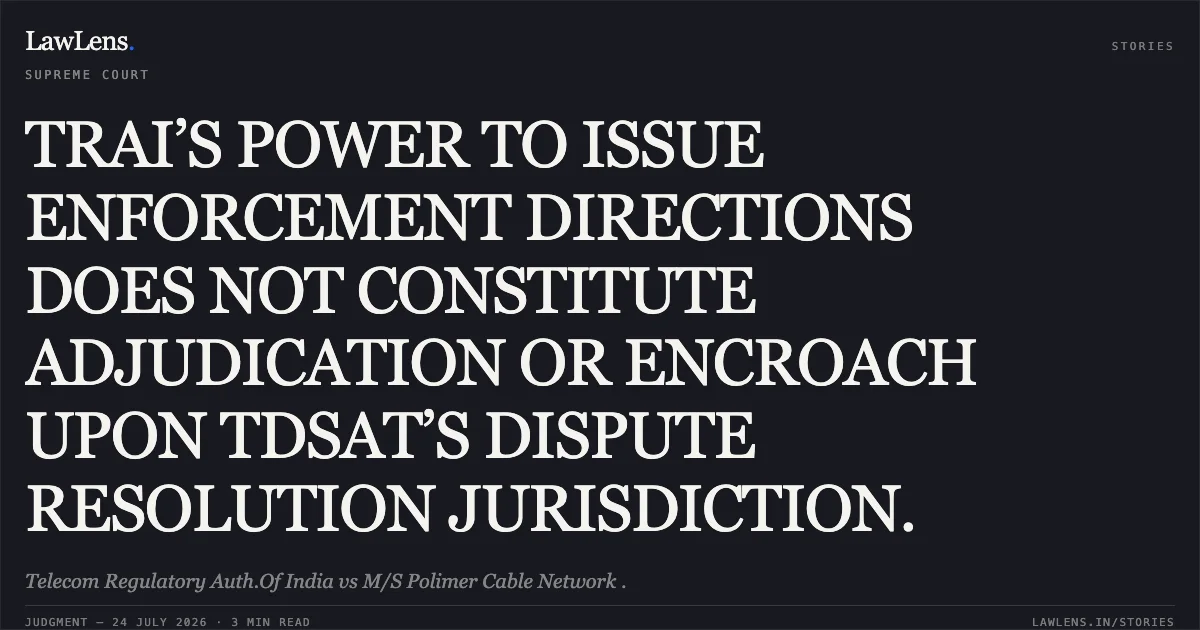
The Court held that TRAI is empowered to issue directions to ensure compliance with its regulations and to initiate criminal prosecution for non-compliance
The Supreme Court allowed the appeal and set aside the TDSAT’s order
Source reference: p. 18, para. 20It clarified that while TRAI cannot render a final binding adjudication of contractual rights or award damages, it may record a prima facie finding of non-compliance to exercise its regulatory and enforcement powers without trespassing upon the TDSAT’s jurisdiction
Source reference: p. 17-18, para. 19.5Acts & Sections Cited
12 provisions across 1 statute referred to in this judgment. Each provision opens on LawLens.
Telecom Regulatory Authority of India Act, 1997
Original Court PDF
Telecom Regulatory Auth.Of IndiavsM/S Polimer Cable Network .
Click to open original judgment
Original judgment, available to read, download and summarize on LawLens.in