Facts
The plaintiff, ANI Media (ANI), a news agency, filed a suit for permanent injunction against OpenAI, alleging unauthorized use of its copyrighted news articles and interviews.
Source reference: p. 6ANI raised two primary claims: a "training claim" regarding the storage of its data to train Large Language Models (LLMs), and an "output claim" alleging that ChatGPT reproduces its copyrighted works in response to user prompts.
Source reference: p. 6OpenAI contended that its servers are located in the US, training occurs outside India, and its use of publicly available data for training constitutes "fair dealing".
Source reference: p. 13-14The court examined the technical functioning of LLMs, including tokenization and Retrieval-Augmented Generation (RAG).
Source reference: p. 8-11Issues
1. Whether the Courts in India have jurisdiction to entertain the lawsuit considering the defendants' servers are located in the USA.
Source reference: p. 13 / Issue IV2. Whether the storage of the plaintiff’s data for training ChatGPT amounts to copyright infringement.
Source reference: p. 61 / Issue I3. Whether the use of the plaintiff’s data to generate user responses amounts to copyright infringement.
Source reference: p. 23 / Issue II4. Whether the defendants’ use of the data qualifies as ‘fair dealing’ under Section 52 of the Copyright Act, 1957.
Source reference: p. 68 / Issue IIILaw Applied
Section 14(a)(i) of the Copyright Act, 1957, which defines copyright as the exclusive right to reproduce work in any material form, including electronic storage.
Source reference: p. 35Section 52(1)(a)(i), which provides a "fair dealing" exception for "private or personal use, including research".
Source reference: p. 92Eastern Book Company v. D.B. Modak to apply the "skill and judgment" test for originality and R.G. Anand v. Deluxe Films for the test of substantial similarity/reproduction.
Source reference: p. 45, p. 42The "doctrine of updating construction" was applied to interpret "research" in the context of AI.
Source reference: p. 112-114Territorial jurisdiction was governed by Section 62(2) of the Copyright Act and Section 20 of the CPC.
Source reference: p. 17, 19Reasoning
Regarding jurisdiction, the court held that since ANI’s principal place of business is in Delhi and the alleged infringing outputs were accessible there, the location of overseas servers did not oust Indian jurisdiction.
Source reference: p. 19-21On the "output claim," the court found no "substantial similarity" between ANI's articles and ChatGPT’s responses; the similarities were primarily factual quotes or information in which copyright does not subsist.
Source reference: p. 52-57Crucially, the court noted that the articles cited by ANI were published after OpenAI's training cut-off, suggesting any reproduction occurred via RAG (live search) rather than "memorization".
Source reference: p. 41-42Regarding the "training claim," the court applied an "updating construction" to Section 52(1)(a)(i), ruling that "research" includes machine learning and is not limited to humans or non-commercial use.
Source reference: p. 112-115The court found OpenAI's use "transformative" because it uses data to find linguistic patterns rather than to substitute ANI's news services, thus satisfying the fairness test.
Source reference: p. 125-127Holding
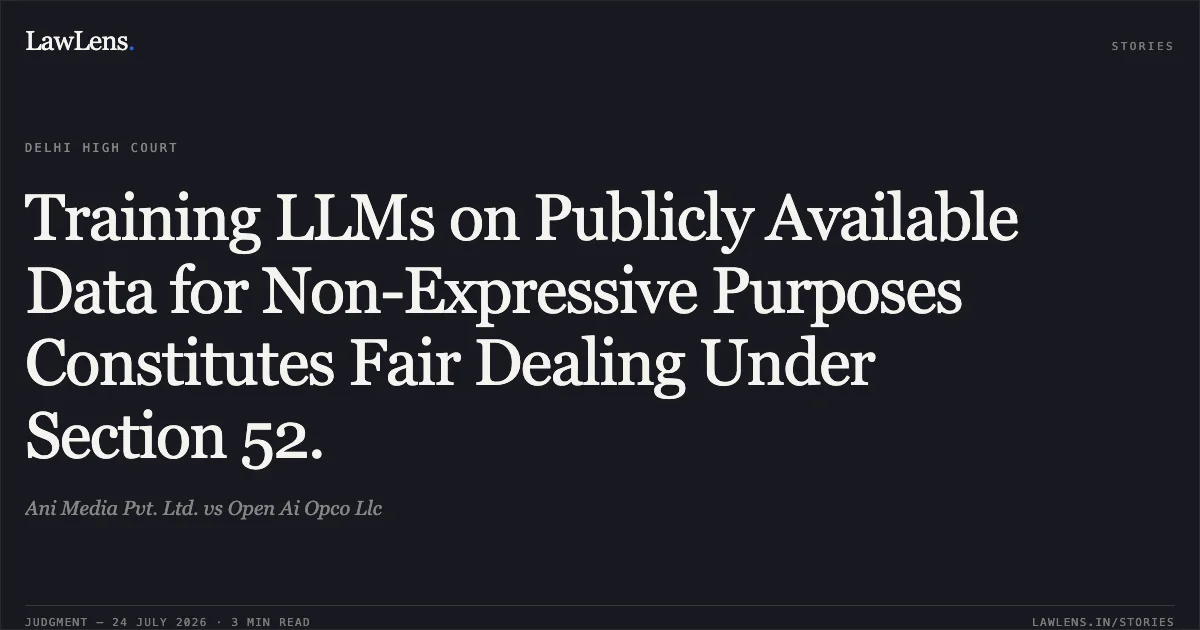
The court dismissed the application for interim injunction (I.A. 45300/2024), holding that OpenAI’s storage of data for training qualifies as "fair dealing" for research purposes under Section 52(1)(a)(i).
It ruled that ANI failed to establish a prima facie case of infringement because: (a) training is a transformative use serving public interest; (b) outputs were not "substantially similar" to the original works; and (c) the balance of convenience favored the continued development of AI technology. The court ordered the trial to proceed while denying immediate relief to the plaintiff.
Source reference: p. 128, p. 57, p. 134-135Acts & Sections Cited
11 provisions across 2 statutes referred to in this judgment. Each provision opens on LawLens.
Code of Civil Procedure, 19081
Original Court PDF
Ani Media Pvt. Ltd.vsOpen Ai Opco Llc
Click to open original judgment
Original judgment, available to read, download and summarize on LawLens.in