01Facts
The petitioners were selected for appointment as Assistant Teachers pursuant to the 1980 recruitment process, having undergone the written examination, interview and medical examination.
They were issued an appointment order dated 25 July 1980 and joined BTI training on 4 August 1980.
¶ 2, 6Clause 7 of the appointment order provided for payment of ₹200 per month during training and contemplated their subsequent posting in the regular pay scale of ₹160–300.
After successfully completing the training, the petitioners were posted as Assistant Teachers in various primary schools by order dated 17 July 1982.
¶ 2, 6The petitioners sought recognition of their seniority from 4 August 1980, whereas the respondents contended that they had merely undergone training in 1980 and were appointed to regular service only in 1982; accordingly, their seniority was reckoned from 1982.
¶ 3The petitioners therefore invoked Article 226 of the Constitution seeking refixation of seniority from 4 August 1980 and consequential benefits.
¶ 102Issues
i.1. Whether the period during which the petitioners underwent BTI training from 4 August 1980 could be counted for determining their seniority as Assistant Teachers.
¶ 5, 8ii.2. Whether, in the absence of any statutory rule, policy or appointment condition postponing seniority until successful completion of training, the respondents were justified in reckoning the petitioners’ seniority from 1982 rather than 1980.
¶ 803Law Applied
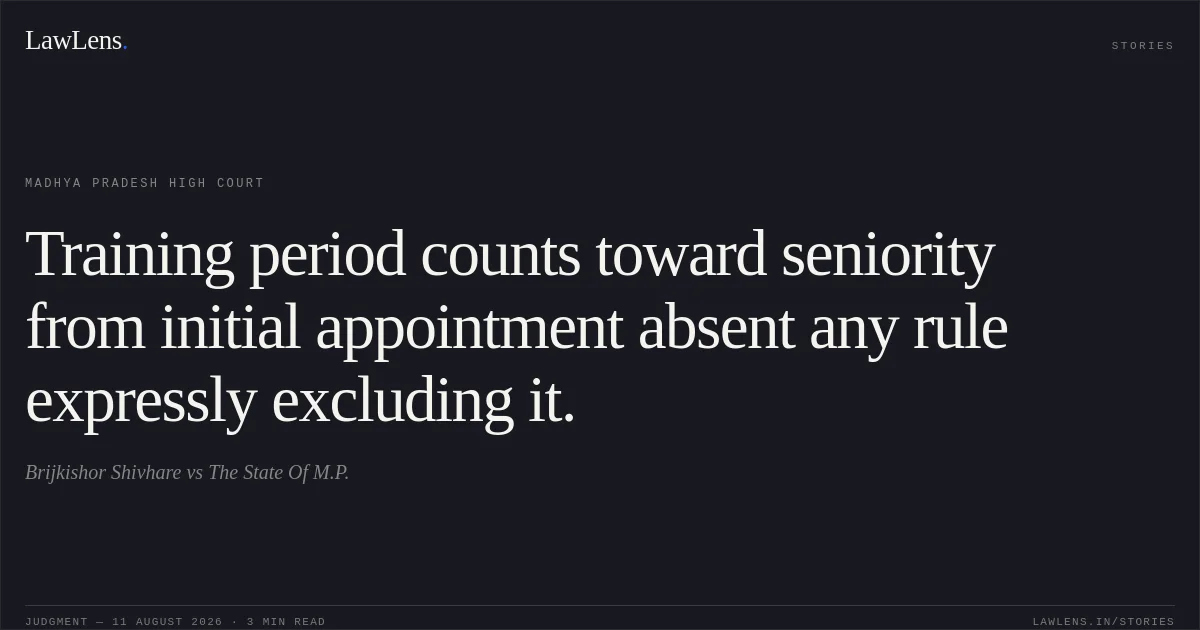
The Court applied the principle that whether training counts as service for seniority depends primarily on the applicable statutory rules and, in their absence, on a valid decision of the competent authority.
¶ 5Relying on State of Himachal Pradesh v. J.L. Sharma, AIR 1998 SC 378, and R.S. Ajara v. State of Gujarat, (1997) 3 SCC 641, the Court held that training may be counted where the rules or government policy treat the training period as service; conversely, under Prafulla Kumar Swain v. Prakash Chandra Mishra, 1993 Supp (3) SCC 181, training would not count where the governing regulation expressly provides that service begins only after successful completion of training.
¶ 5The Court further applied the principle that seniority is ordinarily determined according to merit and the applicable service rules, and not merely by a later date of posting or joining, unless the governing rules specifically provide otherwise.
¶ 804Reasoning
The Court found that the petitioners had been selected through the prescribed recruitment process and had been issued an appointment order in 1980, following which they joined BTI training on 4 August 1980.
¶ 2, 6Unlike the regulation considered in Prafulla Kumar Swain, neither the appointment order nor any applicable statutory rule, policy or executive instruction expressly excluded the training period from service or stipulated that seniority would commence only upon completion of training.
¶ 5, 8The appointment order’s provision for payment during training and subsequent placement in the regular scale supported the conclusion that the training formed part of the appointment arrangement.
Since the petitioners successfully completed the training and were thereafter absorbed and posted as Assistant Teachers, the principle in J.L. Sharma supported counting the training period for seniority.
The respondents also failed to identify any legal authority justifying the postponement of seniority from 1980 to 1982; consequently, such postponement was held arbitrary and unjustified.
¶ 805Holding
The petition was allowed.
¶ 9The Court directed the respondents to reckon the petitioners’ seniority with effect from 4 August 1980, the date of their initial appointment and joining for BTI training, and to extend all consequential benefits within three months of receiving a certified copy of the order.
¶ 9Any pending interlocutory application was also disposed of.
¶ 10Original Court PDF
Brijkishor ShivharevsThe State Of M.P.
Click to open original judgment
Original judgment, available to read, download and summarize on LawLens.in