Facts
The applicant, an Assistant Loco Pilot promoted to Loco Pilot Shunter at Pt. Deen Dayal Upadhyay (DDU) Nagar, challenged a transfer-cum-posting order dated 04.11.2025. This order promoted him to Loco Pilot Goods and transferred him to Ankorha on administrative grounds.
Source reference: p. 3This was the applicant's second round of litigation; in the first (O.A. No. 78/2026), the Tribunal directed the respondents to consider his representation regarding a pending criminal case, his son’s illness, and alleged violations of Railway Board Master Circular No. 67.
Source reference: p. 3, 5The respondents rejected his representation via a speaking order dated 25.03.2026, leading to the current application.
Source reference: p. 4, 5The applicant alleged bias by Vigilance Officers and sought parity with six other employees whose transfer orders were modified to allow them to remain at DDU Nagar.
Source reference: p. 4, 5Issues
1. Whether the transfer order dated 04.11.2025 and the rejection of the representation dated 25.03.2026 were arbitrary, biased, or in violation of statutory rules/circulars.
Source reference: p. 2, 52. Whether the applicant was entitled to parity with other employees regarding the modification of transfer orders based on the principle established in Union of India v. Munshi Ram.
Source reference: p. 4, 5Law Applied
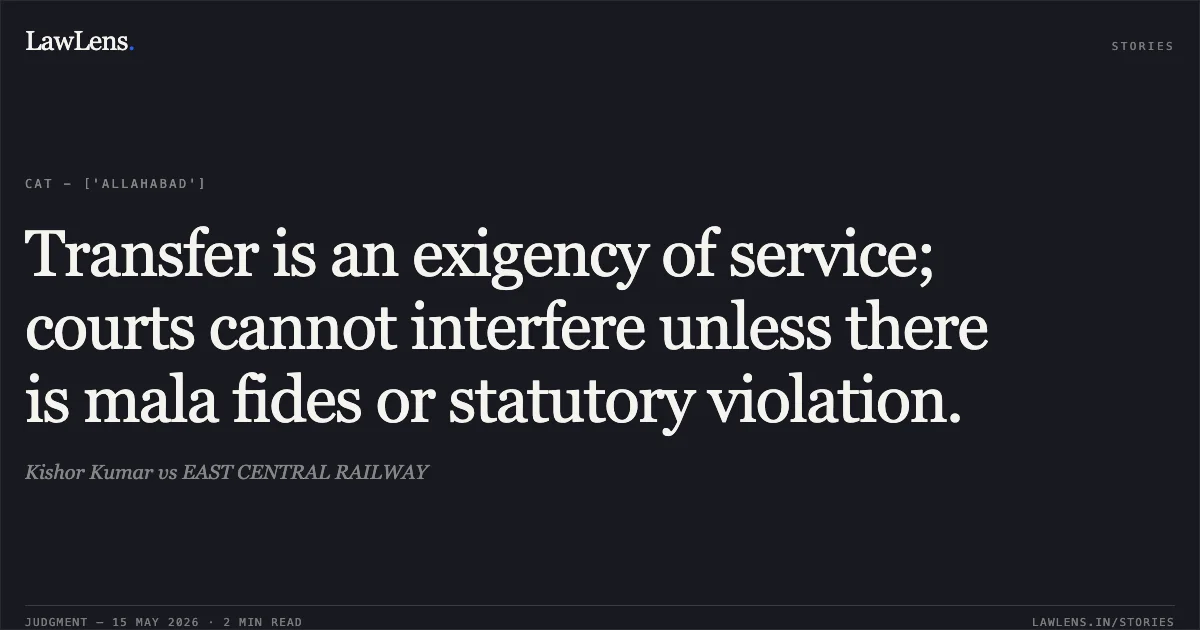
The court primarily applied the settled principle that transfer is an incident of service and an exigency of administration, and a government servant has no vested legal right to be posted at a specific location.
Source reference: p. 6It relied on Rajendra Rai v. Union of India and Union of India v. N.P. Thomas, holding that courts should not interfere with transfers unless there is a violation of statutory rules or evidence of mala fides.
Source reference: p. 6The Tribunal further applied N.K. Singh v. Union of India and Abani Kanta Ray v. State of Orissa, emphasizing that judicial review of transfers is limited to instances of clear arbitrariness.
Source reference: p. 6-7It distinguished Union of India v. Munshi Ram (2022), noting that principles regarding the regularization of daily wagers do not apply to transfer-cum-posting disputes.
Source reference: p. 5Reasoning
The Tribunal found that the applicant failed to prove that the transfer order violated any statutory provisions or was motivated by proven mala fides.
Source reference: p. 5Regarding the plea for parity, the Tribunal determined that the precedent cited by the applicant (Munshi Ram) was irrelevant as it pertained to the regularization of commission vendors, whereas the present case concerned administrative transfers.
Source reference: p. 5The Tribunal noted that the respondents had followed the previous court's direction by issuing a reasoned and speaking order on 25.03.2026, which addressed the applicant's grievances.
Source reference: p. 5It observed that since the applicant was being promoted to a higher pay scale (Level 6) and the transfer was made on administrative grounds, there was no legal basis for the court to substitute its judgment for that of the administration.
Source reference: p. 7-8Holding
The Tribunal answered both issues in the negative, holding that the transfer was a valid exercise of administrative authority and that the applicant had no legal right to remain at DDU Nagar.
The Tribunal declined to interfere with the impugned orders, finding no merit in the allegations of bias or rule violation. The Original Application was dismissed, and no costs were awarded.
Source reference: p. 8Acts & Sections Cited
7 provisions across 1 statute referred to in this judgment. Linked provisions open on LawLens.
Judicial Administration Laws (Repeal) Act, 20017
Original Court PDF
Kishor KumarvsEAST CENTRAL RAILWAY
Click to open original judgment
Original judgment, available to read, download and summarize on LawLens.in


