Facts
The applicant, a Senior Manager (Civil) at RITES Limited (a PSU under the Ministry of Railways), challenged a transfer order dated 21.08.2025 shifting him from Delhi to Kaipadar, Odisha
Source reference: para. 2The applicant contended that he had been transferred four times within a 22-month period: first on promotion to Shillong (Dec 2021), then to Thiruvananthapuram (Oct 2023), back to Delhi (Jan 2025) after being declared surplus, and finally the impugned order to Odisha (Aug 2025)
Source reference: para. 3-6, 25-29He argued the transfer was frequent, arbitrary, and ignored his status as the sole caregiver for his 80-year-old father with 65% locomotor disability
Source reference: para. 13The respondents maintained that the transfers were necessitated by project-based requirements, completion of specific works (PSC Sleeper Plant), and organizational needs
Source reference: para. 9-11The applicant had already joined the new post in Odisha and claimed Composite Transfer Grants (CTG) for all previous transfers
Source reference: para. 6, 11, 29Issues
1. Whether the frequent transfers of the applicant within a short span of 22 months were arbitrary, punitive, or in violation of the RITES Transfer Policy and DoPT guidelines
Source reference: para. 13, 242. Whether the applicant, as a "caregiver" to a disabled dependent, possesses a vested legal right to remain at a specific station under DoPT OMs and the Rights of Persons with Disabilities Act, 2016
Source reference: para. 13(iv), 32Law Applied
The court primarily applied the principle that transfer is an incident of service and an employee has no vested right to a choice posting
Source reference: para. 16, 21It relied on Shilpi Bose v. State of Bihar, establishing that courts should not interfere with transfers unless they violate mandatory statutory rules or are mala fide
Source reference: para. 16, 21It further cited Union of India v. S.L. Abbas, which held that executive guidelines/instructions do not have statutory force and do not confer indefeasible rights
Source reference: para. 17, 22The court also applied State of M.P. v. S.S. Kourav, noting that the "caregiver" or personal hardship grounds are for the administration to consider via representation, not for judicial review
Source reference: para. 18Finally, it followed N.K. Singh v. Union of India regarding the high threshold for proving mala fides
Source reference: para. 35Reasoning
The Tribunal found that each of the applicant's transfers was linked to valid administrative reasons: the first was on promotion [para. 25]; the second for a specific project in Kerala [para. 26]; the third to Delhi because he was "surplus" staff after project completion [para. 27-28]; and the impugned fourth transfer was driven by a Railway Board directive for sleeper plant inspections in Odisha
Source reference: para. 29The court noted the applicant had accepted previous transfers and claimed CTG payments (totaling ₹2,54,605), signifying acquiescence
Source reference: para. 11, 29Regarding the caregiver argument, the court held that while guidelines suggest sympathy, they do not create a statutory bar against transfer, especially when project-specific expertise is required
Source reference: para. 32The court rejected the plea of mala fides, noting a lack of specific evidence or impleadment of biased officers
Source reference: para. 34-36Since the applicant had already joined the post in Odisha, the transfer was considered executed
Source reference: para. 29Holding
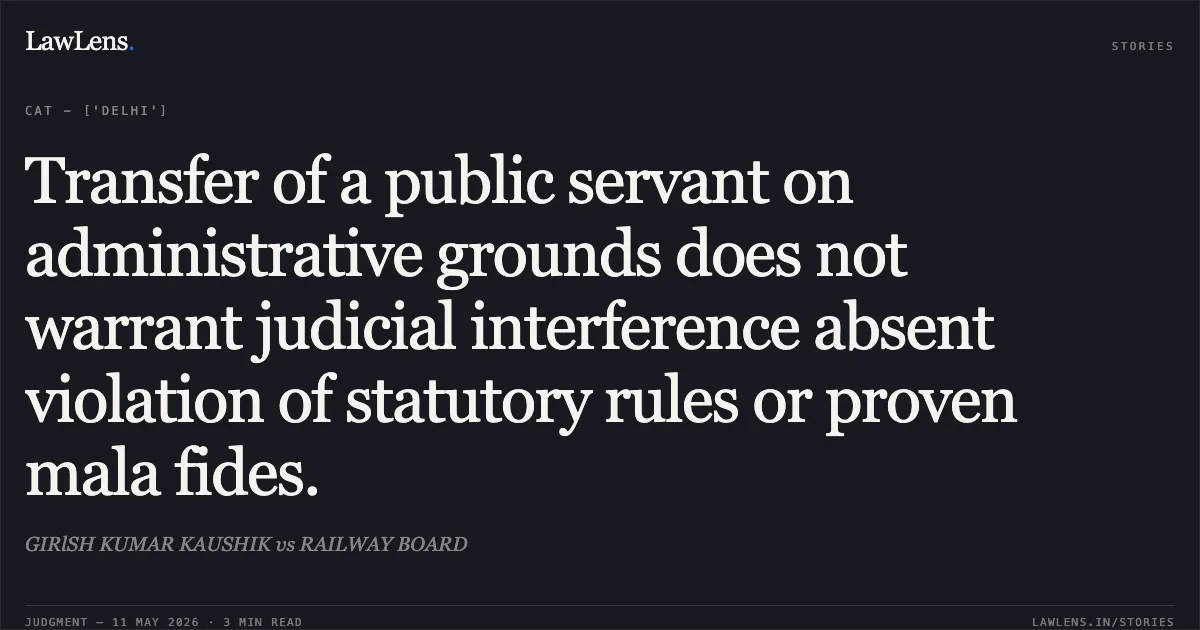
The Tribunal dismissed the OA, holding that the transfer was made in the exigencies of service and organizational requirements
The court answered that frequent transfers necessitated by project completion or staff surplus do not constitute "punitive" action
Source reference: para. 31-33It further held that personal hardships, including caregiver duties, must be addressed through departmental representations rather than judicial interdiction
Source reference: para. 18, 32All interim applications (MA 1807/2026) were dismissed
Source reference: para. 34, 42Original Court PDF
GIRlSH KUMAR KAUSHIKvsRAILWAY BOARD
Click to open original judgment
Original judgment, available to read, download and summarize on LawLens.in