Facts
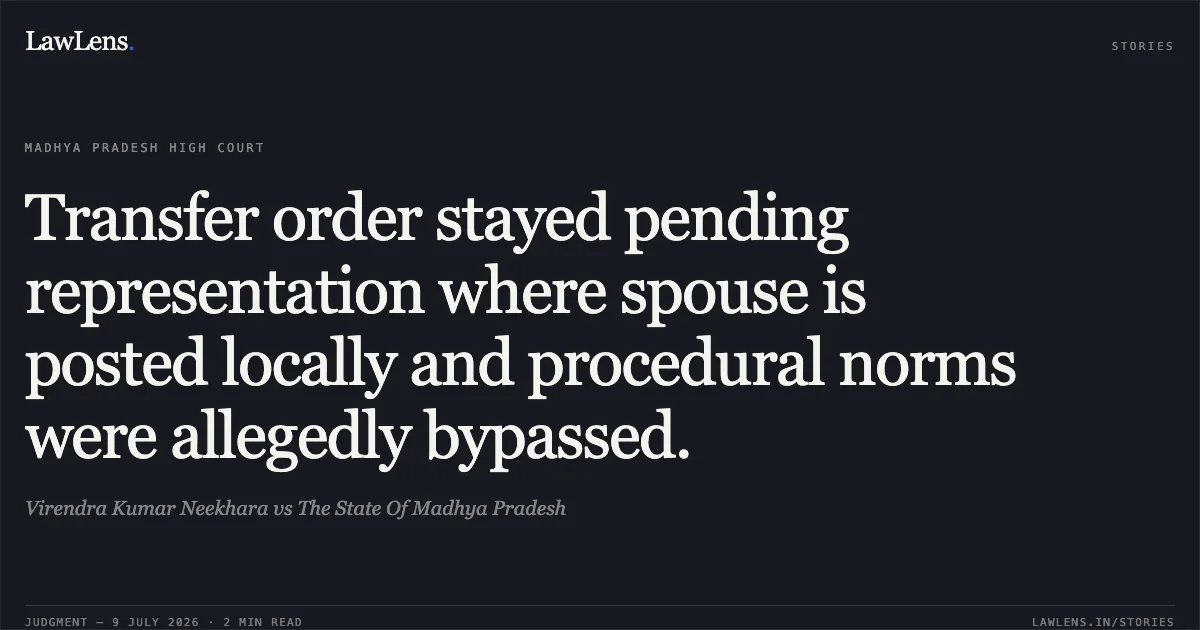
The petitioner, a teacher at Government High School Semari in District Shivpuri, challenged a transfer order dated June 30, 2026, which relocated him to District Teekamgarh, approximately 200 kilometers away
Source reference: para. 2The petitioner argued that the transfer was improper because his spouse is also a government servant posted in District Shivpuri and because he had not consented to a voluntary "own cost" transfer out of the district
Source reference: para. 2, 6Seeking relief under Article 226 of the Constitution, the petitioner requested the court to quash the order or direct the respondents to decide on his representation
Source reference: para. 1, 2Issues
1. Whether the administrative transfer of the petitioner was legally sustainable given the spouse-posting policy and the lack of a voluntary transfer application
Source reference: para. 2, 62. Whether the court should exercise its power of judicial review to stay the transfer pending a decision on the petitioner's representation
Source reference: para. 6Law Applied
The court emphasized that transfer is an inherent incident of service and does not constitute a vested right for an employee to remain at a specific post
Source reference: para. 5It applied the principle that judicial review of transfer orders is limited to instances of mala fide intentions or arbitrary exercise of power, noting that the doctrine of equality under Articles 14 and 16 generally does not apply to transfer disputes
Source reference: para. 5Furthermore, the court looked to procedural precedents, such as Natthu Singh Yadav v. State of Madhya Pradesh (W.P. No. 31488/2024), which allow for the disposal of such petitions via directions for administrative review
Source reference: para. 2Reasoning
The court balanced the principle of administrative autonomy—identifying the employer as the best judge of workforce organization—against the specific grievances raised by the petitioner regarding his family situation and the nature of the transfer
Source reference: para. 5, 6While the court maintained that the petitioner failed to prove initial arbitrariness or malice, it acknowledged that the personal circumstances (the spouse's posting and the distance) warranted a formal administrative review
Source reference: para. 6By directing the petitioner to file a fresh representation, the court sought to ensure that the executive branch evaluates the merits of the transfer policy against the petitioner’s specific facts before the transfer is finalized
Source reference: para. 6Holding
The court disposed of the writ petition without expressing an opinion on the merits
It directed the petitioner to submit a representation within seven working days and ordered the competent authority to decide the matter via a speaking and reasoned order within one month
Source reference: para. 6(i), (ii)Crucially, the court stayed the operation of the transfer order and prohibited any coercive action against the petitioner until the representation is decided, allowing him to continue at his present posting in Shivpuri
Source reference: para. 6(iii)Original Court PDF
Virendra Kumar NeekharavsThe State Of Madhya Pradesh
Click to open original judgment
Original judgment, available to read, download and summarize on LawLens.in