Facts
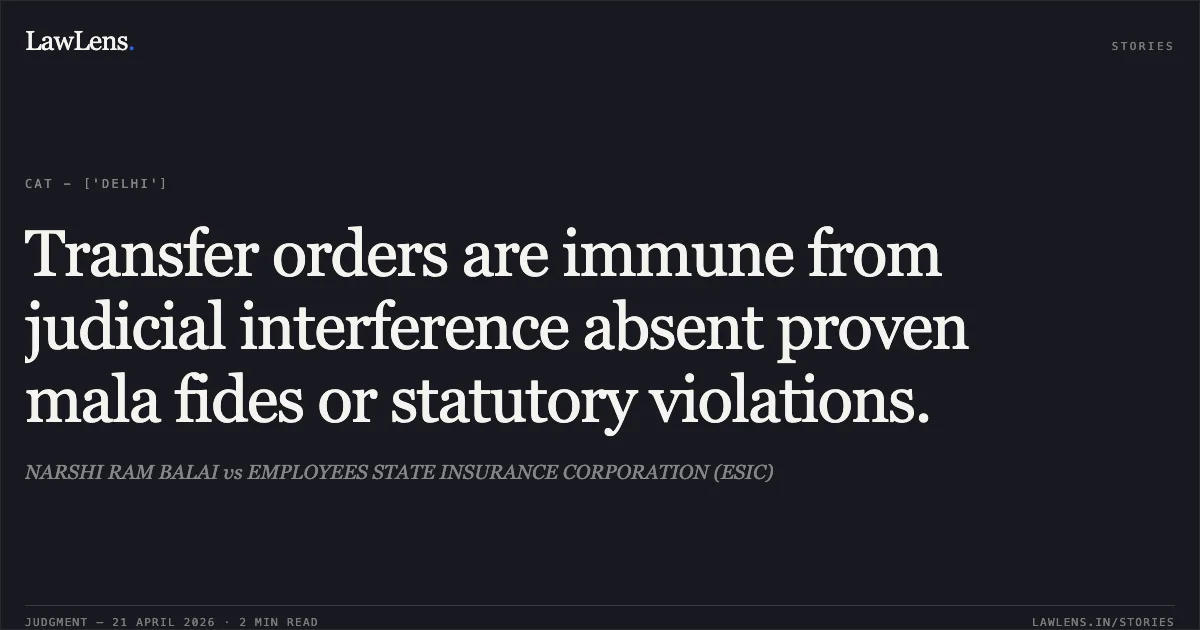
The applicant, a Social Security Officer (SSO) with Locomotor Disability, challenged Transfer Order No. 54 of 2026 dated 10.04.2026, which moved him from ESIC Faridabad (NCR) to RO Mumbai
Source reference: p. 1-2The applicant contended that the transfer violated Clauses 5.2, 7.2, and 7.3 of the SSO Transfer Policy dated 18.12.2024 and the Rights of Persons with Disabilities Act, 2016, which provides for preference in postings
Source reference: p. 2He further cited personal hardships, including his 10-year tenure in Delhi-NCR and his daughter’s enrollment in Class-X
Source reference: p. 2The respondents argued the transfer was in the public interest, no vacancies existed in NCR, and the applicant failed to provide documentary evidence regarding his daughter’s education
Source reference: p. 2-3Issues
1. Whether the transfer order is vitiated by mala fides or violation of statutory provisions and transfer policy
Source reference: p. 5-62. Whether the applicant is entitled to interim relief or a stay on the transfer order based on personal hardship and disability status
Source reference: p. 6Law Applied
The Tribunal relied on Union of India v. S.L. Abbas, which established that transfer guidelines do not confer enforceable rights unless the order is mala fide or violates mandatory statutory provisions
Source reference: p. 3, 5It applied Namrata Verma v. State of U.P., holding that transfer is an incidence of service and employees cannot insist on specific postings
Source reference: p. 5Under Rajendra Roy v. Union of India, the court affirmed that personal hardships are administrative matters for the department to consider
Source reference: p. 6Finally, it cited Dr. Subramanian Swamy v. State of Tamil Nadu to clarify that judicial precedents in service matters are fact-specific and not of universal application
Source reference: p. 4-5Reasoning
The Tribunal found that the applicant had already completed a ten-year tenure in the Delhi-NCR region, weakening the claim against a transfer out of the zone
Source reference: p. 2It distinguished this case from other ESIC matters (e.g., Sugan Lal Meena v. ESIC) cited by the applicant, noting those cases involved different cadres, policies, or specific concessions by the department that were not present here
Source reference: p. 4, 6The Tribunal observed that no mala fides were proved and that judicial review is limited in transfer matters unless statutory violations occur
Source reference: p. 6Relying on the principle that the executive is best suited to evaluate administrative requirements and personal hardships, the Tribunal concluded that the department must first address the applicant's pending representation
Source reference: p. 6-7Holding
The Tribunal declined to interfere with the transfer order or grant interim relief
However, it disposed of the O.A. with a direction to the respondents to consider the applicant's pending representation dated 13.04.2026 in light of the Transfer Policy and DoPT guidelines
Source reference: p. 7The respondents are ordered to pass a reasoned and speaking order within two weeks of receiving the judgment
Source reference: p. 7No order was made as to costs
Source reference: p. 7Original Court PDF
NARSHI RAM BALAIvsEMPLOYEES STATE INSURANCE CORPORATION (ESIC)
Click to open original judgment
Original judgment, available to read, download and summarize on LawLens.in