Facts
The petitioners in four writ petitions challenged transfer orders issued by their respective departments, raising various grounds
Source reference: para. 1–2The High Court heard the petitions together because they involved common questions of law and fact
Source reference: para. 1It found that none of the recognised grounds for judicial review of the impugned transfers had been established
Source reference: para. 13Issues
1. Whether the impugned transfer orders disclosed a ground warranting interference under Article 226 of the Constitution
Source reference: para. 9–132. Whether the petitioners should be permitted to seek administrative consideration of their grievances while the transfer orders were temporarily held in abeyance
Source reference: para. 14–17Law Applied
Transfer is an incidence of service; an employee has no vested right to remain posted at a place of choice, and the employer may transfer employees to meet administrative exigencies and public interest
Source reference: para. 4–5Relying on Shilpi Bose & Ors. v. State of Bihar, AIR 1991 SC 532, the Court reiterated that transfer orders should not ordinarily be interfered with by courts or tribunals
Source reference: para. 6Judicial review under Article 226 is limited and does not permit the Court to act as an appellate authority on the convenience of a transfer
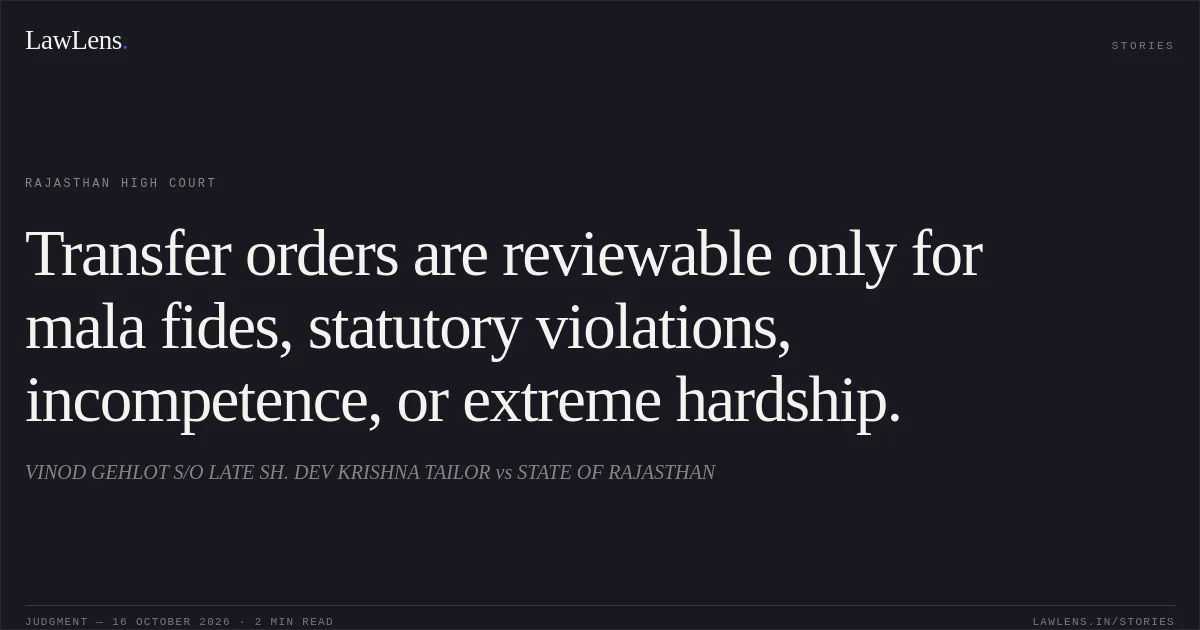
Source reference: para. 9–10The Court identified the permissible grounds for interference as mala fides or bias specifically pleaded and proved, breach of a statutory provision or rule, lack of competence of the transferring authority, or—only in a rare case—extreme hardship arising from a life-threatening disease affecting service conditions
Source reference: para. 11Personal inconvenience, hardship and long stay at a posting are ordinarily matters for the authorities, not the courts
Source reference: para. 12Reasoning
The Court treated the petitions as challenges to transfer orders and applied the narrow grounds of review set out above.
Source reference: no citationIt concluded that none of those grounds had been made out in the cases before it
Source reference: para. 13It therefore declined to review the merits or convenience of the transfers, while allowing the petitioners to submit representations so their grievances could be considered by the competent authorities
Source reference: para. 10, 14–15The temporary abeyance of the orders was intended to allow that process to take place; the Court expressly left the merits of the parties’ cases open
Source reference: para. 16, 18Holding
The Court disposed of all four writ petitions without setting aside the transfer orders.
It permitted the petitioners to file detailed representations within two weeks, which the competent authorities were directed to decide expeditiously, preferably within the following two weeks, by reasoned and speaking orders
Source reference: para. 15The impugned transfers were to remain in abeyance for four weeks, and the petitioners were not to be compelled to relieve during that period; this direction did not apply to anyone who had already joined the new posting
Source reference: para. 16, 20If a representation was rejected, the respondents could give effect to the transfer, and disciplinary action could follow if the employee then failed to join
Source reference: para. 17The Court expressed no view on the merits of the grievances
Source reference: para. 18Original Court PDF
VINOD GEHLOT S/O LATE SH. DEV KRISHNA TAILORvsSTATE OF RAJASTHAN
Click to open original judgment
Original judgment, available to read, download and summarize on LawLens.in