Facts
The petitioner, a Rajasthan Police Constable, was charged under Rule 16 of the Rajasthan Civil Services (Classification, Control and Appeal) Rules, 1958, with remaining absent from assigned sentry duty without sanctioned leave from 8 to 18 March 2002.
Source reference: para. 1–2.5The charge-sheet also referred to 51 earlier instances of absence.
Source reference: para. 1–2.5Following an inquiry, the Disciplinary Authority dismissed him from service on 24 February 2003 and treated the ten-day period as leave without pay; the appellate authority dismissed his appeal on 30 June 2003.
Source reference: para. 1–2.5The petitioner challenged both orders, alleging procedural unfairness, failure to consider his explanation that his mother was seriously ill, improper reliance on past absences, double jeopardy, non-speaking orders and disproportionate punishment.
Source reference: para. 4.1–4.14, 7Issues
1. Whether the disciplinary inquiry complied with Rule 16 of the 1958 Rules and afforded the petitioner an effective opportunity to defend himself.
Source reference: para. 8–8.62. Whether the appellate authority properly considered the petitioner’s grounds of appeal and whether the orders were non-speaking or mechanical.
Source reference: para. 9–9.13. Whether the petitioner’s explanation concerning his mother’s illness was substantiated and required the disciplinary orders to be set aside.
Source reference: para. 10–10.14. Whether consideration of the 51 earlier instances of absence amounted to double jeopardy or otherwise invalidated the penalty.
Source reference: para. 11–11.105. Whether the penalty of dismissal warranted interference under Article 226, including on proportionality grounds.
Source reference: para. 7, 12–13Law Applied
Rule 16 of the 1958 Rules governs major-penalty inquiries, including communication of definite charges, an opportunity to submit a defence, and consideration of the inquiry report; under Rule 16(11A), a separate opportunity to make representations on the proposed penalty is not required.
Source reference: para. 8, 8.5Under Article 226, a reviewing court does not ordinarily reappreciate evidence; interference may be warranted for an error of law, no evidence, perversity, or a material procedural or natural-justice violation, but not merely because evidence is said to be insufficient.
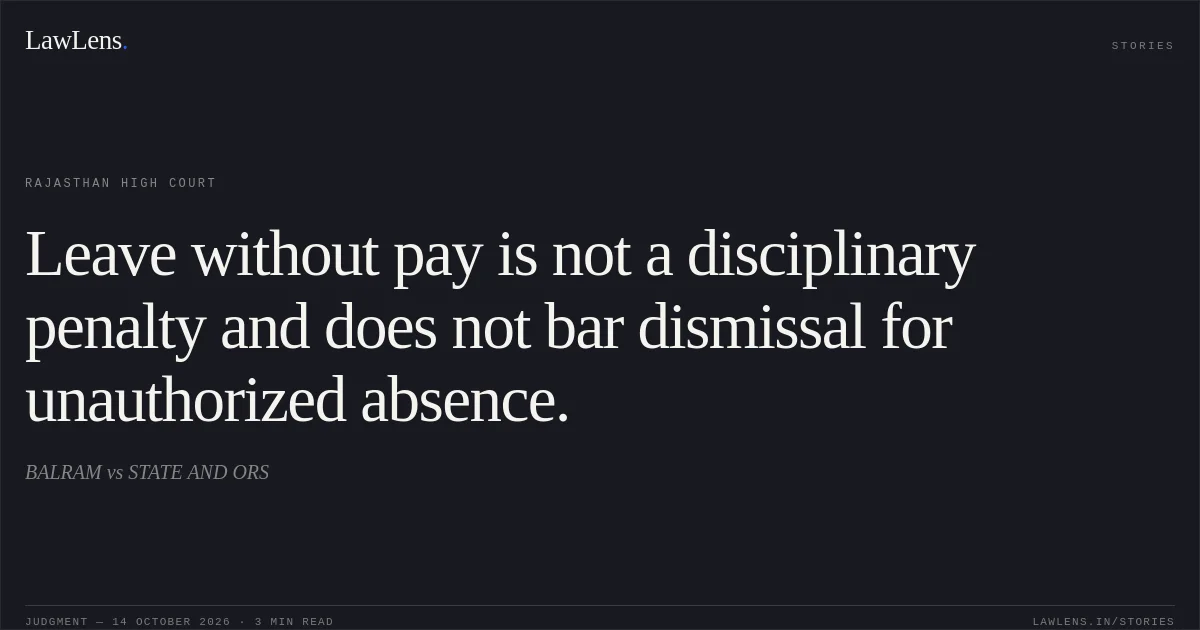
Source reference: para. 7.1–7.3Rule 14 enumerates the penalties available under the Rules; leave without pay is not itself a disciplinary penalty.
Source reference: para. 11.6–11.9State of U.P. v. Madhav Prasad Sharma, (2011) 2 SCC 212, was relied on for the propositions that leave without pay is not a prescribed penalty and that the double-jeopardy objection does not arise where only one disciplinary penalty is imposed.
Source reference: para. 11.6–11.9The Court also referred to State of Punjab v. Ex. C. Satpal Singh, 2025 Supreme (SC) 1283, concerning consideration of past conduct in assessing punishment, and to the principle that punishment is not ordinarily disturbed absent gross or shocking disproportionality.
Source reference: para. 11.4, 12Reasoning
The Court found that the petitioner had received the charge-sheet and an opportunity to submit a written defence, was represented during the inquiry, could cross-examine departmental witnesses and lead defence evidence, and received the inquiry report with an opportunity to respond.
Source reference: para. 8.1–8.6He sought additional time but ultimately filed no further representation; the Court therefore found no material denial of opportunity or prejudice under Rule 16.
Source reference: para. 8.1–8.6It read the appellate order as showing consideration of the inquiry record, appeal grounds and principal defence, notwithstanding the absence of a paragraph-by-paragraph response.
Source reference: para. 9.1The medical explanation was rejected as unsubstantiated because no contemporaneous medical or other supporting evidence was produced.
Source reference: para. 10.1The Court held that the current penalty rested on the separately charged absence in March 2002, not on the 51 earlier instances; reference to past conduct did not amount to punishing the petitioner again for those instances.
Source reference: para. 11.1–11.3, 11.6–11.10It also held that leave without pay was not a second penalty under Rule 14.
Source reference: para. 11.1–11.3, 11.6–11.10Finding no established procedural defect or other ground for judicial interference, the Court declined to disturb the disciplinary authorities’ decision.
Source reference: para. 7.3, 12–13Holding
The High Court held that the inquiry and appellate proceedings disclosed no violation of Rule 16, that the medical explanation and double-jeopardy objection were not made out, and that no ground for interference under Article 226 was established.
It dismissed the writ petition and disposed of any pending application.
Source reference: para. 13Original Court PDF
BALRAMvsSTATE AND ORS
Click to open original judgment
Original judgment, available to read, download and summarize on LawLens.in