Facts
The petitioner, a Hindi teacher (E-Cadre) at Govt. Middle School, Janjgiri, Durg, challenged a transfer order dated 07.06.2025.
Source reference: p. 2Under this order, she was moved to Govt. Middle School, Kodwagobarra, Kabirdham District.
Source reference: p. 2The petitioner contended the transfer was arbitrary, violated rationalization policy norms, and caused personal hardship.
Source reference: p. 2The State argued the matter was squarely covered by a previous Division Bench judgment in Shashi Shrivastava v. State of Chhattisgarh (WA No. 674 of 2025).
Source reference: p. 3Issues
1. Whether the transfer order dated 07.06.2025 was illegal, arbitrary, or in violation of the teacher rationalization policy.
Source reference: p. 22. Whether administrative guidelines regarding teacher rationalization override the general powers of an employer to transfer employees in public interest.
Source reference: p. 4, para. 8Law Applied
The Court relied on Section 3 of the judgment which cites the Division Bench ruling in Shashi Shrivastava v. State of Chhattisgarh.
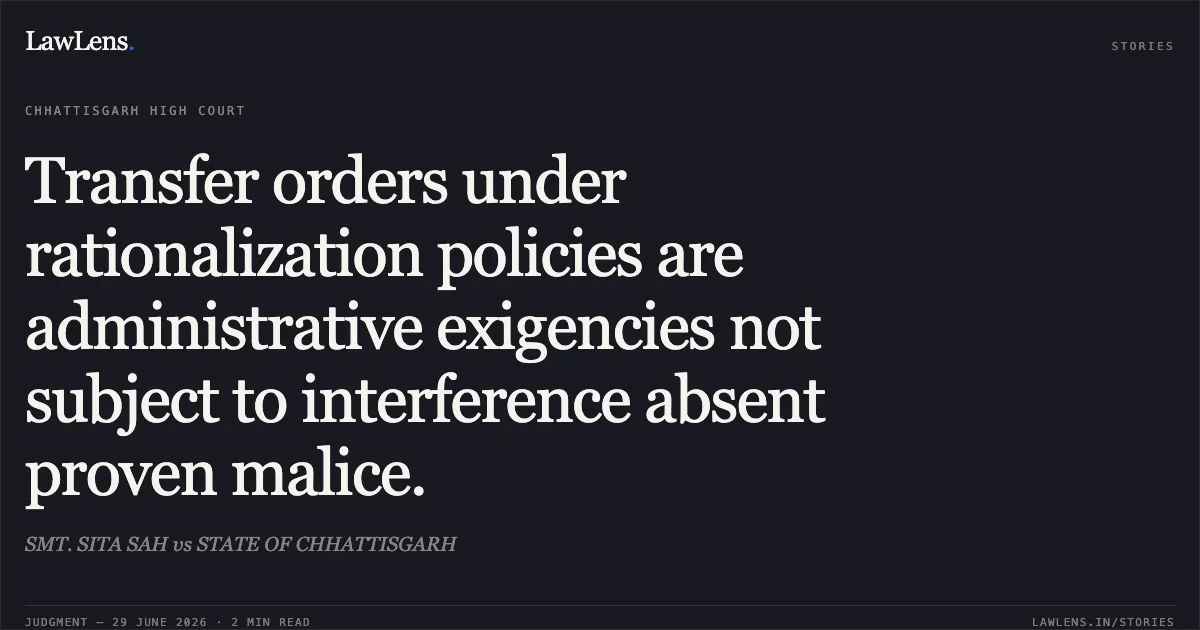
Source reference: p. 3This precedent establishes that teacher rationalization instructions are mere guidelines and cannot supplant the general powers of the employer provided under statutory service rules to post personnel based on public interest or administrative exigency.
Source reference: p. 4, para. 8it is a settled principle that transfer is an incidence of service, and courts should only interfere if there is proven malice, lack of competence, or infraction of statutory rules.
Source reference: p. 4, para. 8Reasoning
The Court examined the petitioner’s claim of policy violation against the established legal position that rationalization instructions are advisory guidelines rather than mandatory statutory restrictions.
Source reference: p. 4, para. 8Relying on the reasoning in Shashi Shrivastava, the Court noted that unless a transfer order is tainted by mala fides or a clear breach of statutory regulations, it remains within the administrative discretion of the employer.
Source reference: p. 4, para. 8Since the facts of the present case—involving a teacher transferred under rationalization—were identical to the precedents cited by the State, the Court found no reason to depart from the earlier judicial view that such transfers are valid administrative actions taken in the public interest.
Source reference: p. 5, para. 5Holding
The Court answered the issues in the negative, holding that the transfer order was not illegal or arbitrary.
The High Court dismissed the writ petition, maintaining that transfer is a condition of service and the petitioner failed to prove any malice or statutory violation warranting judicial interference.
Source reference: p. 5, para. 10The petition was dismissed in terms of the order passed in WA No. 674 of 2025.
Source reference: p. 5, para. 6Original Court PDF
SMT. SITA SAHvsSTATE OF CHHATTISGARH
Click to open original judgment
Original judgment, available to read, download and summarize on LawLens.in