Facts
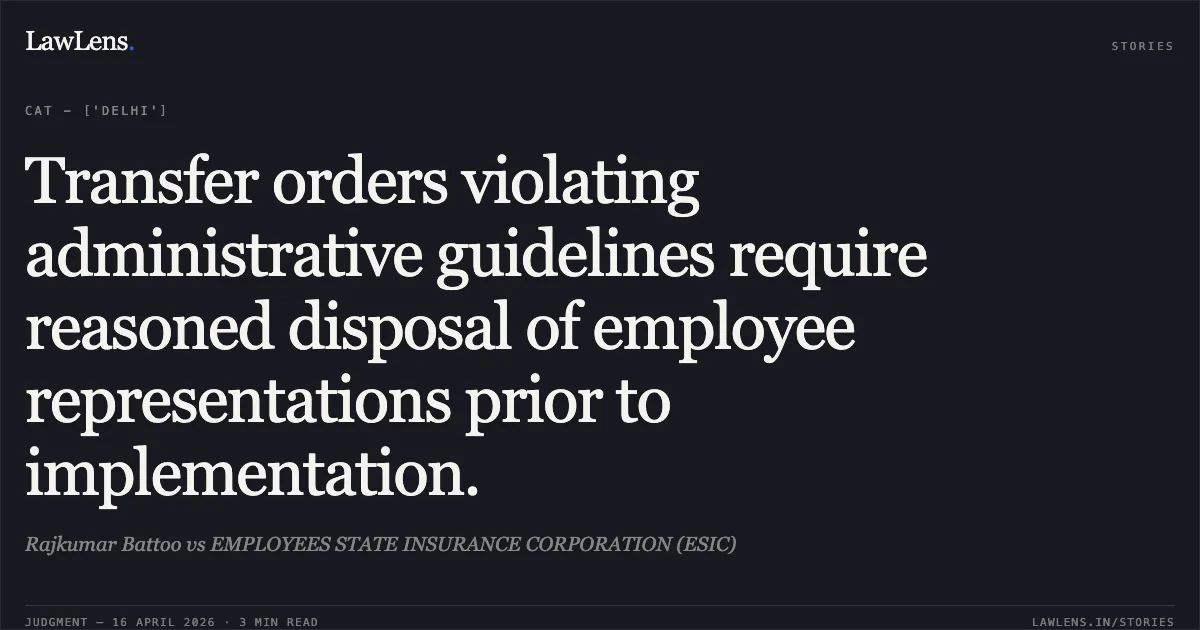
The applicant, a Social Security Officer (SSO) aged 58, challenged the transfer order dated 10.04.2026, which directed his relocation from RO-Rajendra Place, New Delhi, to SRO, Thane, Maharashtra.
Source reference: p. 1-2The applicant joined ESIC in 1996 and had been posted in Delhi-NCR since 2024 following a previous transfer where he exercised choice stations.
Source reference: p. 2He contended that the new transfer occurred after only 18 months at his current post, ignored the fact that his spouse is a Primary School Teacher in a non-transferable post in Delhi, and disregarded her medical ailments.
Source reference: p. 2-3He filed a representation on 11.04.2026 seeking retention on spouse grounds and challenged the Transfer Policy dated 19.12.2024 as arbitrary.
Source reference: p. 2-3At the time of the hearing, the applicant had not yet been relieved from his current post.
Source reference: p. 5Issues
1. Whether the impugned transfer order was liable to be quashed for violating DoPT instructions regarding the posting of husband and wife at the same station and the ESIC Transfer Policy.
Source reference: p. 3-42. Whether the court should exercise judicial review to interfere with an administrative transfer order based on personal hardships and policy guidelines.
Source reference: p. 5-6Law Applied
The Tribunal applied the principle that transfer is an incidence of service and guidelines do not confer an enforceable right unless the order is mala fide or violates statutory provisions, as established in Union of India v. S.L. Abbas.
Source reference: p. 4, 6Namrata Verma v. State of U.P.
Source reference: p. 5It also relied on the DoPT Office Memorandums dated 30.09.2009 and 14.10.2009, which mandate that the government should endeavor to post husband and wife at the same station.
Source reference: p. 3-4The court cited Rajendra Roy v. Union of India, which establishes that personal hardships resulting from transfers are matters for departmental consideration.
Source reference: p. 6R.S. Chaudhary v. State of M.P., holding that the proper remedy for policy violations is a representation to the authorities.
Source reference: p. 6Reasoning
The Tribunal observed that while administrative authorities possess the prerogative to transfer employees based on requirements, they must objectively consider established guidelines and personal hardships.
Source reference: p. 5-6The court noted the applicant's specific grievances, including his wife's non-transferable employment in Delhi and her health issues, which align with the protections intended by the DoPT spouse-ground instructions and Clause 7.4 of the ESIC Transfer Policy.
Source reference: p. 4-5Rather than quashing the order, the Tribunal determined that the administrative grievance redressal mechanism should be exhausted first.
Source reference: p. 6Following the precedent set in similar matters (e.g., Sugan Lal Meena v. ESIC), the Tribunal found it equitable to protect the applicant’s current status while directing the respondents to perform a sympathetic and reasoned review of his pending representation.
Source reference: p. 5, 7Holding
The Tribunal disposed of the O.A. at the admission stage without quashing the transfer order but granted significant procedural relief.
It directed the respondents to decide on the applicant’s representation dated 11.04.2026 by passing a reasoned and speaking order.
Source reference: p. 7The Tribunal ordered that the transfer order shall not be implemented and the applicant shall be allowed to continue at his current post in New Delhi until the representation is decided.
Source reference: p. 7If the decision is adverse to the applicant, the respondents were directed not to implement the transfer for an additional fifteen days from the date of communication of the decision to allow the applicant further legal recourse.
Source reference: p. 7Original Court PDF
Rajkumar BattoovsEMPLOYEES STATE INSURANCE CORPORATION (ESIC)
Click to open original judgment
Original judgment, available to read, download and summarize on LawLens.in