01Facts
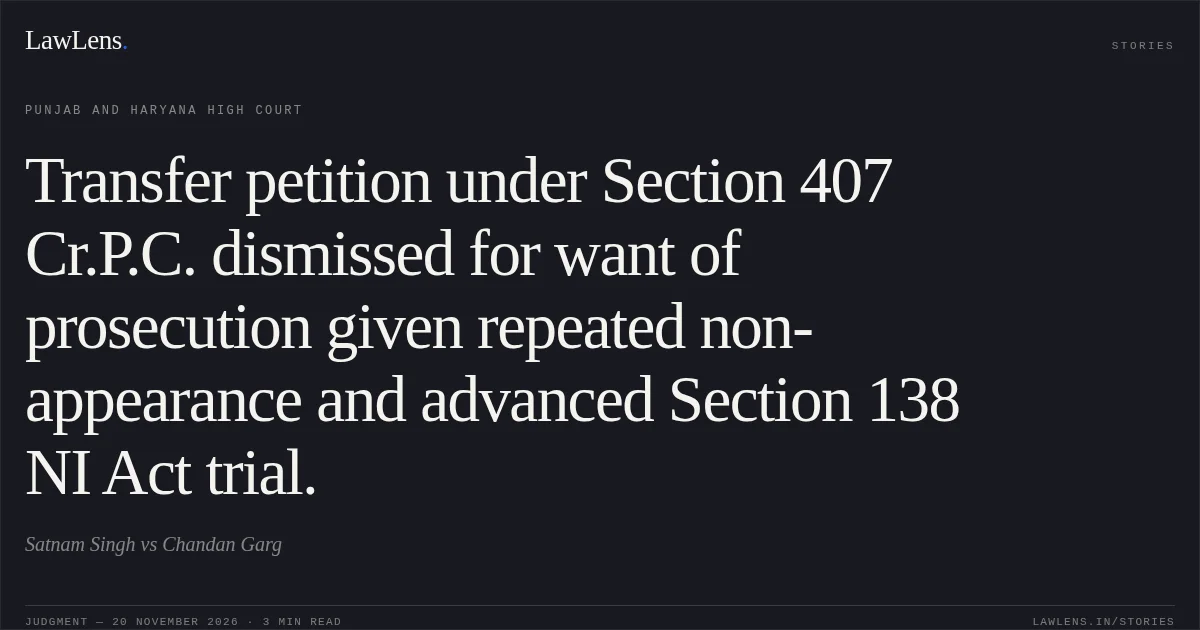
The petitioner, Satnam Singh, filed a petition under Section 407 Cr.P.C., read with Section 482 Cr.P.C., seeking transfer of two complaints under Section 138 of the Negotiable Instruments Act, 1881 (NACT/4827/2023 and NACT/4832/2023, Chandan Garg v. Satnam Singh).
¶ 1The complaints were pending before the Judicial Magistrate First Class, Chandigarh, and the petitioner sought their transfer to Gidderbaha, District Muktsar Sahib.
¶ 1On 13.02.2024, the Court noted that notice to the respondent had returned unserved, and directed the petitioner to furnish the respondent's correct address within seven days.
¶ 2On 25.04.2024, no one appeared for the petitioner. The matter was adjourned to 29.07.2024 for final disposal, with the Registry directed to notify counsel telephonically and by e-mail, and with a clear warning that no further adjournment would be granted.
¶ 3On 29.07.2024, no one appeared, and the petition was dismissed for non-prosecution.
¶ 4The petitioner again failed to appear on 31.08.2026 and, on the date of the impugned order, did not appear even after two calls.
¶ 5The respondent's counsel informed the Court that the Section 313 Cr.P.C. statement of the accused had been recorded and the complaint cases were awaiting final adjudication.
¶ 602Issues
i.1. Whether a transfer petition under Section 407 Cr.P.C. should be dismissed for want of prosecution where the petitioner has repeatedly failed to appear despite sufficient opportunities and express warnings, and the trial has reached an advanced stage.
¶ 5, 7, 8, 10ii.2. Whether continued pendency of the transfer petition, in the absence of effective prosecution, is justified where Section 138 NI Act complaints require expeditious disposal.
¶ 7, 903Law Applied
The Court invoked Sections 407 and 482 Cr.P.C. as the procedural basis for seeking transfer of the complaints, but the judgment does not quote or analyse their text.
¶ 1The Court treated the complaints as proceedings under Section 138 of the Negotiable Instruments Act, which must be dealt with expeditiously.
¶ 9A litigant invoking the High Court's jurisdiction must pursue the proceedings with due diligence and seriousness, and courts cannot keep matters pending indefinitely where the party itself declines to prosecute.
¶ 8Provisions in the judgment · 4 · Linked ones open on LawLens
Code of Criminal Procedure, 1973 Section 407Section 482Section 313
Negotiable Instruments Act, 1881 Section 138
04Reasoning
The Court examined the procedural history and found a consistent pattern of default: unserved notice, the petitioner's failure to furnish the correct address, repeated non-appearance, and disregard of an express warning that no further adjournment would be granted. Because the Registry had given counsel direct intimation of the hearing date, the non-appearance could not be attributed to lack of notice.
¶ 2-5The Court then weighed the relief sought against the stage of the complaint proceedings. The petitioner sought transfer but never substantiated the grounds for it, and the trial had already progressed to the Section 313 Cr.P.C. stage. Continuing the petition would prolong the disposal of Section 138 complaints without justification, which the Court considered inconsistent with the statutory requirement of expeditious disposal.
¶ 6-7, 905Holding
Given the petitioner's repeated defaults, the opportunities already afforded, and the advanced stage of the trial before the learned Magistrate, no useful purpose would be served by keeping the transfer petition pending, and the petition served no useful purpose.
¶ 10The petition was dismissed for want of prosecution, and the complaints (NACT/4827/2023 and NACT/4832/2023) remain before the Judicial Magistrate First Class, Chandigarh, for final adjudication.
¶ 11Original Court PDF
Satnam SinghvsChandan Garg
Click to open original judgment
Original judgment, available to read, download and summarize on LawLens.in