Facts
The petitioner, Manish Dalal, challenged a transfer order dated June 18, 2026, issued by Respondent No. 3, and a subsequent relieving order dated June 22, 2026, issued by Respondent No. 4.
Source reference: Order Page 1The petitioner contended that the transfer violated the provisions of the prevailing transfer policy and that he was relieved from service without the respondents considering his formal representation dated June 19, 2026.
Source reference: Order Page 1-2The petitioner sought a writ of certiorari to quash the impugned orders.
Source reference: para. 1Issues
1. Whether a transfer order can be interfered with by the High Court under Article 226 of the Constitution solely on the ground of a violation of executive transfer guidelines/policy.
Source reference: para. 2, 42. Whether the impugned transfer order was vitiated by mala fides or violation of statutory provisions requiring judicial intervention.
Source reference: para. 5Law Applied
Article 226 of the Constitution of India regarding the scope of judicial review in administrative matters.
Source reference: para. 1Sri Pubi Lombi v. State of Arunachal Pradesh (2024), which establishes that judicial review of transfers is limited to cases of proven mala fides, violation of statutory provisions, or lack of jurisdiction.
Source reference: para. 3Union of India v. S.L. Abbas (1993) and R.S. Chaudhary v. State of M.P., which hold that transfer policies/guidelines are mere executive instructions without statutory force and do not confer a legally enforceable right upon an employee.
Source reference: para. 3, 4Reasoning
The Court reasoned that transfer is an "integral part of service" and an incidence of employment necessary for effective administration.
Source reference: para. 4, 5It observed that the petitioner failed to plead or prove any mala fides or specific violation of a mandatory statutory rule, relying instead on a breach of the transfer policy.
Source reference: para. 5Following established precedents, the Court noted that "non-observation of executive instructions does not confer a legally enforceable right" because the authorities must prioritize administrative exigencies over individual convenience.
Source reference: para. 3The Court further highlighted that it cannot act as an appellate authority to assess the "niceties of administrative needs".
Source reference: para. 4Since the petitioner had already been relieved and no statutory infraction was evidenced, the court found no "judicially manageable standards" to warrant interference.
Source reference: para. 3, 5Holding
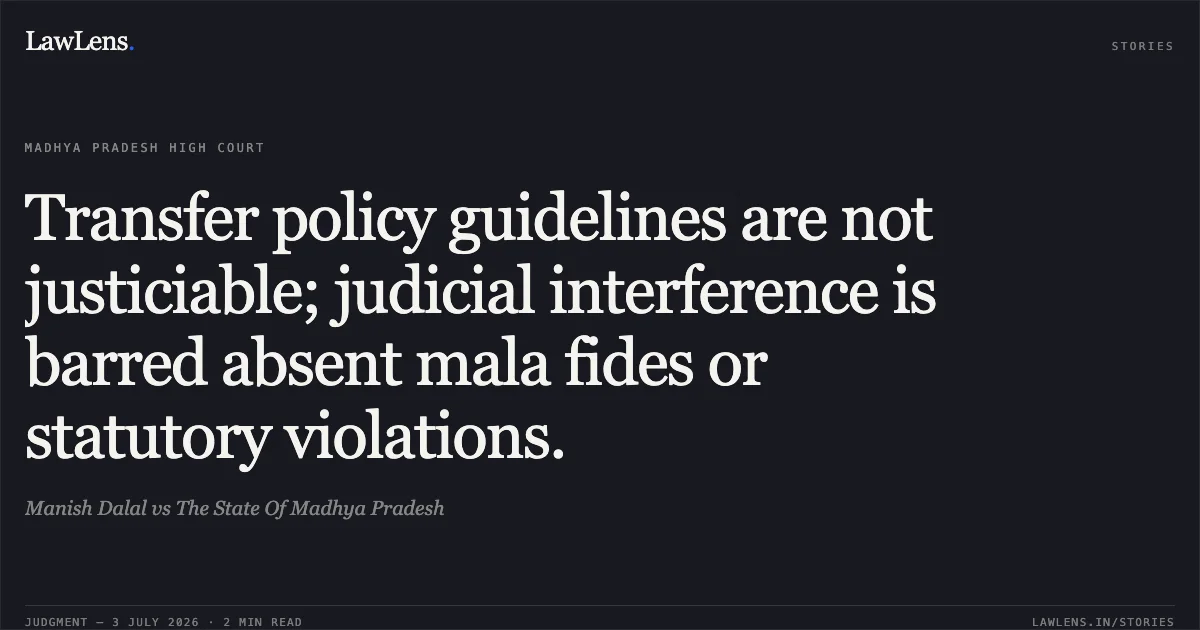
The Court held that the transfer order was valid as it was issued based on administrative exigency and did not violate any statutory provisions.
The Court answered the issues in the negative, stating that in the absence of mala fides or statutory breach, the scope of judicial review under Article 226 is restricted.
Source reference: para. 10 of cited Pubi Lombi, para 5The Writ Petition was dismissed.
Source reference: Order Page 10Original Court PDF
Manish DalalvsThe State Of Madhya Pradesh
Click to open original judgment
Original judgment, available to read, download and summarize on LawLens.in