Facts
The petitioner, a government employee, challenged the transfer order dated 24.07.2026 (Serial No. 03) which relocated him from Tehsil Ashoknagar to Tehsil Mungawali.
Source reference: p. 1-2The petitioner contended that the transfer was illegal as it occurred during a "prohibited period," violated Clauses 6, 29, and 32 of the Transfer Policy 2026, and failed to consider his personal hardships—specifically the serious illnesses of his dependent parents (Myasthenia Gravis in his father).
Source reference: para. 1-2The State argued that transfer is an incident of service, the order was passed by the competent authority (Collector) for administrative exigencies alongside nine other employees, and the petitioner had suppressed details regarding his previous tenure at Ashoknagar.
Source reference: para. 3Issues
1. Whether an order of transfer can be quashed solely on the ground of personal inconvenience or violation of administrative transfer guidelines/policy?
Source reference: para. 5, 10, 142. Whether the impugned transfer order was vitiated by mala fides or lack of jurisdiction?
Source reference: para. 12, 15Law Applied
The court relied on the established principle that transfer is an incident of service and not a vested right, as held in Gujarat Electricity Board v. Atmaram Sungomal Poshani [(1989) 2 SCC 602] and Rajendra Singh v. State of U.P. [(2009) 15 SCC 178].
Source reference: para. 7-8Judicial review under Article 226 is limited to cases of proven mala fides, violation of statutory rules, or lack of competence, per Rajendra Roy v. Union of India [(1993) 1 SCC 148].
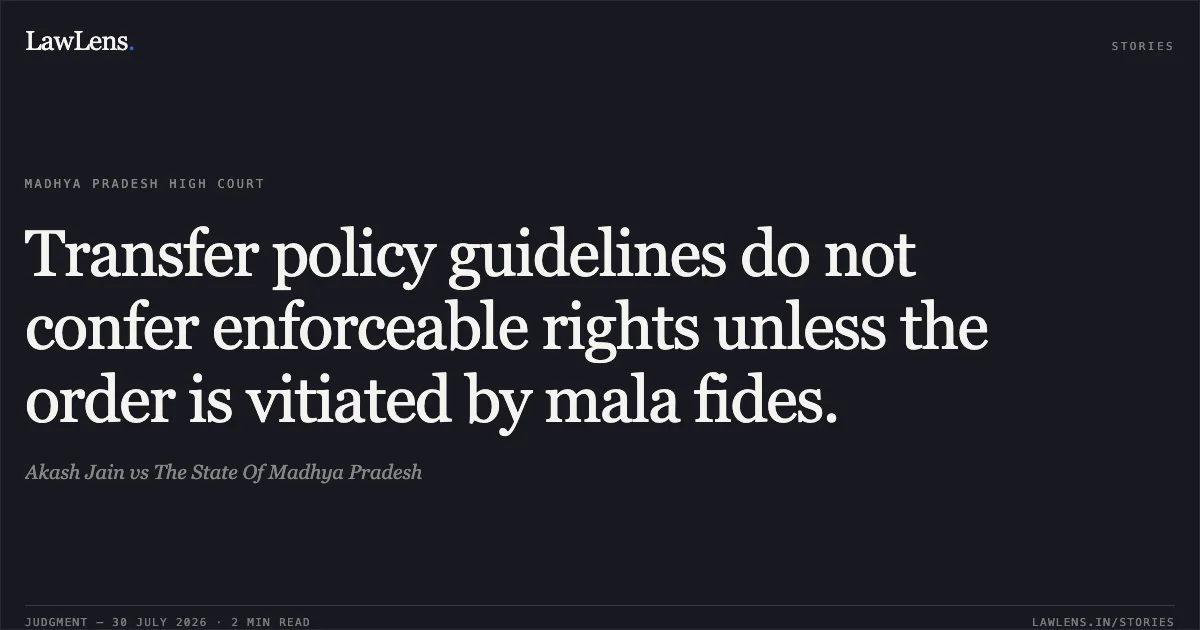
Source reference: para. 6Crucially, the court applied the doctrine from State of U.P. v. Gobardhan Lal [(2004) 11 SCC 402], which clarifies that administrative guidelines or transfer policies do not confer legally enforceable rights and their transgression does not warrant judicial interference.
Source reference: para. 10, 14Reasoning
The Court observed that the petitioner failed to demonstrate any violation of statutory provisions or prove that the authority (the Collector) lacked the competence to issue the order.
Source reference: para. 15Regarding the petitioner's plea of personal hardship and the "ban period" under the Transfer Policy, the Court noted that while authorities should consider representations regarding such difficulties, these do not justify evading a transfer order unless it is stayed or modified by the department itself.
Source reference: para. 7, 11The Court found that the petitioner had "deliberately omitted" details of his previous stay at Ashoknagar, indicating a lack of transparency.
Source reference: para. 5Since the transfer was part of a larger administrative exercise involving nine other employees and was not shown to be an outcome of mala fide exercise of power, the Court refused to substitute its decision for that of the administrative authorities.
Source reference: para. 5, 10, 12Holding
The Court answered the issues in the negative, holding that transfer is a condition of service and the petitioner has no legal right to remain at a specific post.
The Court held that even if a transfer transgresses administrative guidelines (such as a ban period), it cannot be interfered with unless it is vitiated by mala fides or statutory violations, none of which were proven here. Consequently, the Writ Petition was dismissed as being without substance.
Source reference: para. 14-16Original Court PDF
Akash JainvsThe State Of Madhya Pradesh
Click to open original judgment
Original judgment, available to read, download and summarize on LawLens.in