Facts
The petitioner challenged an order dated January 3, 2026, passed by a Senior Civil Judge-cum-Rent Controller ("predecessor judge") in RC ARC No. 5135/16.
Source reference: para. 1Final arguments in the matter concluded on August 20, 2025, and the case was reserved for judgment on September 17, 2025.
Source reference: para. 4Subsequently, the predecessor judge was transferred via an official notification dated October 17, 2025.
Source reference: para. 6Despite being listed multiple times for pronouncement, the predecessor judge eventually released the matter from the stage of judgment on January 3, 2026, citing the need for "clarifications" and the fact of their transfer, directing the file to be sent to a successor judge for further proceedings.
Source reference: para. 5The petitioner contended this would cause undue delay and violated the High Court’s transfer guidelines.
Source reference: para. 3Issues
1. Whether a judicial officer who has reserved a judgment prior to transfer is obligated to pronounce the same notwithstanding their relocation to a different court.
Source reference: para. 3, 72. Whether the predecessor judge was justified in releasing the case from the stage of judgment for "clarifications" after the matter had been reserved for a considerable period.
Source reference: para. 8Law Applied
The Court primarily applied Article 227 of the Constitution of India regarding the High Court's supervisory jurisdiction.
Source reference: para. 1It relied on the administrative mandate of Transfer Order No. 41/DHC/Gaz/G-7/VI.E.2(a)/2025, specifically Note 2, which requires transferred officers to notify cases with reserved judgments and pronounce orders within 2-3 weeks of relinquishing charge.
Source reference: para. 6Furthermore, the Court followed the precedent set in Parvesh Mann @ Sagar Mann v. State (NCT of Delhi) and B.D. Sharma vs. State of NCT of Delhi & Anr., which establish that once final arguments are heard, a judge is bound to pronounce judgment to avoid defeating the mandate of transfer orders and causing avoidable delays.
Source reference: para. 7Reasoning
The Court observed that the matter remained reserved for judgment for approximately four months with the predecessor judge.
Source reference: para. 8It found the predecessor judge’s reasoning—that "clarifications" were necessary—to be unjustified given the length of time the case was held.
Source reference: para. 8The Court reasoned that directing a rehearing by a successor judge not only violates the specific instructions contained in the High Court’s transfer order but also imposes an unnecessary burden on the judiciary and litigants by duplicating efforts.
Source reference: para. 7The High Court emphasized that the transfer order expressly permits and requires judicial officers to pronounce judgments in matters reserved before their transfer, "notwithstanding the posting/transfer".
Source reference: para. 6Holding
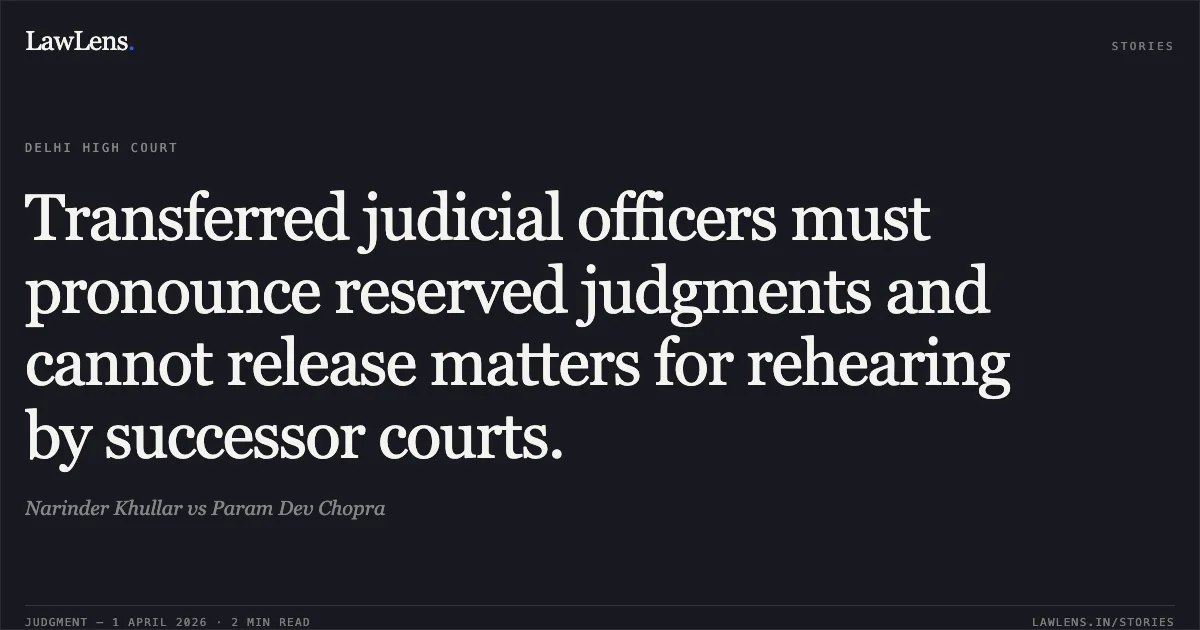
The Court set aside the impugned order dated January 3, 2026, holding that the predecessor judge is legally bound to pronounce the judgment.
The Court directed that RC ARC 5135/16 be transferred from the South East District (Saket Courts) to the predecessor judge, currently posted as CJM, Shahdara (Karkardooma Courts), specifically for the purpose of pronouncing the judgment.
Source reference: para. 9The petition was disposed of with directions for immediate compliance.
Source reference: para. 10-11Original Court PDF
Narinder KhullarvsParam Dev Chopra
Click to open original judgment
Original judgment, available to read, download and summarize on LawLens.in