Facts
The land comprised in Survey Nos. 87/1, 110, 111, 112 and 113 originally belonged to the petitioners’ predecessor, who transferred it to the predecessor of respondent Nos. 6.1 and 6.2 through a registered sale deed dated 30 April 1968; the sale was followed by revenue-entry proceedings.
Source reference: para. 2.1Since Survey No. 87/1 measured 0-48-57 sq. mtrs., proceedings under the Bombay Prevention of Fragmentation and Consolidation of Holdings Act, 1947 (“Fragmentation Act”) were initiated, but were later terminated by order dated 19 May 2009, resulting in mutation of Entry No. 288.
Source reference: para. 2.2The purchaser’s subsequent Entry No. 293 was rejected by the Circle Officer, and his RTS appeal was dismissed on 2 July 2012, with a direction to take Entry No. 288 into revision.
Source reference: paras. 2.3–2.4In proceedings under the Fragmentation Act, the Deputy Collector, Savli, by order dated 25 June 2014, upheld Entries Nos. 293 and 288 and held that the Act had not been violated.
Source reference: para. 2.6The petitioners challenged that order before the Special Secretary, Revenue Department (“SSRD”) in Revision Application No. MVV/CON/VDD/1/2016. The SSRD rejected the revision on the ground of approximately two years’ delay.
Source reference: para. 2.7The petitioners consequently invoked Articles 226 and 227 of the Constitution and sought quashing of the SSRD’s order and adjudication of the revision on merits.
Source reference: para. 1Issues
Whether the SSRD was justified in rejecting the petitioners’ revision application solely on the ground of delay, instead of deciding the challenge to the Deputy Collector’s order on merits?
Source reference: paras. 4, 7Whether, in view of the subsequent amendment to Section 9 of the Fragmentation Act regularising transfers made between 29 January 1948 and 31 March 2026, any useful purpose would be served by remanding the matter to the SSRD?
Source reference: paras. 5, 8–11Whether the petitioners, having executed the registered sale deed and received the sale consideration, retained locus standi to challenge the purchaser’s title or the consequential revenue entries?
Source reference: paras. 12–13Law Applied
The Court exercised jurisdiction under Articles 226 and 227 of the Constitution and considered the Bombay Prevention of Fragmentation and Consolidation of Holdings Act, 1947, whose object is to prevent fragmentation of agricultural holdings and promote their consolidation and efficient management.
Source reference: paras. 1, 8It applied the principle that, ordinarily, a meritorious matter should not be rejected at the threshold on hyper-technical grounds of delay and that delay-condonation matters should generally receive a merits-oriented consideration.
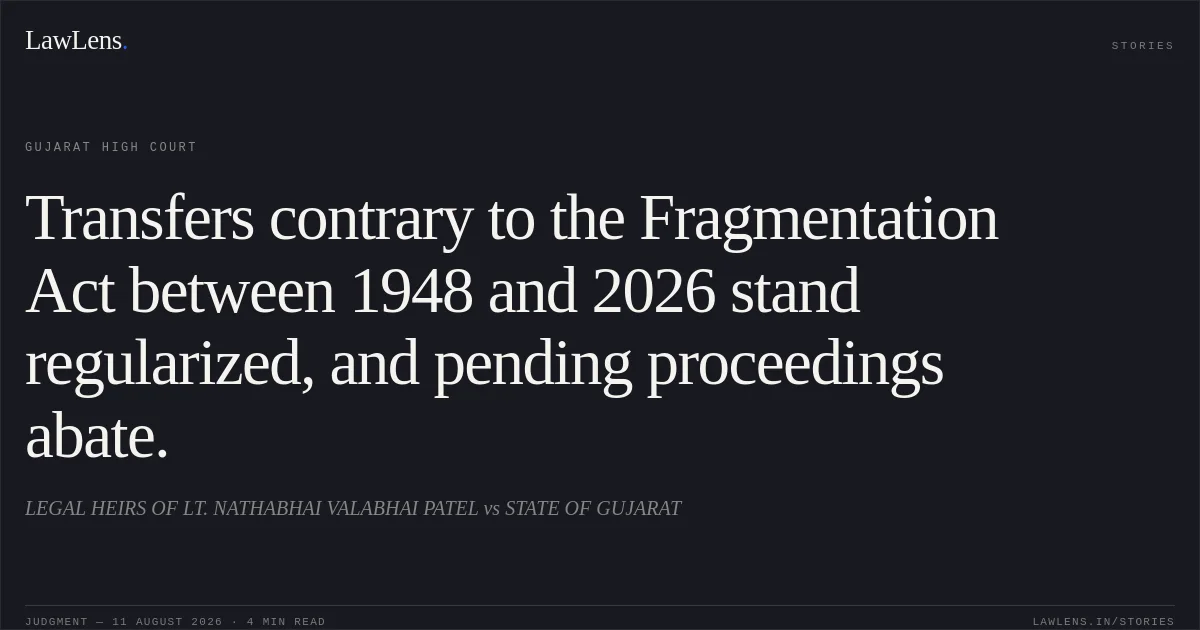
Source reference: para. 7The Court also relied on the amendment to Section 9, particularly the newly inserted Section 9(4), under which a transfer or partition contrary to the Act made on or after 29 January 1948 and on or before 31 March 2026 is deemed regularised without penalty or premium, and pending proceedings concerning such transfer or partition abate.
Source reference: paras. 8–10Section 5(4), as referred to in the judgment, empowers the State Government to declare a standard area for any class of land in a local area.
Source reference: para. 9The Court further relied on Narendrabhai Maganbhai Patel v. State of Gujarat, 2019 (1) GLH 33, for the principle that original owners who have executed a registered sale deed and received consideration cannot indirectly seek to defeat the purchaser’s title by belatedly invoking fragmentation proceedings.
Source reference: para. 12Reasoning
The Court observed that the SSRD had assigned cogent reasons for refusing to condone the approximately two-year delay, but held that, as a general principle, the revision ought ordinarily to have been considered on merits rather than rejected at the threshold.
Source reference: para. 7Nevertheless, the Court found that the subsequent statutory amendment rendered a remand futile. The registered sale deed was dated 30 April 1968, which fell within the statutory period covered by Section 9(4); accordingly, any transfer contrary to the Fragmentation Act stood deemed regularised and pending proceedings relating to it stood abated.
Source reference: paras. 9–11The Court further reasoned that the petitioners’ predecessor had voluntarily transferred the land and received the entire sale consideration, and therefore could not belatedly challenge the purchaser’s rights or use the Fragmentation Act to obtain an indirect advantage after the sale.
Source reference: paras. 12–13On these grounds, although the Court disapproved of deciding a potentially meritorious matter solely on delay in principle, it concluded that no effective relief could result from reopening the revision.
Source reference: paras. 7, 10–13Holding
The petition was rejected.
The Court held that, in light of the retrospective regularisation introduced by Section 9(4) of the Fragmentation Act, the 1968 sale transaction was covered by the statutory deeming provision and no useful purpose would be served by remanding the matter to the SSRD for a merits decision.
Source reference: paras. 10–13The petitioners’ challenge was therefore dismissed, Rule was discharged, and interim relief was vacated.
Source reference: para. 14Acts & Sections Cited
3 provisions across 1 statute referred to in this judgment. Linked provisions open on LawLens.
Bombay Prevention of Fragmentation and Consolidation of Holdings Act, 19473
Original Court PDF
LEGAL HEIRS OF LT. NATHABHAI VALABHAI PATELvsSTATE OF GUJARAT
Click to open original judgment
Original judgment, available to read, download and summarize on LawLens.in