Facts
The petitioner was referred to the Foreigners Tribunal by the Superintendent of Police Border, Bongaigaon, under Reference No. BNGN/FT/1663/2003 on suspicion of being an illegal migrant
Source reference: p. 2The petitioner filed a written statement claiming Indian citizenship by birth, asserting his parents' names (Sadar Ali and Mojiran Nessa) appeared in the 1966 and 1970 electoral rolls in Bhutkura village
Source reference: p. 3-4He produced 14 documents and evidence from himself (DW1) and his brother (DW2), who had previously been declared a non-foreigner in a 2010 proceeding
Source reference: p. 3-5The Foreigners Tribunal No. 2, Abhayapuri, via judgment dated 15/02/2019, declared the petitioner a foreigner who entered India after 25/03/1971
Source reference: p. 2The petitioner challenged this opinion via the present writ petition
Source reference: p. 2Issues
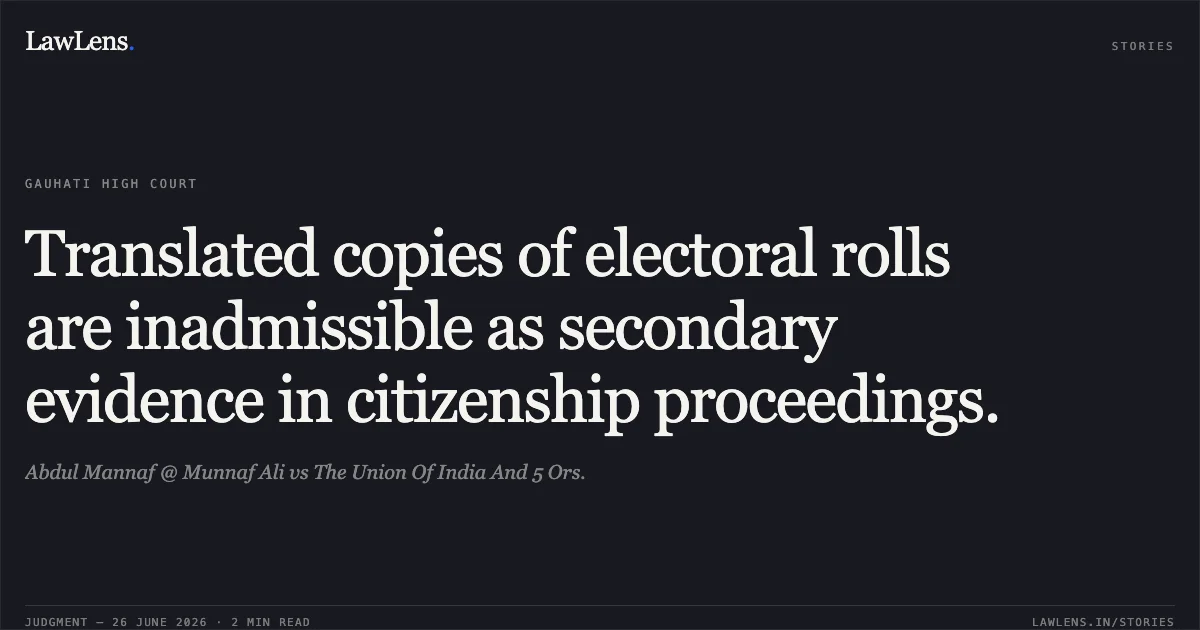
1. Whether the translated copies of electoral rolls produced by the petitioner are admissible as secondary evidence to prove citizenship and linkage
Source reference: p. 7-82. Whether a self-sworn affidavit regarding variations in names of family members carries evidentiary value
Source reference: p. 8-93. Whether a previous court finding declaring a sibling as a non-foreigner automatically entitles the petitioner to the same status
Source reference: p. 9Law Applied
The court primarily applied Section 9 of the Foreigners Act, 1946, which places the burden of proof on the person suspected of being a foreigner
Source reference: p. 8It applied Sections 63, 65, 66, 74, and 76 of the Indian Evidence Act, 1872, regarding the admissibility of secondary and public documents
Source reference: p. 7-8The court relied on Isiran Nessa v. Union of India, establishing that translated copies of documents are not certified copies and cannot be treated as secondary evidence
Source reference: p. 7It further cited Musstt. Ayesha Khatun v. Union of India regarding the necessity of disclosing all material facts in the written statement
Source reference: p. 8The court cited Romila Khatun v. Union of India, which held that self-serving affidavits are not proof under the Evidence Act or the CPC
Source reference: p. 9Reasoning
The court found that the petitioner failed to discharge his burden of proof under Section 9 of the Foreigners Act.
Source reference: p. 7-8The primary documents relied upon for linkage—electoral rolls from 1985, 1997, and 2011—were merely translated copies, which the court held to be inadmissible as secondary evidence because they lacked certification by a competent authority as required by the Evidence Act
Source reference: p. 7-8The court rejected the petitioner's self-sworn affidavit (Exhibit G) intended to explain discrepancies in his father's multiple aliases, ruling that such "self-serving" documents do not constitute legal proof
Source reference: p. 8-9Regarding the petitioner's brother (DW2), the court reasoned that citizenship proceedings function on an individual basis; a favorable order for one family member does not automatically confer citizenship on another, as each proceedee must independently satisfy the court on the merits of their own case
Source reference: p. 9Holding
The Court answered the issues in the negative, holding that the petitioner failed to establish a valid legal linkage to Indian ancestors.
The Gauhati High Court upheld and confirmed the Foreigners Tribunal's opinion dated 15/02/2019, declaring the petitioner a foreigner of the post-25/03/1971 stream. The writ petition was dismissed, and all interim orders were vacated
Source reference: p. 9Acts & Sections Cited
1 provisions across 1 statute referred to in this judgment. Each provision opens on LawLens.
Code of Civil Procedure, 19081
Original Court PDF
Abdul Mannaf @ Munnaf AlivsThe Union Of India And 5 Ors.
Click to open original judgment
Original judgment, available to read, download and summarize on LawLens.in