Facts
The prosecution alleged that the deceased and the appellant had married in July 2014. On 7 November 2014, she was travelling in the appellant’s auto when she fell and sustained serious injuries. PW10 and PW12 said they helped take her to hospital, and PW1 was informed that she had been in an accident. She died the following day.
Source reference: p. 3–7The initial complaint alleged an accident; after the post-mortem recorded injuries around the neck and genitalia, the police altered the offences and filed a final report. The Sessions Court convicted the appellant under Sections 366, 376(B), 302 and 201 read with 302 IPC. He appealed against the conviction and sentence.
Source reference: p. 3–7Issues
Whether the prosecution evidence proved beyond reasonable doubt that the appellant committed the offences for which he was convicted, including causing the deceased’s death
Source reference: p. 8–10, 20–23Whether the medical evidence, considered alongside the evidence about the deceased’s treatment and the witnesses’ accounts, established homicidal death and sexual assault attributable to the appellant
Source reference: p. 9–12, 15–22Law Applied
The appeal was brought under Section 415(2) of the BNSS.
Source reference: p. 1The conviction concerned Sections 366, 376(B), 302 and 201 read with 302 of the IPC.
Source reference: p. 1–2The Court applied the principle that a criminal charge must be established by cogent and concrete evidence and cannot be proved merely by inference; the prosecution evidence must sufficiently connect the accused to the offences.
Source reference: p. 14, para. 23Reasoning
The Court found that PW10 and PW12 supported the account that the deceased fell from the auto and was taken to hospital with the appellant, while PW1’s initial information was that she had suffered an accident.
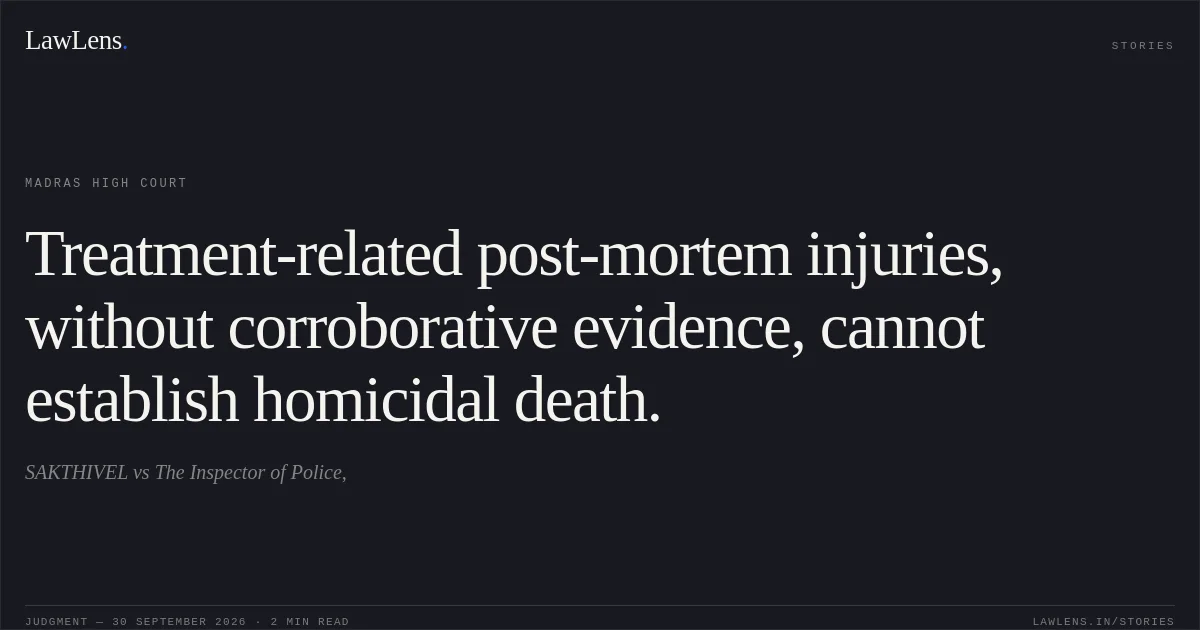
Source reference: p. 10–11, paras. 14–15It considered the post-mortem findings against the CMC records, which documented severe head injury and intensive treatment, including intubation and ventilation. The Court regarded the neck and genital injuries as potentially treatment-related and found the medical evidence insufficient to establish sexual assault or death by strangulation attributable to the appellant.
Source reference: p. 11–12, 14, paras. 15–18, 22It also found no reliable evidence that the appellant had taken the deceased to the alleged place of occurrence and treated the family witnesses’ evidence with caution in light of their opposition to the marriage.
Source reference: p. 12–13, 20–21In the Court’s view, the evidence did not establish the charges to the required standard.
Source reference: p. 14, para. 23Holding
The Court held that the charges had not been proved by sufficient legal evidence and allowed the appeal. It set aside the Sessions Court’s judgment and acquitted the appellant;
any fine paid was ordered to be refunded, his bail bond discharged, and the connected miscellaneous petition closed.
Source reference: p. 14–15, paras. 23–24Acts & Sections Cited
7 provisions across 3 statutes referred to in this judgment. Each provision opens on LawLens.
Bharatiya Nagarik Suraksha Sanhita, 20231
Indian Penal Code, 18604
Code of Criminal Procedure, 19732
Original Court PDF
SAKTHIVELvsThe Inspector of Police,
Click to open original judgment
Original judgment, available to read, download and summarize on LawLens.in