Facts
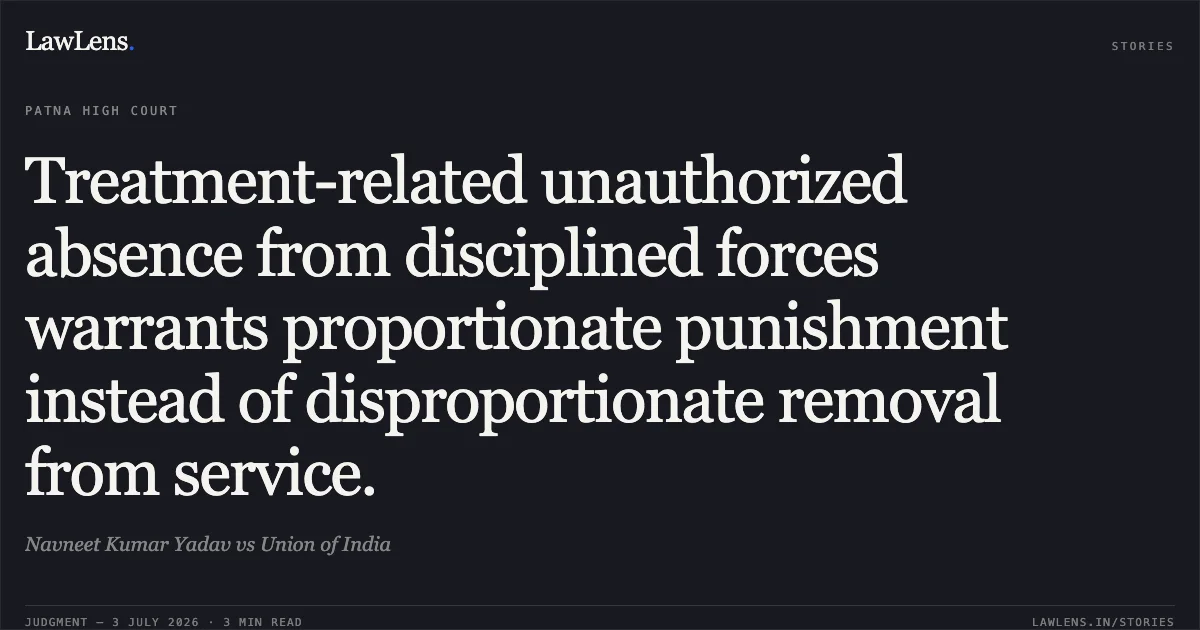
The petitioner was appointed as a Constable/GD in the CISF at Patna in 2017.
Source reference: para 2While undergoing training in Bhilai, he was granted 7 days of leave from 18.10.2018.
Source reference: para 2Due to a serious spinal ailment requiring treatment at Darbhanga Medical College Hospital (DMCH), Bihar, he sought extensions but ultimately remained absent for 137 days.
Source reference: para 3, 9, 10A departmental enquiry found him guilty of unauthorized absence, leading to his removal from service, which was upheld in appeal and revision.
Source reference: para 3, 30The petitioner challenged these orders before the Patna High Court, while the Union of India raised a preliminary objection regarding territorial jurisdiction, as the proceedings occurred in Odisha and Chhattisgarh.
Source reference: para 5Issues
1. Whether the Patna High Court has territorial jurisdiction to entertain the writ petition when the disciplinary proceedings and orders took place outside Bihar.
Source reference: para 14, 152. Whether the punishment of removal from service for 137 days of unauthorized absence is disproportionate to the gravity of the misconduct.
Source reference: para 11, 33Law Applied
The court applied Article 226(2) of the Constitution of India, which allows a High Court to issue writs if the cause of action arises, wholly or in part, within its territories.
Source reference: para 15It relied on Kusum Ingots Alloys Ltd. v. Union of India regarding the "integral facts" of cause of action and the doctrine of forum conveniens.
Source reference: para 18, 19It further cited Nawal Kishore Sharma v. Union of India, which established that communication of rejection to a native place where a person is forced to stay due to disability can constitute a part of the cause of action.
Source reference: para 25On the merit of punishment, the court applied the principle of proportionality as seen in Yasodhar Kamat v. DG, BSF.
Source reference: para 36The court applied the Division Bench ruling in Sumit Kumar @ Sumit Kumar Tiwary v. Union of India, which held that absence due to compelling circumstances should not result in dismissal.
Source reference: para 37Reasoning
On jurisdiction, the court reasoned that since the petitioner was initially appointed in Patna, fell ill in Bihar, underwent treatment at DMCH, and made all correspondences explaining his medical condition from his native place, a fraction of the cause of action arose within Bihar.
Source reference: para 27, 31, 32On merits, the court noted that the petitioner did not "abandon" duty but failed to report due to a documented spinal ailment.
Source reference: para 34While unauthorized absence in a disciplined force is serious, the court found that the petitioner had submitted medical prescriptions and representations for extensions.
Source reference: para 29, 34Applying the test of proportionality, the court held that the penalty of removal "shocks the conscience of the Court" as the absence was not willful but due to medical necessity, and the petitioner had joined duty immediately upon recovery.
Source reference: para 35, 39Holding
The court rejected the jurisdictional objection and allowed the writ petition.
It set aside the orders of removal, appeal, and revision.
Source reference: para 39, 40The court directed the respondents to reinstate the petitioner within two months but ruled he is not entitled to back wages for the period out of service, though the period is to be counted notionally for benefits.
Source reference: para 41, 42The unauthorized absence is to be treated as leave to his credit while allowing the authorities to impose a minor penalty or warning.
Source reference: para 41Acts & Sections Cited
2 provisions across 1 statute referred to in this judgment. Each provision opens on LawLens.
Code of Civil Procedure, 19082
Original Court PDF
Navneet Kumar YadavvsUnion of India
Click to open original judgment
Original judgment, available to read, download and summarize on LawLens.in