Facts
Following an FIR registered in 2019 under Section 363 IPC (later adding Sections 328/376 IPC and Section 4 POCSO Act) regarding a missing minor, several Investigating Officers (IOs) handled the case.
Source reference: p. 2-3During the hearing of an anticipatory bail application filed by a co-accused, the learned Additional Sessions Judge (ASJ) noted delays in the investigation and, vide order dated 22.02.2022, called for status reports and directed the previous IOs and SHOs to appear in person.
Source reference: p. 3Despite disposing of the bail application, the ASJ continued the proceedings, subsequently ordering departmental enquiries and seeking explanations from various police officials, including high-ranking IPS officers, for alleged supervisory lapses.
Source reference: p. 3-4Issues
1. Whether a Court becomes functus officio regarding ancillary directions after the final disposal of a bail application.
Source reference: p. 4, para. 82. Whether a Trial Court exceeds its jurisdiction by directing and monitoring departmental disciplinary proceedings against police officials.
Source reference: p. 5, para. 103. Whether adverse remarks and directions for enquiry can be passed without affording the affected officials an opportunity to be heard.
Source reference: p. 5, para. 9Law Applied
The Court relied on Section 439 of the Cr.P.C., asserting that jurisdiction is limited to the grant or refusal of bail.
Source reference: p. 7, para. 13It applied the principle from State v. M. Murugesan, which holds that courts cannot issue directions to "improve the system" under the color of a bail order.
Source reference: p. 7, para. 13Precedents including State of West Bengal v. Mir Mohammad Omar and Om Prakash Chautala v. Kanwar Bhan were cited to establish that disparaging remarks against officials should not be made without a hearing and are only permissible when absolutely necessary for adjudication.
Source reference: p. 5, 8Furthermore, State v. Yogender Singh established that monitoring disciplinary proceedings encroaches upon the administrative domain of the Police Department.
Source reference: p. 5, para. 10Reasoning
The High Court reasoned that the ASJ became functus officio the moment the anticipatory bail application was disposed of; consequently, retaining the matter on the board to monitor investigative delays was "completely unwarranted".
Source reference: p. 7, para. 14-15The Court observed that while the ASJ’s concern regarding investigative delay was laudable, the "means and manner" of directing departmental enquiries exceeded the court's statutory remit.
Source reference: p. 10, para. 18By passing adverse remarks and initiating enquiries without issuing notice to the petitioners, the ASJ violated the principles of natural justice.
Source reference: p. 7, para. 15The Court emphasized that a judge's function is to salvage justice despite investigative flaws, not to waste judicial time castigating officers for perfunctory investigations, especially when such officers are not parties to the bail plea.
Source reference: p. 8-9, para. 16Holding
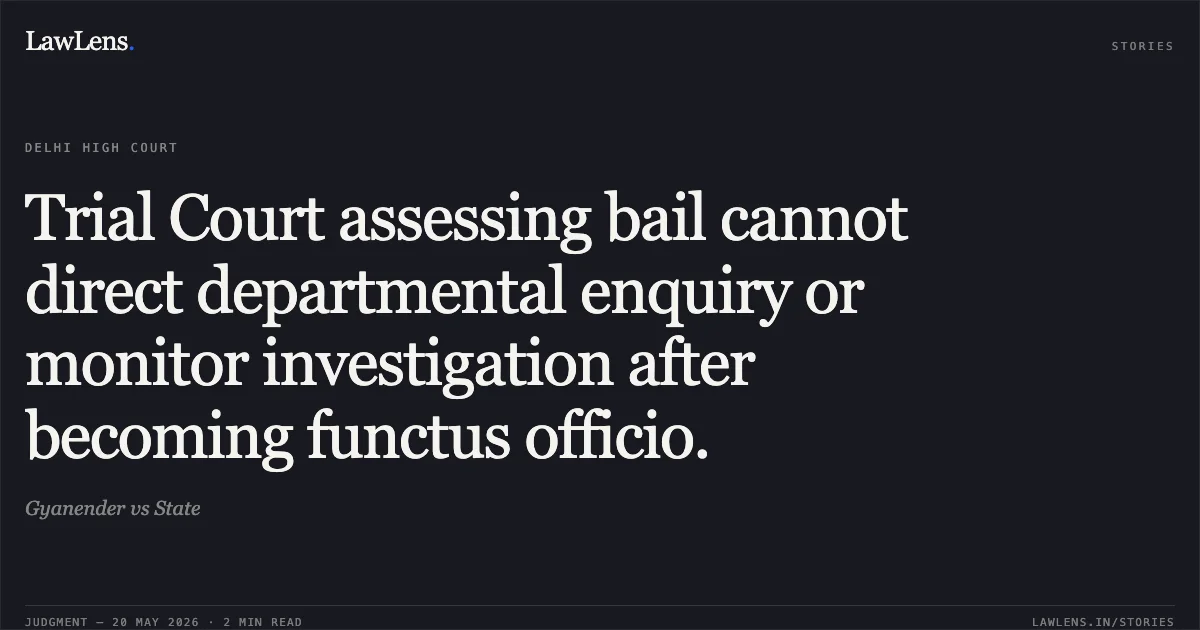
The Court held that a Trial Court cannot pass strictures or monitor disciplinary actions while exercising bail jurisdiction.
The High Court allowed the petitions and set aside the impugned order dated 22.02.2022 and all consequential directions.
Source reference: p. 10, para. 19All adverse remarks against the petitioners were expunged.
Source reference: p. 10, para. 19The Court directed that the judgment be circulated to all District Judges to ensure Trial Courts refrain from similar judicial overreach in bail matters.
Source reference: p. 10, para. 21Acts & Sections Cited
1 provisions across 1 statute referred to in this judgment. Each provision opens on LawLens.
Protection of Children from Sexual Offences Act, 20121
Original Court PDF
GyanendervsState
Click to open original judgment
Original judgment, available to read, download and summarize on LawLens.in