Facts
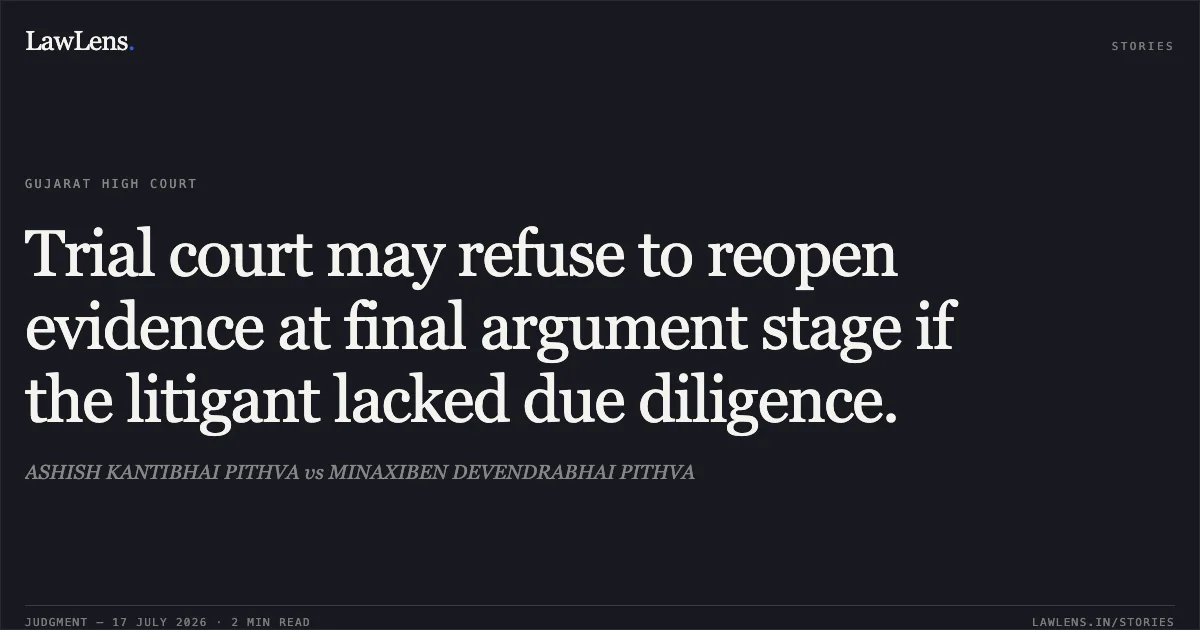
The petitioner (original defendant No. 5) challenged two orders dated 09.04.2026 passed by the Principal Civil Judge, Ahmedabad (Rural) in a 2010 suit concerning HUF properties.
Source reference: p. 2-4The Trial Court had twice previously reopened the defendant’s right to lead evidence after earlier foreclosures, once upon payment of costs.
Source reference: p. 9-10After the defendant's cross-examination concluded on 02.05.2025, the Trial Court closed the defendant’s right to lead further evidence on 04.10.2025 due to inaction.
Source reference: p. 10Only after the plaintiff completed final oral arguments on 07.01.2026 did the defendant file applications (Exhibits 195 and 196) to reopen the evidence stage and issue witness summons to bankers.
Source reference: p. 10-11Issues
1. Whether the Trial Court erred in refusing to reopen the defendant's right to lead evidence and issue witness summons at the stage of final arguments.
Source reference: p. 4-52. Whether the defendant demonstrated "compelling and acceptable reasons" to justify reopening evidence after multiple prior opportunities were granted.
Source reference: p. 13-14Law Applied
The court applied the principles of the Code of Civil Procedure (CPC) as interpreted by the Supreme Court in Bagai Construction v. Gupta Building Material Store (2013), which holds that applications for reopening or recalling witnesses are interim measures to be avoided unless there are "compelling and acceptable reasons," especially to prevent filling lacunae in pleadings or evidence.
Source reference: p. 8, 13-14K.K. Velusamy v. N. Palanisamy (2011) regarding the court's inherent power under Section 151 CPC to reopen evidence, while noting that such power must be used sparingly to ensure the object of the CPC amendments (expeditious trial) is not defeated.
Source reference: p. 6, 13Standard for writ jurisdiction under Article 227 of the Constitution, which limits interference to cases of perversity or egregious error as per Sameer Suresh Gupta v. Rahul Kumar Agarwal.
Source reference: p. 15Reasoning
The court found the petitioner-defendant to be an "indolent litigant" who failed to exercise due diligence despite the suit being 16 years old and despite the Trial Court previously granting two opportunities to lead evidence.
Source reference: p. 11-12The court noted that the defendant sought to examine bankers regarding accounts not mentioned in the original pleadings or oral evidence, suggesting an attempt to fill lacunae rather than address a bona fide oversight.
Source reference: p. 14-15The court reasoned that since the plaintiff’s oral and written arguments were already completed/submitted, granting the applications at such a late stage would frustrate the objective of a timely trial.
Source reference: p. 12-13The court concluded that no perversity existed in the Trial Court's decision to prioritize procedural finality over the defendant’s belated request.
Source reference: p. 15Holding
The court held that while procedural rules are handmaids of justice, they cannot be used to protect a party who remains silent for years and fails to utilize multiple opportunities granted by the court.
The petitioner failed to establish any egregious error or perversity required for interference under Article 227.
Source reference: p. 15The High Court dismissed both petitions, upholding the Trial Court’s orders dated 09.04.2026. No costs were awarded.
Source reference: p. 16Acts & Sections Cited
1 provisions across 1 statute referred to in this judgment. Each provision opens on LawLens.
Code of Civil Procedure, 19081
Original Court PDF
ASHISH KANTIBHAI PITHVAvsMINAXIBEN DEVENDRABHAI PITHVA
Click to open original judgment
Original judgment, available to read, download and summarize on LawLens.in