Facts
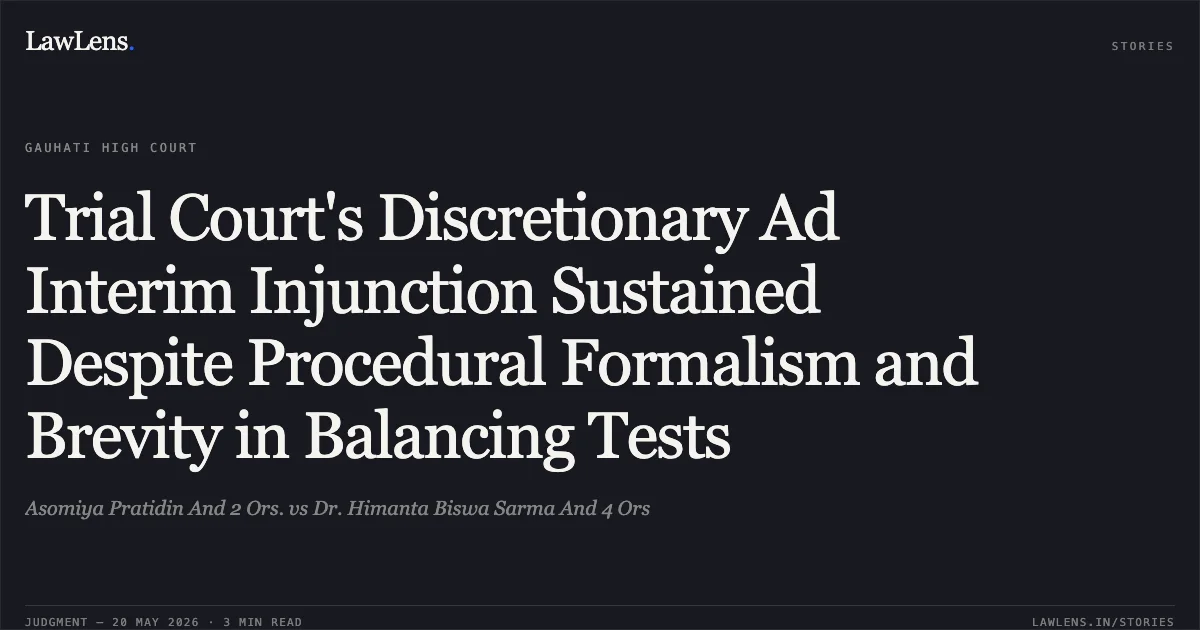
The Appellants (a newspaper and its management) challenged an ex-parte ad-interim injunction order dated 11.02.2026 passed by the Civil Judge (Senior Division) No. 1, Kamrup (M)
Source reference: p. 4, 6The Respondent No. 1 (the Chief Minister of Assam) filed a defamation suit (Title Suit No. 85/2026) seeking ₹500 Crores in damages and a permanent injunction regarding news items published on 05.02.2026
Source reference: p. 4-5These reports alleged that the Respondent and his family were involved in land grabbing (12,000 Bighas) and various scams
Source reference: p. 5-6The Trial Court granted the ex-parte injunction restraining further publication of such defamatory material until the appearance of the defendants
Source reference: p. 6-7The Appellants argued that the injunction stifled public debate and was granted without a finding of malice or falsehood
Source reference: p. 7Issues
1. Whether the Trial Court exercised its discretion arbitrarily or perversely in granting the ex-parte ad-interim injunction without a full-fledged trial
Source reference: p. 7-8 / para. 10-112. Whether the appeal is maintainable given the absence of a specific sub-clause in the cause title (Order 43) and the lack of a formal prayer portion in the memo of appeal
Source reference: p. 9-10 / para. 14-15Law Applied
The Court applied Order 43 Rule 1(r) regarding appeals from interim orders and Order 41 Rule 1(2) concerning the contents of a memorandum of appeal
Source reference: p. 14, 16It relied on Bloomberg Television Production Services v. Zee Entertainment regarding the cautious approach required for pre-trial injunctions against media
Source reference: p. 8It applied the principle from Wander Ltd. v. Antox India P. Ltd., which restricts appellate interference in discretionary orders unless they are arbitrary, capricious, or perverse
Source reference: p. 8, 17Regarding procedural defects, it cited Pournami Oil Mills v. State of Kerala, holding that non-mentioning of a specific statutory provision does not invalidate an application if the power exists
Source reference: p. 14For the definition of "perversity," the court used the "working test" from Associate Builders v. DDA, focusing on whether the finding defies logic or ignores relevant material
Source reference: p. 18-19Reasoning
The High Court first addressed maintainability, ruling that the failure to specify Order 43 Rule 1(r) was a curable defect that did not affect the merits
Source reference: p. 16It further held that while a prayer portion is desirable, Order 41 Rule 1(2) does not strictly mandate it for an appeal memo to be valid
Source reference: p. 16On merits, the Court found that the Trial Court did not act perversely. The Trial Court had identified a prima facie case, balance of convenience, and the risk of irreparable injury/multiplicity of suits
Source reference: p. 16-17, 19The High Court noted that the Respondent No. 1 had denied the allegations on oath and that the Appellants had not yet filed a written objection or sought to vacate the order at the Trial Court level despite appearing there
Source reference: p. 11-12, 17Given that the injunction was temporary and the matter was listed for hearing immediately (14.05.2026), the High Court declined to substitute its discretion for that of the Trial Court
Source reference: p. 19-20Holding
The Court held that the impugned order was not perverse or arbitrary, as it was based on an acceptable assessment of reputational harm and the potential for successive defamatory publications
The appeal was disposed of without interfering with the injunction. The Court directed the Appellants to file their objections before the Trial Court and ordered the Trial Court to dispose of the injunction application (Misc. (J) Case No. 156/2026) expeditiously after hearing both sides
Source reference: p. 20Acts & Sections Cited
2 provisions across 1 statute referred to in this judgment. Each provision opens on LawLens.
Code of Civil Procedure, 19082
Original Court PDF
Asomiya Pratidin And 2 Ors.vsDr. Himanta Biswa Sarma And 4 Ors
Click to open original judgment
Original judgment, available to read, download and summarize on LawLens.in