Facts
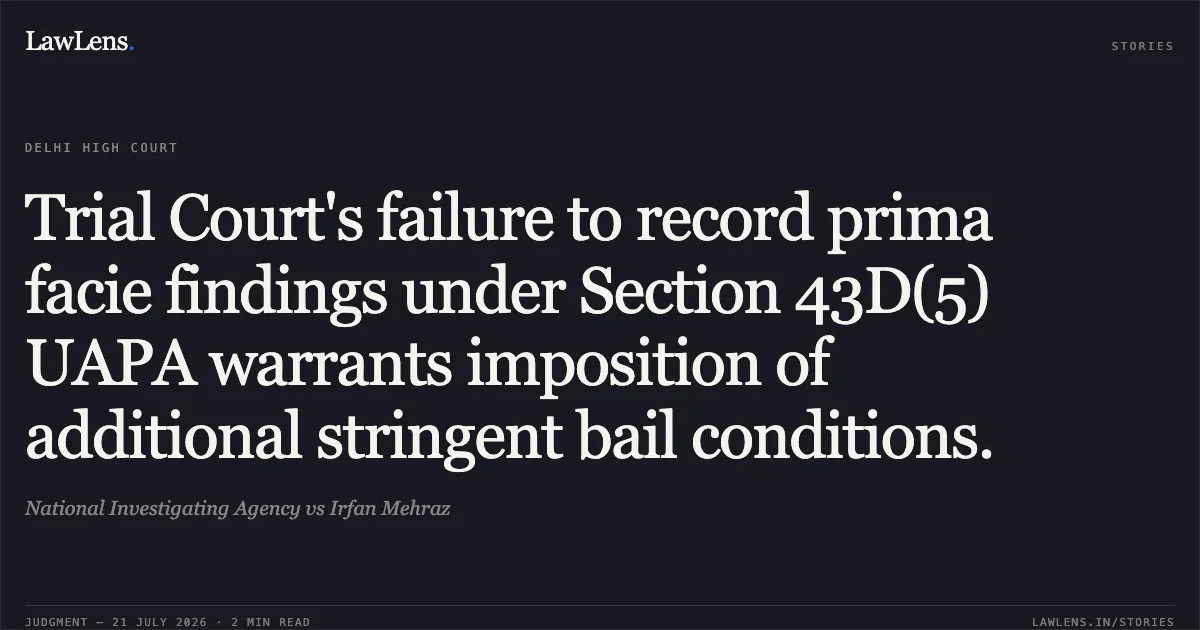
The National Investigation Agency (NIA) appealed against the orders dated July 18, 2026, passed by the Principal District & Sessions Judge, Patiala House Courts, which granted regular bail to the Respondents.
Source reference: p. 2The Respondents were charged under Sections 120B and 124A of the IPC and Sections 17, 18, 22A, 22C, 38, 39 & 40 of the Unlawful Activities (Prevention) Act (UAPA), 1967.
Source reference: p. 2The NIA alleged the Respondents used the Jammu & Kashmir Coalition of Civil Society (JKCCS) as a front to raise foreign funds for the proscribed terrorist organization Hizbul Mujahideen and facilitate secessionist activities.
Source reference: p. 3-4The Trial Court granted bail primarily because the evidence was based on oral testimony and the trial was at an early stage.
Source reference: p. 9-10Issues
1. Whether the Trial Court erred in granting bail without recording a finding under the proviso to Section 43D(5) of the UAPA regarding the prima facie truth of the accusations.
Source reference: p. 72. Whether additional stringent conditions should be imposed on the Respondents pending the final disposal of the NIA's appeal to safeguard national security.
Source reference: p. 10Law Applied
The Court primarily considered Section 43D(5) of the UAPA, which mandates that an accused shall not be released on bail if the Court, on a perusal of the case diary or report, is of the opinion that there are reasonable grounds for believing that the accusation against such person is prima facie true.
Source reference: p. 7, 9It also considered the discretionary powers under Section 439 of the Cr.P.C. regarding the imposition of bail conditions to ensure the integrity of the trial and public order.
Source reference: p. 5-7Reasoning
The High Court observed that the Trial Court failed to satisfy the statutory mandate of Section 43D(5) of the UAPA, as it did not reach a prima facie conclusion regarding the innocence or guilt of the Respondents based on the materials on record.
Source reference: p. 9The High Court noted that while the Trial Court focused on the oral nature of the evidence and potential trial delays, the NIA's chargesheet actually relied on documentary evidence which the lower court ignored.
Source reference: p. 10Rather than staying the bail orders—since the Trial Court is not a Constitutional Court and should have followed the statute strictly—the High Court decided to scrutinize the mandate itself in further hearings.
Source reference: p. 10In the interim, given the gravity of the allegations involving secessionism and terrorism, the Court found it necessary to augment the existing bail conditions to prevent any prejudice to national interest or the pending trial.
Source reference: p. 10-11Holding
The High Court declined to stay the operation of the impugned bail orders but imposed six additional stringent conditions on the Respondents.
These include: reporting to the NIA Chief Investigating Officer twice weekly; refraining from associating with the JKCCS or similar organizations; and a total prohibition on addressing rallies, circulating materials, or communicating with co-accused or international contacts related to the case.
Source reference: p. 10-11The Court further directed that the Trial Court's orders shall not be treated as a precedent and scheduled the final hearing for August 24, 2026.
Source reference: p. 11-12Acts & Sections Cited
1 provisions across 1 statute referred to in this judgment. Each provision opens on LawLens.
Code of Criminal Procedure, 19731
Original Court PDF
National Investigating AgencyvsIrfan Mehraz
Click to open original judgment
Original judgment, available to read, download and summarize on LawLens.in