Facts
The plaintiffs filed a suit for injunction regarding agricultural land, claiming title via inheritance and R.S. Khatian No. 741/9.
Source reference: para. 4(ii)The defendants claimed possession and title based on a different record, R.S. Khatian No. 741/36.
Source reference: para. 4(iv)On January 20, 2024, the Trial Court restrained the defendants from interfering with the plaintiffs' possession.
Source reference: para. 4(vi)This was stayed by the First Appellate Court on July 16, 2024, and later set aside on July 16, 2025, with a direction to maintain status quo as to the nature and character of the land while remanding the injunction application.
Source reference: para. 4(viii)-(ix)Subsequently, the plaintiffs moved an application under Section 151 of the CPC to harvest the paddy crop.
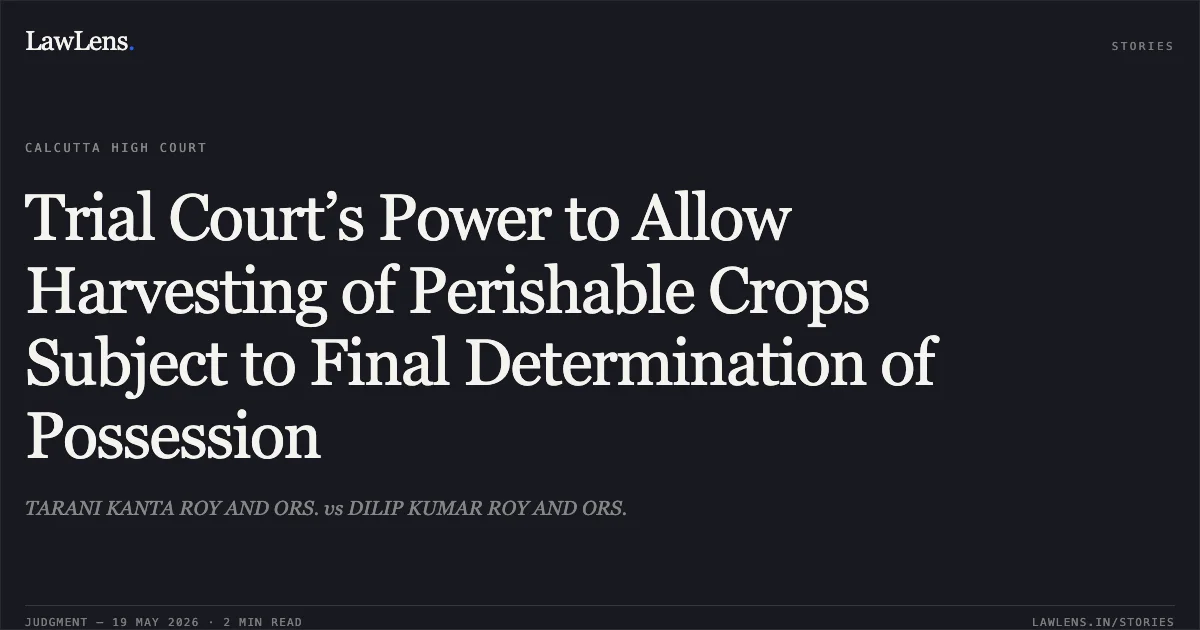
Source reference: para. 4(x)On December 6, 2025, the Trial Court allowed the plaintiffs to harvest the crop subject to the final judgment on title.
Source reference: para. 2The defendants challenged this order via the present revision, claiming they had cultivated the land during the period the initial injunction was stayed.
Source reference: para. 5(b)Issues
1. Whether the Trial Court committed a material irregularity by allowing the plaintiffs to harvest the crop while the question of possession remained undecided.
Source reference: para. 5 & 122. Whether the defendants provided sufficient prima facie evidence to prove they had cultivated the suit property during the subsistence of the stay order.
Source reference: para. 9-10Law Applied
Section 151 of the Code of Civil Procedure, 1908 (CPC), which grants inherent powers to the court to make orders necessary for the ends of justice or to prevent abuse of process.
Source reference: para. 2Principles governing the grant of interim relief and the "burden of proof" in establishing prima facie possession in agricultural disputes, noting that perishable assets like standing crops require immediate judicial intervention.
Source reference: para. 12Reasoning
The Court observed that the Trial Court's order was balanced as it explicitly left the final determination of title and possession open for the injunction hearing.
Source reference: para. 7-8The High Court rejected the defendants' argument that they cultivated the land, noting a lack of corroborative evidence. While the defendants produced seed purchase bills, they failed to provide photographs, tractor hiring bills, hand-tiller receipts, or documentation regarding the water source used for irrigation.
Source reference: para. 9The Court further reasoned that the Appellate stay of the original injunction did not automatically authorize the defendants to enter and cultivate the land; it merely kept the restraint order in abeyance.
Source reference: para. 6(i) & 8Additionally, the Khatian numbers cited by both parties were distinct, and the defendants had failed to file any prior police complaints or representations to revenue authorities (BL & LRO) regarding dispossession, weakening their claim of actual possession.
Source reference: para. 11Holding
The Court held that there was no perversity or illegality in the Trial Court’s order, as standing crops are perishable and required harvesting to prevent waste.
The Court answered the issues in the negative, finding the defendants failed to provide adequate proof of cultivation. The civil revisional application was dismissed, and all interim orders, including the appointment of the Special Officer, were vacated.
Source reference: para. 10-14Acts & Sections Cited
1 provisions across 1 statute referred to in this judgment. Each provision opens on LawLens.
Code of Civil Procedure, 19081
Original Court PDF
TARANI KANTA ROY AND ORS.vsDILIP KUMAR ROY AND ORS.
Click to open original judgment
Original judgment, available to read, download and summarize on LawLens.in