Facts
The plaintiffs filed O.S. No. 1884/2023 seeking partition and a ¼ share, a declaration that agreements of sale in favour of defendant Nos. 8 and 9 were not binding on them, and a permanent injunction.
Source reference: p. 4, para. 2Defendant Nos. 8 and 9 applied under Order VII Rule 11(a) and (d) CPC to reject the plaint, contending, among other things, that registered transactions dating from 1999 to 2013 put the plaintiffs on notice, that the plaintiffs had not sought possession, and that the suit was time-barred.
Source reference: p. 4, para. 2The trial court dismissed the application, treating limitation and possession as matters requiring evidence.
Source reference: pp. 5–6, paras. 3–4The defendants challenged that order in this revision petition.
Source reference: p. 3Issues
1. Whether the trial court adequately considered the defendants’ grounds for rejection of the plaint under Order VII Rule 11(a) and (d) CPC, including limitation and the alleged failure to seek possession.
Source reference: pp. 6–8, paras. 5–72. Whether the trial court’s order dismissing the application should be set aside and the matter remanded for reconsideration.
Source reference: p. 8, para. 7Law Applied
The application was brought under Order VII Rule 11(a) and (d) CPC, which was invoked as the procedural basis for seeking rejection of the plaint.
Source reference: p. 4, para. 2Article 59 of the Limitation Act prescribes three years for seeking cancellation or setting aside of an instrument, or rescission of a contract, from when the facts entitling the plaintiff to that relief first become known; the trial court considered the pleaded date of knowledge relevant to limitation.
Source reference: p. 5, para. 3The defendants also relied on Section 3(1) of the Transfer of Property Act, arguing that registration constituted constructive notice, and invoked Article 110 of the Limitation Act in connection with possession.
Source reference: pp. 4, 6, paras. 2, 4The High Court did not finally determine the application of these provisions to the suit.
Source reference: no citationReasoning
The High Court noted that the suit sought partition and a declaration concerning the agreements, while the defendants relied on registered transactions, constructive notice, and the plaintiffs’ failure to seek possession.
Source reference: pp. 7–8, para. 7It held that the trial court had considered the application superficially and had not adequately addressed those grounds.
Source reference: p. 8, para. 7Rather than decide whether the suit was time-barred or whether possession relief was necessary, the Court considered that the application required reconsideration by the trial court.
Source reference: no citationIt expressly left the merits open.
Source reference: p. 9, order cl. iiiHolding
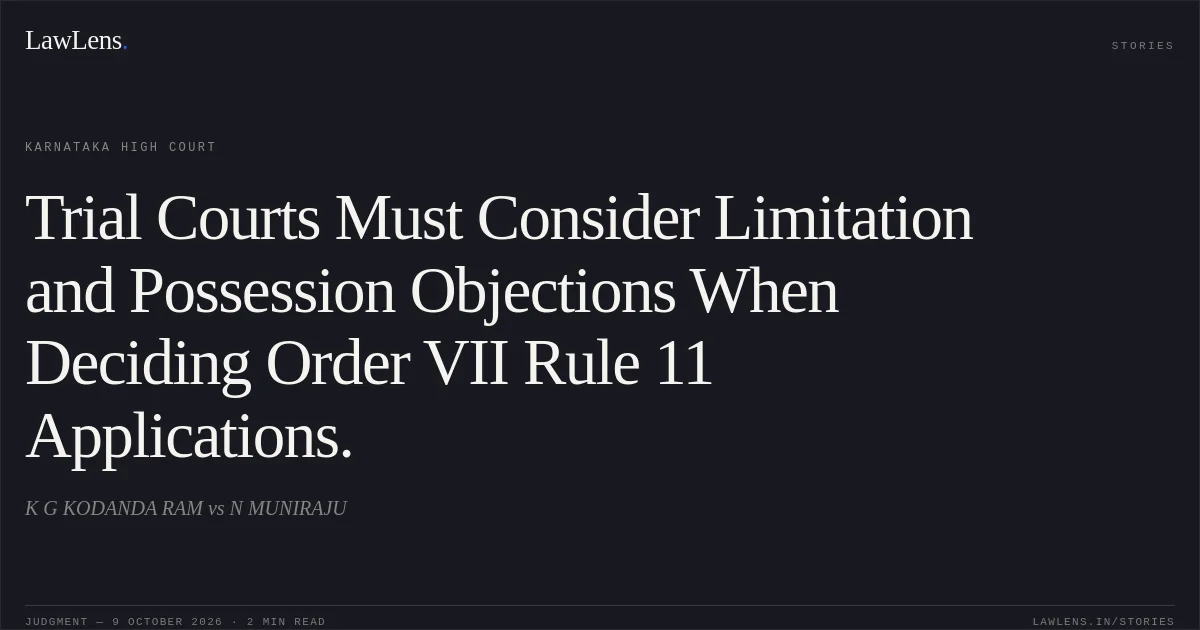
The High Court allowed the civil revision petition, set aside the order dated 20 September 2024 dismissing I.A. No. IV, and remanded the matter to the trial court.
It expressed no opinion on the merits and closed all interlocutory applications in the revision petition.
Source reference: p. 9, order cls. iii–ivActs & Sections Cited
3 provisions across 3 statutes referred to in this judgment. Each provision opens on LawLens.
Code of Civil Procedure, 19081
Transfer of Property Act, 18821
Limitation Act, 19631
Original Court PDF
K G KODANDA RAMvsN MUNIRAJU
Click to open original judgment
Original judgment, available to read, download and summarize on LawLens.in