Facts
The petitioner, Mukesh Jain, sought a writ of mandamus for the expeditious disposal of an application filed under Sections 497 and 503 of the Bharatiya Nagarik Suraksha Sanhita (BNSS), 2023.
Source reference: p. 2The underlying case arose from a complaint alleging a stock market fraud of ₹4.83 crores, leading to the registration of Crime No. 250/2025.
Source reference: p. 3-4Pursuant to a search warrant, the police seized cash, gold, silver, bank documents, and electronic items from the petitioner’s residence on 13-08-2025.
Source reference: p. 5The petitioner filed I.A. No. III on 03-09-2025 for the interim custody/release of these seized articles.
Source reference: p. 5Despite arguments being heard and the matter being reserved for orders since October 2025, the XLVII Additional Chief Metropolitan Magistrate, Bengaluru, failed to pass a final order, instead posting the matter for "clarifications".
Source reference: p. 5Issues
1. Whether the jurisdictional Magistrate is legally mandated to dispose of applications for the release of seized property within the specific timelines prescribed under Section 497 of the BNSS, 2023.
Source reference: p. 7-82. Whether the continued detention of the property and the delay in disposing of the interim application violated the statutory mandate and caused unjust deprivation to the petitioner.
Source reference: no citationLaw Applied
The court primarily applied Section 497 of the BNSS, 2023, which replaced Section 451 of the Cr.P.C.
Source reference: p. 9-10Section 497(2) mandates the preparation of a property statement within 14 days of production, and Section 497(5) requires the Court to pass orders for disposal or delivery within 30 days of such statement.
Source reference: p. 9-10The court relied on Sunderbhai Ambalal Desai v. State of Gujarat (2002), which established that powers for disposal of property should be exercised expeditiously to prevent loss or decay.
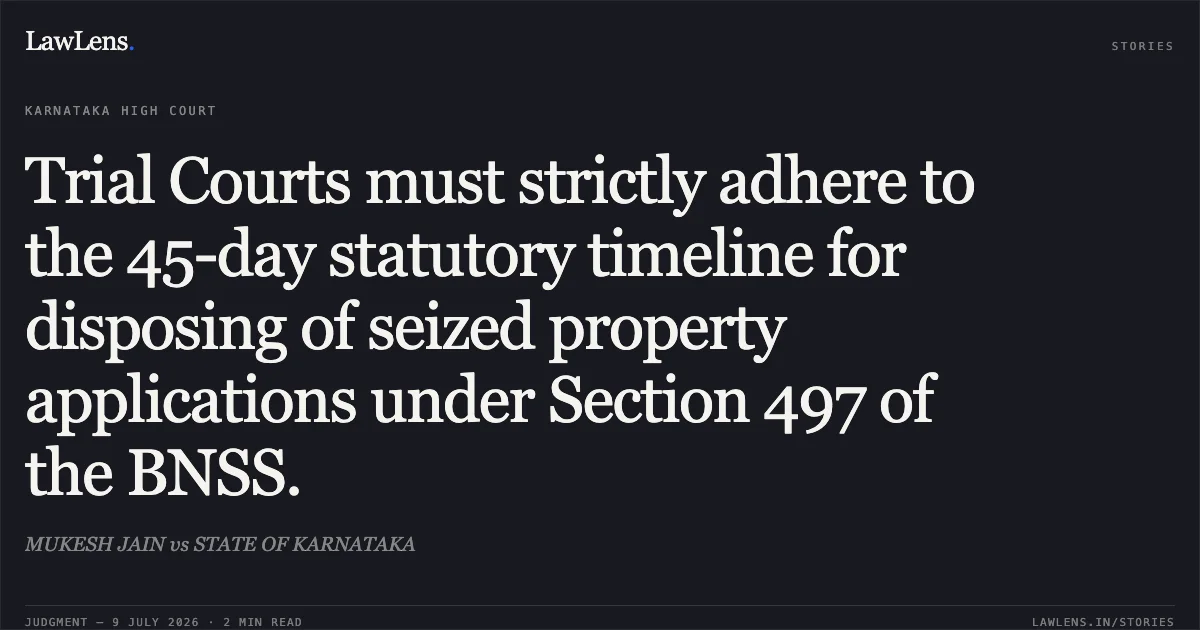
Source reference: p. 15-18The court cited Kanak Cattle Feeds Pvt. Ltd. v. State of U.P. and R. Saiju v. Superintendent of Police to emphasize that the BNSS introduced a "strict timeline of 45 days" for the completion of the disposal process.
Source reference: p. 13-14Reasoning
The High Court observed that the BNSS significantly expanded the scope of property disposal compared to the Cr.P.C. by allowing orders during the investigation stage and imposing a strict 45-day cumulative deadline.
Source reference: p. 10-11In analyzing the timeline of the present case, the Court noted that the search occurred on 25-08-2025, yet no order was passed as of February 2026.
Source reference: p. 12The Court found that the Magistrate had "rendered the mandate of the statute nugatory" by failing to adhere to the 14-day limit for property description and the subsequent 30-day limit for disposal.
Source reference: p. 12The Court reasoned that since the BNSS introduces a time-bound disposal mechanism, mechanical adherence to old procedures without regarding the new legislative scheme is impermissible.
Source reference: p. 14Holding
The Court allowed the Writ Petition and issued a writ of mandamus.
The Court held that the concerned Magistrate must strictly comply with the time-bound mandate of Section 497 of the BNSS.
Source reference: p. 14The Court directed the XLVII Additional Chief Metropolitan Magistrate, Bengaluru, to dispose of I.A. No. III within one week from the date of receipt of the order.
Source reference: p. 19Acts & Sections Cited
7 provisions across 3 statutes referred to in this judgment. Each provision opens on LawLens.
Bharatiya Nagarik Suraksha Sanhita, 20234
Bharatiya Nyaya Sanhita, 20232
Code of Criminal Procedure, 19731
Original Court PDF
MUKESH JAINvsSTATE OF KARNATAKA
Click to open original judgment
Original judgment, available to read, download and summarize on LawLens.in


