Facts
The Appellant’s mother, a housemaid, was traveling from Nallasopara to Santacruz on December 28, 2010, with a valid season pass.
Source reference: para. 3Between 6:30 a.m. and 7:00 a.m., she died due to a fall from the train.
Source reference: para. 3The Railway Claims Tribunal (Tribunal) rejected the compensation claim on January 31, 2018, on the sole ground that the death did not constitute an "untoward incident".
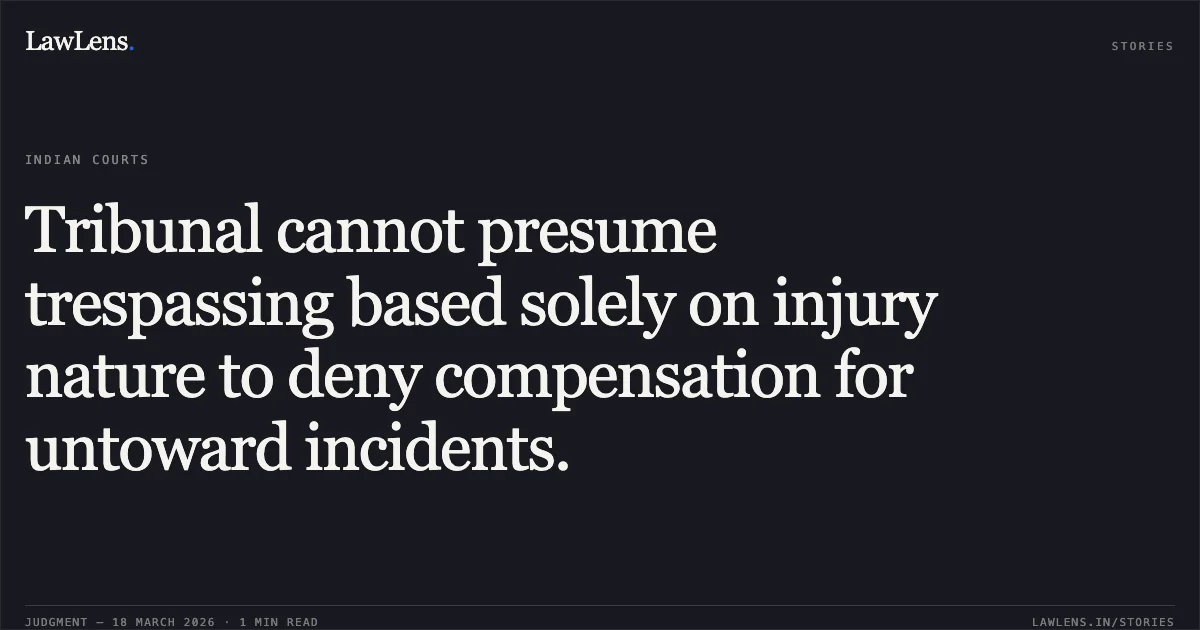
Source reference: para. 1While the Tribunal accepted that the deceased was a "bonafide passenger," it concluded, based on the nature of the injuries and railway reports, that she was knocked down while trespassing/crossing the tracks.
Source reference: para. 4The Appellant challenged this finding before the High Court.
Source reference: no citationIssues
1. Whether the death of the deceased qualifies as an "untoward incident" as defined by the Railways Act, 1989.
Source reference: para. 1, 42. Whether the deceased’s actions amounted to an "own criminal act" or trespassing under Section 124A(c) and Section 147 of the Railways Act, 1989, thereby excluding the Railway’s liability.
Source reference: para. 13Law Applied
The court primarily applied Section 124A of the Railways Act, 1989, which provides for compensation in cases of "untoward incidents," including accidental falls from a train.
Source reference: para. 1, 13It further considered the exceptions under Section 124A(c), which exempt the Railway from liability if the death is caused by the passenger’s "own criminal act".
Source reference: para. 13Additionally, the court examined Section 147 of the Act regarding unlawful entry and trespassing.
Source reference: para. 13The court also applied the evidentiary principle that the findings of a Tribunal must be based on expert testimony or direct evidence rather than conjecture regarding the nature of injuries.
Source reference: para. 12Reasoning
The Court found that the Tribunal’s conclusion of trespassing was unsupported by the evidence.
Source reference: no citationIt noted that the Station Master’s initial report dated December 28, 2010, stated the cause of death was "not known," rather than trespassing.
Source reference: para. 6The Court rejected the inquest panchnama’s opinion that the deceased was crossing the tracks, noting the panchas were not eyewitnesses.
Source reference: para. 7Similarly, the Police Report and the Divisional Railway Manager’s (DRM) Report were found to be based on incorrect premises not present in the original Station Master’s memo.
Source reference: para. 8, 10The Court specifically critiqued the Tribunal for acting as a medical expert by inferring trespassing from the nature of the injuries without any testimony from a medical professional or eyewitness.
Source reference: para. 12Furthermore, since there was no evidence that the deceased entered the railway without authority, the Court held that the exclusion for an "own criminal act" under Section 124A(c) was inapplicable.
Source reference: para. 13Holding
The High Court allowed the appeal and set aside the Tribunal’s order, reversing the finding on "untoward incident".
The Court held that the deceased died due to an accidental fall from a train while being a bonafide passenger.
Source reference: para. 14The Respondent was directed to pay compensation of ₹4,00,000 with 6% interest per annum from the date of the accident until realization, subject to a total cap of ₹8,00,000.
Source reference: para. 15The Court also directed the authorities to use the Appellant’s married name for the remittance of funds.
Source reference: para. 16Acts & Sections Cited
1 provisions across 1 statute referred to in this judgment. Each provision opens on LawLens.
Railways Act, 19891
Original Court PDF
SHYAMAL SACHIN SALVIvsUNION OF INDIA THROUGH THE GENERAL MANAGER
Click to open original judgment
Original judgment, available to read, download and summarize on LawLens.in