Facts
On May 6, 2019, the deceased (Ranjith Kumar) was involved in a fatal accident while riding a two-wheeler
Source reference: p. 2His parents, the first and second respondents, filed a claim petition under Section 166 of the Motor Vehicles Act (MVA), 1988, alleging negligence by the third respondent’s vehicle
Source reference: p. 2The Motor Accident Claims Tribunal, Chennai, evaluated the evidence (including eye-witness PW-2) and concluded that the deceased was the tortfeasor, meaning the accident occurred due to his own negligence
Source reference: p. 2, 4Despite this finding, the Tribunal suo motu converted the petition from Section 166 to Section 163A of the MVA and awarded compensation of Rs. 4,14,333/- under the structured formula
Source reference: p. 2-3The Insurance Company appealed this conversion
Source reference: p. 3Issues
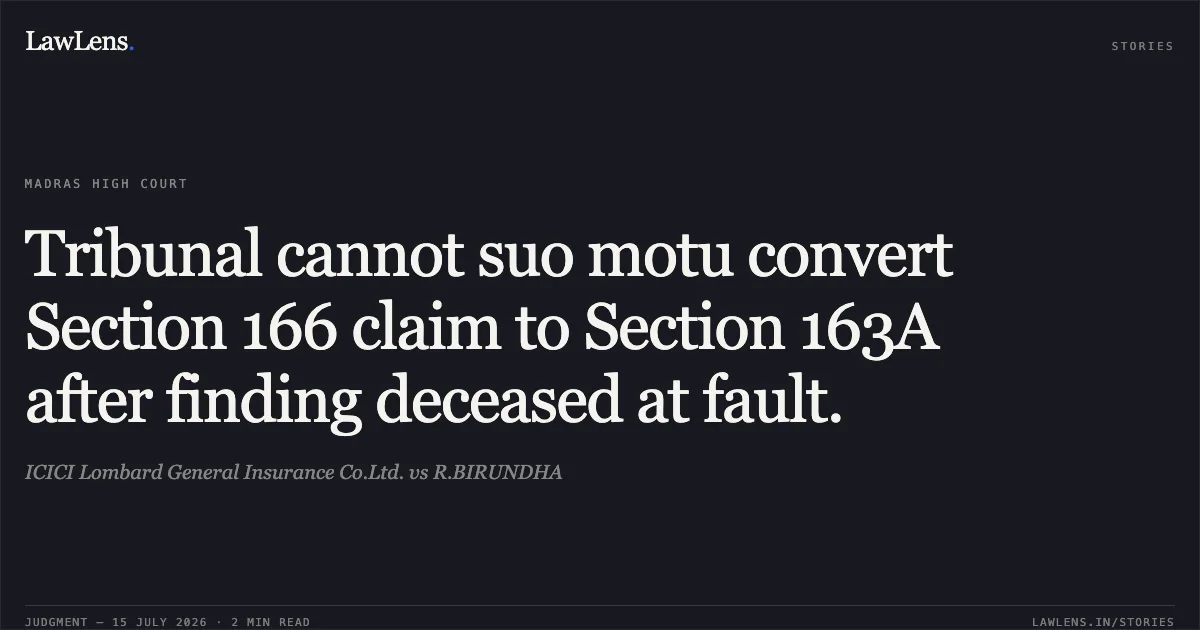
1. Whether the Tribunal can suo motu convert a claim petition from Section 166 to Section 163A of the Motor Vehicles Act after rendering a finding of negligence against the deceased
Source reference: p. 3, para. 52. Whether the High Court can independently reappreciate the Evidence of negligence in the absence of a cross-objection by the claimants
Source reference: p. 5, para. 11-12Law Applied
A claim petition filed under Section 166 of the MVA (requiring proof of negligence) cannot be converted to Section 163A (no-fault liability/structured formula) after the Tribunal has already appreciated evidence and rendered a finding on negligence
Source reference: p. 5, para. 9The Court relied on the Apex Court precedent Kasthuri @ A. Kasthuri Bai v. P.T. Prem Satheesh and another [2023-1-L.W.468] regarding the impermissibility of such conversion
Source reference: p. 5Under Order XLI Rule 33 of the Civil Procedure Code, the Court cannot interfere with findings unfavorable to the respondent (claimants) unless a formal cross-objection is filed, as per R. Gnana Soundari v. R. Chellappan (died) [2026 (2) CTC 885]
Source reference: p. 6Reasoning
The Court observed that the claimants consciously opted to prosecute the case under Section 166, attempting to prove the third respondent's negligence. Once the Tribunal evaluated the merits and arrived at a categorical finding that the deceased was the tortfeasor, it lacked the legal authority to "midway" convert the claim to Section 163A to grant relief
Source reference: p. 4-5Regarding the claimants' request for the High Court to re-examine the rough sketch and evidence to reverse the negligence finding, the Court held it was barred from doing so because the claimants had not filed a cross-objection against the Tribunal's finding of negligence
Source reference: p. 5-6The Court emphasized that while the claimants have suffered a loss, sympathy cannot override established legal procedures
Source reference: p. 6Holding
The High Court held that the conversion of the claim was unsustainable in law and the finding of negligence against the deceased remained unchallenged due to the lack of a cross-objection
The High Court allowed the appeal and set aside the award passed by the Motor Accident Claims Tribunal. The Insurance Company was permitted to withdraw any amount already deposited with the Tribunal
Source reference: p. 6Acts & Sections Cited
3 provisions across 1 statute referred to in this judgment. Each provision opens on LawLens.
Motor Vehicles Act, 19883
Original Court PDF
ICICI Lombard General Insurance Co.Ltd.vsR.BIRUNDHA
Click to open original judgment
Original judgment, available to read, download and summarize on LawLens.in


