01Facts
The appellant, Smt. Kalavati (aged 58 at the time of the accident per the hospital records), was injured in a road accident on 31.03.2022 at about 2:30 p.m. near Nadisinnuru village on NH-50, when the car bearing Reg. No. KA-02/AF-9318, owned by Respondent No. 1 and insured by Respondent No. 2, dashed against a roadside tree.
¶ 4(i), 4(iv), 20, 49She claimed medical expenses exceeding ₹8.5 lakh and pre-accident household income of ₹25,000 per month, and alleged that the accident was caused solely by the driver's negligence.
¶ 4(v)–(vi)She was admitted to United Hospital on 01.04.2022 and discharged on 09.04.2022 after a nine-day inpatient stay.
¶ 20, 58–59Her injuries included a left distal femur comminuted fracture with knee-joint involvement, a right radius and ulna forearm fracture, a right distal radius fracture, a left temporal scalp haematoma, and nasal bone fractures; no intracranial injury was found.
¶ 19, 23–24, 27–30, 32–34The treating doctor (PW-2) assessed whole-body disability at 51.11% and deposed to future medical expenses of ₹90,000 for implant removal.
¶ 11–12, 42, 64The Tribunal (MVC No. 1079/2022, judgment dated 02.01.2024) assessed disability at 17%, adopted notional income of ₹14,750 per month, awarded ₹2,92,176 towards medical expenses, and granted a total of ₹5,93,000 with 6% interest from the date of the claim petition.
¶ 9, 45, 48The claimant appealed, seeking enhancement.
¶ 1002Issues
i.1. Whether the Tribunal was justified in reassessing the appellant's whole-body disability at 17% in disregard of the treating doctor's assessment of 51.11%, without assigning adequate reasons.
¶ 11, 18, 42–47ii.2. Whether the appellant is entitled to compensation for future medical expenses.
¶ 12, 64–65iii.3. Whether the appellant's notional income, future prospects, age, and multiplier were correctly determined for computing loss of future earning capacity.
¶ 44, 48–53iv.4. Whether the non-pecuniary and other heads (pain and suffering, loss of income during treatment, attendant charges, nourishment, transportation, and loss of amenities) were inadequately awarded by the Tribunal.
¶ 13, 55–6303Law Applied
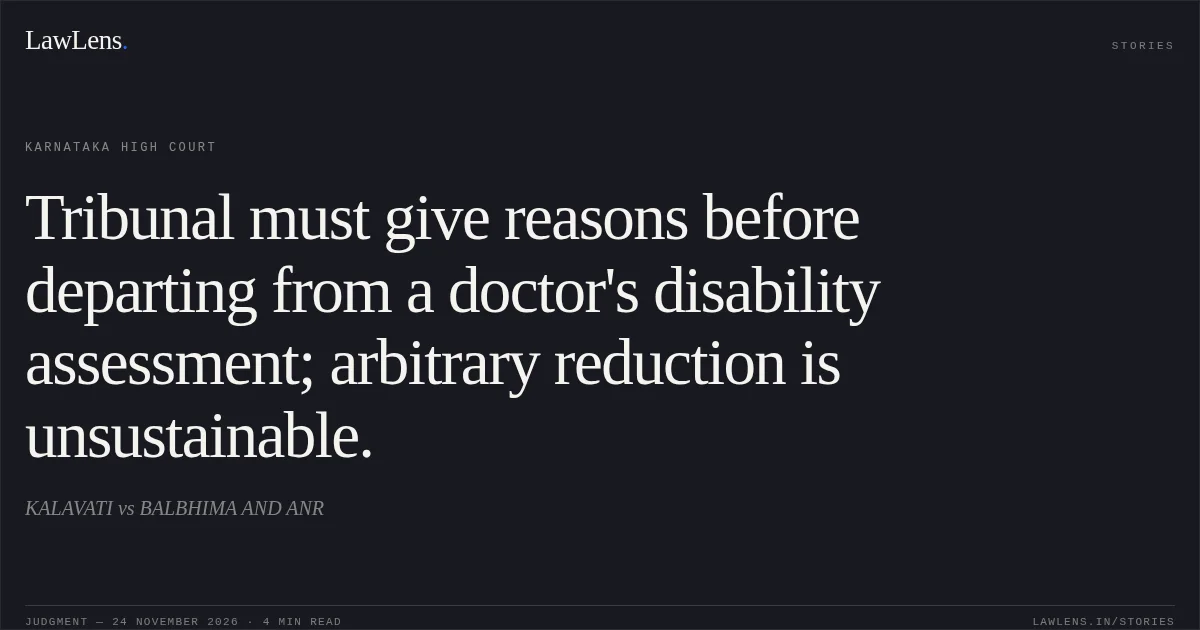
A Tribunal must assign reasons when departing from the medical evidence of disability, and a treating doctor's evidence, if unshaken in cross-examination, should be accepted.
¶ 43, 45, 47The notional income method applies where a claimant fails to prove actual income, as reflected in the KSLSA notional income chart for 2022.
¶ 48National Insurance Co. v. Pranay Sethi, 2017 (16) SCC 680, applies to add 10% future prospects to income.
¶ 50A multiplier of 9 applies to the claimant's age, and a claimant is entitled to just compensation under the non-pecuniary heads (pain and suffering, loss of amenities, attendant charges, nourishment, transport, and loss of income during treatment) and future medical expenses where reasonably established by evidence.
¶ 53, 55–65Under the Motor Vehicles Act, 1988, s. 173(1), the appeal lies against the award and enables enhancement.
pp. 1–2Provisions in the judgment · 1 · Linked ones open on LawLens
Motor Vehicles Act, 1988 Section 173
04Reasoning
The Court examined the discharge summaries (Exs. P5, P8) and the wound certificate (Ex. P4), and construed the medical terminology to determine the functional consequences of the injuries. It held that the left femur and right forearm fractures caused serious and lasting consequences, while the scalp haematoma did not, by itself, establish permanent disability.
¶ 19–41 · ¶ 27–29, 41Finding the doctor's evidence consistent with the injuries and unshaken in cross-examination, the Court held the doctor's evidence must be accepted. The Tribunal's reduction of the disability to 17%, approximately one-third of the assessed figure, was held unsupported by reasons. Because the appellant was not shown to be wholly incapacitated (she could pursue sedentary work and had not been removed from employment), the Court fixed whole-body disability at 20% rather than 51.11%.
¶ 42–43 · ¶ 45 · ¶ 44, 46–47The appellant failed to prove ₹25,000 per month, so the notional income of ₹14,750 was retained, with 10% future prospects added, yielding ₹16,225 per month. The claimant's age was taken as 58, based on contemporaneous hospital records rather than the pleaded age of 48. Applying 20% disability and a multiplier of 9 produced a loss of future earning capacity of ₹3,50,460.
¶ 48, 50–51 · ¶ 49 · ¶ 52–53The Court found the Tribunal's awards of ₹10,000 each under the non-pecuniary heads to be on the lower side, given the two fractures in a 58-year-old woman and the nine-day hospitalisation. It enhanced pain and suffering to ₹30,000, awarded ₹10,000 for transport, ₹48,675 for three months' loss of income during treatment, ₹10,000 for nourishment, ₹30,000 for attendant charges, and ₹40,000 for loss of amenities.
¶ 56–57, 59 · ¶ 57 · ¶ 58 · ¶ 59–60 · ¶ 61 · ¶ 62 · ¶ 63For future medical expenses, the Court noted the uncontested evidence of a ₹90,000 implant-removal surgery and awarded ₹75,000 without interest. No enhancement was granted under medical expenses, as no proof of expenditure beyond the ₹2,92,176 awarded was produced.
¶ 64–65 · ¶ 5405Holding
The Court held that whole-body disability is 20%. The appellant is entitled to total compensation of ₹8,86,320 (rounded), against the Tribunal's ₹5,93,000, an enhancement of ₹2,93,320.
¶ 47, 66The appeal is allowed in part. The enhanced amount carries 6% interest per annum from the date of the claim petition until realisation, except the ₹75,000 future medical expenses, which carry no interest.
¶ 65–66 · Order (iii)Respondent No. 2 (New India Assurance Co. Ltd.) must deposit the enhanced compensation within six weeks of receipt of the certified copy, and its deposit and release shall follow the Tribunal's order.
Order (iv)–(v)Original Court PDF
KALAVATIvsBALBHIMA AND ANR
Click to open original judgment
Original judgment, available to read, download and summarize on LawLens.in