Facts
The applicant, a Postal Assistant serving as Sub-Postmaster at Malancha Mahinagar Sub Post Office since 2012, faced an annual inspection on 11.11.2014
Source reference: p.2The inspection revealed discrepancies in accounts, specifically a shortage of ₹15,00,000, allegedly concealed by showing them as cheques in the S.O. account to hide misappropriation
Source reference: p.7An FIR was lodged under Sections 420 and 409 of the IPC, and disciplinary proceedings under Rule 14 of the CCS (CCA) Rules, 1965, were initiated
Source reference: p.2Following an inquiry report submitted on 26.06.2018, the applicant was dismissed from service on 14.09.2018
Source reference: p.2-3An appeal was filed and subsequently rejected by the Appellate Authority on 09.05.2019
Source reference: p.3The applicant challenged the disciplinary proceedings and the appellate order, alleging non-application of mind and procedural inconsistencies
Source reference: p.3-7Issues
1. Whether the findings of the Disciplinary and Appellate Authorities were based on no evidence or were perverse
Source reference: p.9, para. 62. Whether the Tribunal can re-appreciate evidence or act as an appellate forum over the findings of a disciplinary inquiry
Source reference: p.8, para. 63. Whether the punishment of dismissal was disproportionate to the gravity of the proven misconduct
Source reference: p.10, para. 6Law Applied
The court primarily applied the principles of judicial review in departmental proceedings as established in B.C. Chaturvedi v. Union of India (1995), which holds that judicial review is restricted to the decision-making process rather than the decision itself
Source reference: p.8, para. 6State of Karnataka & Anr. v. Umesh (2022), affirming that Courts/Tribunals must not re-appreciate evidence but only ensure compliance with natural justice, statutory rules, and the absence of perversity
Source reference: p.8-9, para. 6The "Preponderance of Probability" standard applies to departmental inquiries rather than "Proof Beyond Reasonable Doubt."
Source reference: no citationReasoning
The Tribunal observed that the applicant’s challenges to the appellate order were framed in "general and vague terms" without specific substantiation of procedural lapses
Source reference: p.9, para. 6Applying the B.C. Chaturvedi and Umesh precedents, the Tribunal noted that the Disciplinary Authority is the sole judge of facts and that the Tribunal cannot substitute its own conclusions for those of the departmental authorities unless the findings are "wholly perverse"
Source reference: p.9, para. 6The Tribunal found that the charges were specific, the inquiry followed due process, and the applicant had been granted ample opportunity to defend himself
Source reference: p.10, para. 6It determined that the shortage of ₹15,00,000 was a grave matter of financial misappropriation, and the applicant's act of crediting the shortage amount back into the account post-inspection suggested an admission of the discrepancy
Source reference: p.7-8, para. 4Holding
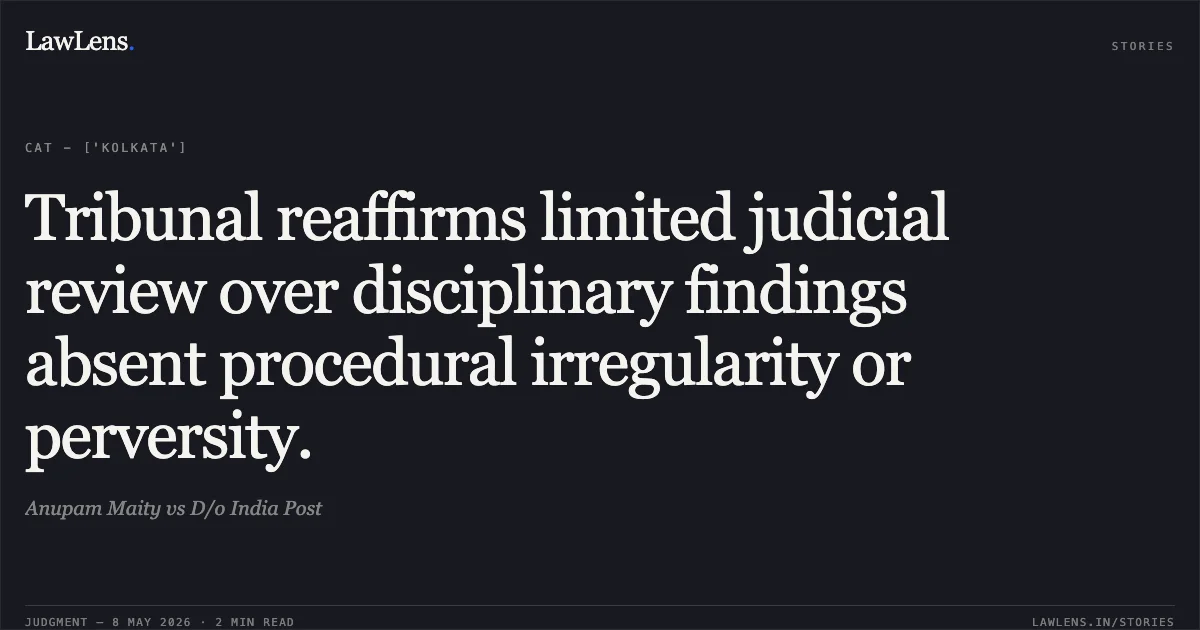
The Tribunal held that there was no legal infirmity in the decision-making process and that the findings of the authorities were cogent and based on record
punishment of dismissal was not disproportionate to the gravity of the proven misconduct involving misappropriation of government money
Source reference: p.10, para. 6Original Application (O.A.) was dismissed for lack of merit, and no interference with the impugned orders was deemed necessary
Source reference: p.10, para. 7-8Acts & Sections Cited
1 provisions across 1 statute referred to in this judgment. Each provision opens on LawLens.
Administrative Tribunals Act, 19851
Original Court PDF
Anupam MaityvsD/o India Post
Click to open original judgment
Original judgment, available to read, download and summarize on LawLens.in