Facts
The claimant, a pillion rider on a motorcycle, sustained injuries when the motorcycle collided with a Bolero jeep on 5 February 2004.
Source reference: paras. 1–4; pp. 1–4The Motor Accident Claims Tribunal awarded Rs. 7,76,769, attributing 80% negligence to the jeep and 20% to the motorcycle. In assessing the claimant’s income, the Tribunal accepted only 60% of the agricultural income disclosed in his income-tax returns (ITRs).
Source reference: paras. 1–4; pp. 1–4The claimant appealed, seeking enhanced compensation; the insurer supported the award and sought recovery of any amount paid beyond its share from the other tortfeasor.
Source reference: paras. 7, 13–14; pp. 9–10Issues
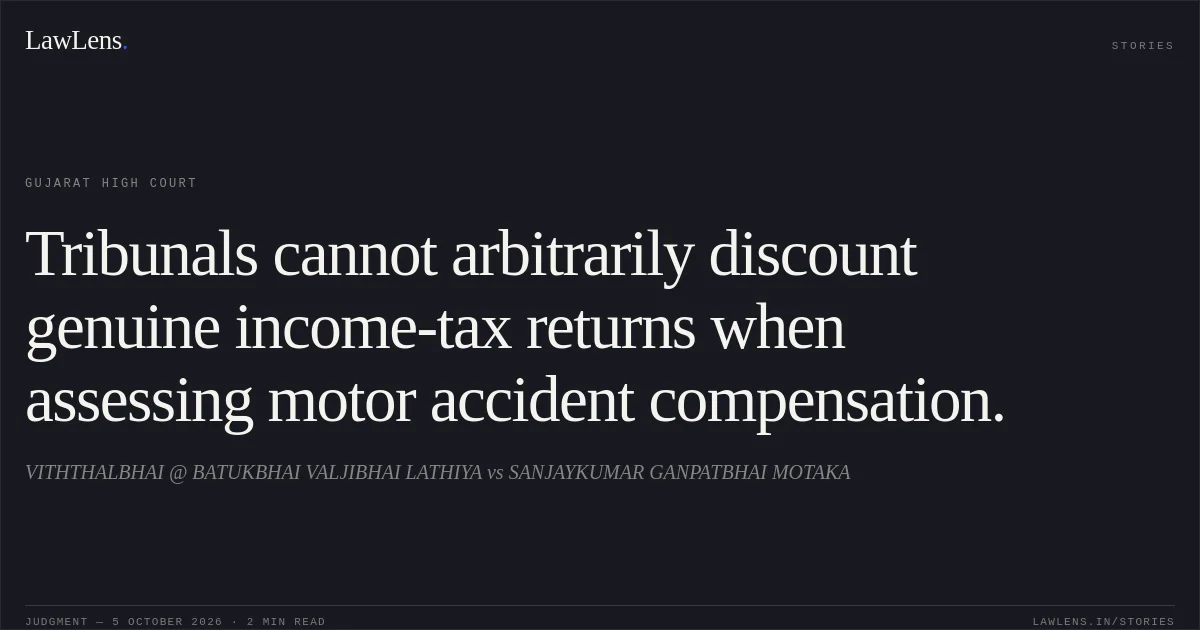
Whether the Tribunal erred in discounting the agricultural income shown in the claimant’s ITRs and whether the compensation should be reassessed on the basis of that income.
Source reference: paras. 5, 7–12; pp. 3–9Whether the insurer, after satisfying the claimant’s award, could recover from the other tortfeasor any amount paid in excess of its inter se liability.
Source reference: paras. 6, 13–14; pp. 3, 9–10Law Applied
Section 173 of the Motor Vehicles Act provides for an appeal against an award of the Claims Tribunal, while Section 168 requires determination of just compensation.
Source reference: no citationThe Court relied on Rashmirekha Tripathi v. Branch Manager, Reliance General Insurance Company Limited, holding that ITRs are an important reference point for assessing income and that, for self-employed persons or business operators, income shown in ITRs for up to the preceding three years may be averaged, having regard to relevant circumstances.
Source reference: para. 8; pp. 5–7It also referred to Mohit Garg v. Hari Ram through LRs on the evidentiary value of genuine, undisputed ITRs.
Source reference: para. 9; p. 7Under Khenyei v. New India Assurance Company Ltd., where joint tortfeasors are impleaded and their respective negligence is determined, the claimant may recover the compensation jointly and severally; a tortfeasor who pays more than its share may recover the excess from the other in execution proceedings.
Source reference: paras. 13–14; pp. 9–10Reasoning
The Court found that the insurer had not disputed the claimant’s ITRs and held that the Tribunal’s decision to accept only 60% of the disclosed agricultural income was unduly parsimonious and inconsistent with the objective of awarding just and fair compensation.
Source reference: paras. 10–12; pp. 7–9It accepted the income reflected in the returns and used the resulting monthly figure of Rs. 11,666 as the base for recalculating future loss of income, including 25% future prospects, 22% functional disability and a multiplier of 14.
Source reference: paras. 10–12; pp. 7–9On liability, the Court applied Khenyei: the claimant, as a third-party victim, could recover from any or all tortfeasors, while the insurer could seek recovery from the other tortfeasor for any amount paid beyond its liability.
Source reference: paras. 13–14; pp. 9–10Holding
The appeal was partly allowed.
The Court awarded an additional Rs. 2,01,026, with interest at 7.5% per annum from the date of the claim petition until realization, and directed the insurer to deposit that amount within eight weeks.
Source reference: paras. 15–16.6; pp. 10–11The Tribunal was directed to disburse the amounts held by it, subject to verification and applicable court fees.
Source reference: paras. 15–16.6; pp. 10–11The Tribunal’s remaining directions were left unchanged, and the insurer was granted the right to recover any amount deposited in excess of its liability from the other tortfeasor by executing the judgment.
Source reference: paras. 15–16.6; pp. 10–11Acts & Sections Cited
3 provisions across 1 statute referred to in this judgment. Each provision opens on LawLens.
Motor Vehicles Act, 19883
Original Court PDF
VITHTHALBHAI @ BATUKBHAI VALJIBHAI LATHIYAvsSANJAYKUMAR GANPATBHAI MOTAKA
Click to open original judgment
Original judgment, available to read, download and summarize on LawLens.in