01Facts
The petitioner sustained grievous injuries in a motor accident on 4 October 2023 and subsequently filed a claim petition before the Motor Accident Claims Tribunal, Datia.
¶ 2 · p. 1By award dated 24 September 2025, the Tribunal awarded compensation of ₹18,33,950 with interest, directing that ₹12,00,000 be kept in a five-year Fixed Deposit Receipt (FDR).
¶ 2 · p. 1The petitioner later sought premature encashment of the FDR, stating that he had incurred substantial medical expenses, that his artificial-jewellery business had remained closed during his treatment, and that the amount was required for reviving and operating the business.
¶ 3 · p. 2He also asserted that he was literate, an income-tax assessee, and financially capable of managing the compensation.
¶ 4 · p. 2The Tribunal rejected the application by order dated 13 May 2026, leading to the present petition under Article 227 of the Constitution.
¶ 1 · p. 102Issues
i.Whether the Tribunal erred in rejecting the petitioner’s application for premature encashment of the ₹12,00,000 FDR without properly considering his literacy, financial capacity, business requirements, and genuine need for the funds?
¶ 1, 3–6 · pp. 1–4ii.Whether the principles governing investment of compensation in long-term fixed deposits require such investment to be maintained rigidly in the case of a literate and financially capable claimant?
¶ 5 · pp. 2–403Law Applied
The Court exercised its supervisory jurisdiction under Article 227 of the Constitution of India.
¶ 1 · p. 1It relied on General Manager, Kerala S.R.T.C. v. Susamma Thomas, (1994) AIR 1631, which laid down safeguards for protecting compensation amounts from being frittered away, particularly in the case of minors, illiterate claimants, and widows.
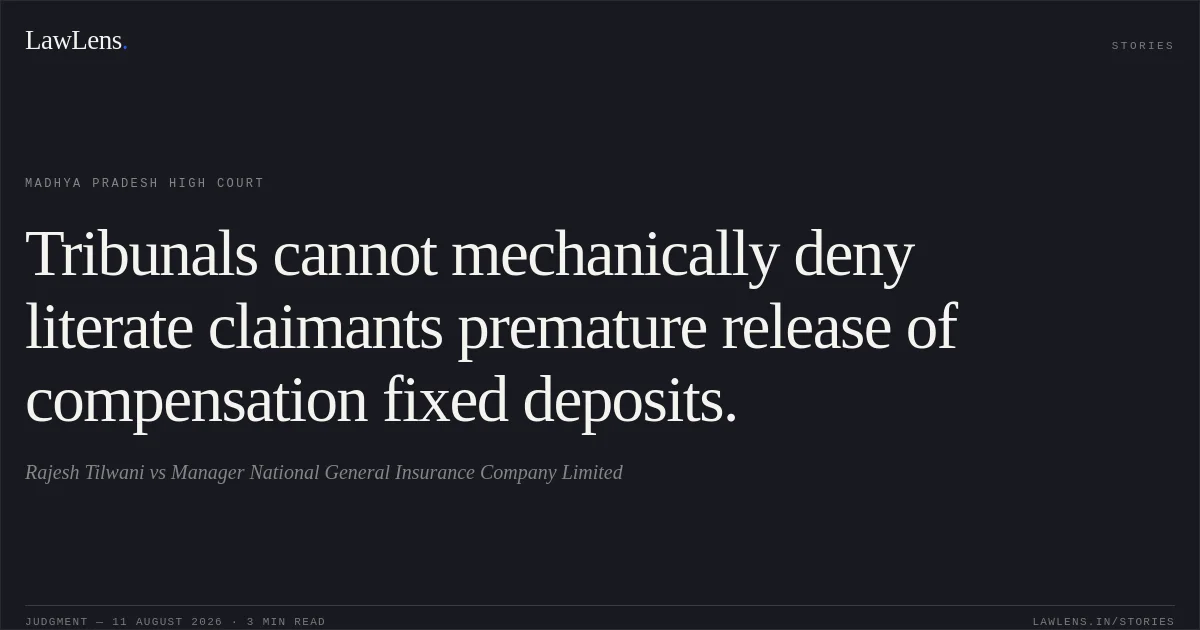
¶ 5 · pp. 2–3Applying the clarification in A.V. Padma v. R. Venugopal, (2012) 3 SCC 378, the Court held that long-term fixed-deposit investment is not mandatory in every case.
¶ 5 · pp. 2–4In the case of literate persons, the Tribunal has discretion to release the whole or part of the compensation, and should direct long-term investment only where, having regard to the claimant’s age, fiscal background, social circumstances, and other relevant considerations, such investment is necessary in the claimant’s larger interest.
¶ 5 · pp. 2–4Tribunals must therefore examine each request on its merits and must not mechanically insist on long-term deposits.
¶ 5 · p. 404Reasoning
The Court found that the petitioner was a literate businessman and an income-tax assessee, and was therefore capable of making informed financial decisions.
¶ 6 · p. 4His stated need to use the FDR proceeds for medical-related financial rehabilitation and revival of his artificial-jewellery business was supported by documents placed on record.
¶ 3, 6 · p. 2, 4In light of A.V. Padma, the protective rationale behind compulsory long-term deposits did not justify a rigid restriction in the petitioner’s case.
¶ 5–7 · pp. 3–4The Tribunal’s rejection of the application, without adequately applying the distinction between vulnerable claimants and literate, financially competent persons, was therefore unsustainable.
¶ 5–7 · pp. 3–405Holding
The High Court allowed the petition and set aside the Tribunal’s order dated 13 May 2026.
¶ 7 · p. 4It directed that the petitioner be permitted to prematurely encash and withdraw the entire ₹12,00,000 kept in the FDR pursuant to the award dated 24 September 2025.
¶ 7 · p. 4The Claims Tribunal was directed to release the amount through the petitioner’s savings bank account, subject to verification of identity and completion of necessary formalities.
¶ 7 · p. 4The miscellaneous petition and any pending applications were accordingly disposed of.
¶ 8–9 · p. 5Original Court PDF
Rajesh TilwanivsManager National General Insurance Company Limited
Click to open original judgment
Original judgment, available to read, download and summarize on LawLens.in