Facts
The Malabar Devaswam Board (Appellant) challenged judgments of a Single Judge which declared that employees of "Special Grade Devaswams" (Njangattiri Bhagavathi and Thirupuraikkal Bhagavathi) were entitled to salary revisions and pay scales on par with government servants
Source reference: p. 5-6The Trustees of these temples—who are the statutory "paymasters"—had resolved to implement these revisions based on parity with five other Special Grade Devaswams recognized in a government order (Ext.P1)
Source reference: p. 6, 8The Board opposed the revision, contending that such an increase would cause establishment charges to exceed the 30% statutory limit of the temples' income as per the Madras Hindu Religious and Charitable Endowments Act, 1951
Source reference: p. 6-7Issues
1. Whether the Malabar Devaswam Board has the authority to prohibit Trustees of Special Grade Devaswams from implementing salary revisions on par with government servants when the Trustees are the designated paymasters
Source reference: p. 52. Whether the potential risk of administrative expenses exceeding 30% of income is a valid ground for the Board to interfere with a Trustee's decision on pay revision at the pre-implementation stage
Source reference: p. 9Law Applied
The court applied the provisions of the Madras Hindu Religious and Charitable Endowments Act, 1951 ("HR&CE Act"), which defines the Board as a supervisory body while vesting administrative powers, including the duty of the "paymaster," in the Trustees
Source reference: p. 6-7It relied on precedents established in WP(C) No. 13754 of 2014 and WP(C) No. 24492 of 2015, which affirmed that employees of Special Grade Devaswams are entitled to parity in pay scales
Source reference: p. 5The court also affirmed the principle from WP(C) No. 23148 of 2014, which held that the Government or the Board cannot interfere with the Trustees' decision on pay revisions solely on the grounds of financial burden
Source reference: p. 8-9Reasoning
The Court reasoned that under the HR&CE Act, the Board’s role is primarily supervisory, whereas the actual administration and financial responsibility for salaries rest with the Trustees
Source reference: p. 6, 9The Court noted that the Board's primary objection was factual—the fear that expenses might exceed 30% of income. However, the Court found this apprehension to be "premature," clarifying that such a factual determination could only be made after the implementation of the revision
Source reference: p. 8, 9Since the Trustees had already decided to grant the pay scales and were prepared to bear the financial burden from the temples' own income, the Board lacks the locus to block the implementation
Source reference: p. 7, 9The Court emphasized that judicial declarations already exist stating that the Board cannot interfere with the paymasters' decision on the basis of perceived financial burden
Source reference: p. 9Holding
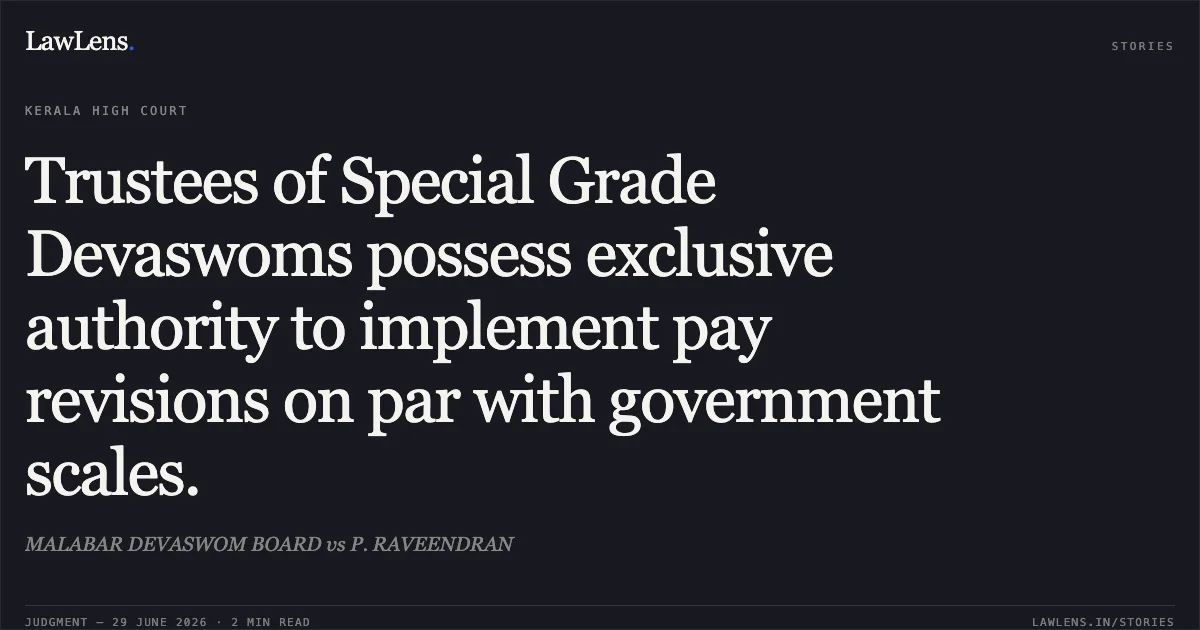
The Court answered the issues in favor of the employees, holding that the Trustees are the ultimate authority in deciding pay revisions for Special Grade Devaswams and the Board cannot preemptively block such decisions
The Court dismissed the Writ Appeals, confirming the Single Judge’s judgment that the employees are eligible for the revised pay scales on par with government servants. The Board's role is limited to supervising the affairs to ensure they remain within statutory parameters after the implementation
Source reference: p. 10, 9-10Acts & Sections Cited
1 provisions across 1 statute referred to in this judgment. Linked provisions open on LawLens.
Madras Hindu Religious and Charitable Endowments Act, 19511
Original Court PDF
MALABAR DEVASWOM BOARDvsP. RAVEENDRAN
Click to open original judgment
Original judgment, available to read, download and summarize on LawLens.in


