Facts
Indian Oil Corporation Limited (“IOCL”) issued an all-India tender for a rate contract involving the supply, fabrication, transportation, installation and commissioning of Retail Visual Identity (“RVI”) elements at retail outlets across 16 State Offices. The tender contemplated 109 work orders covering approximately 4,730 retail outlets, with an estimated aggregate value of approximately Rs. 1,198 crore.
Source reference: paras. 2, 15; pp. 3, 14–15The Petitioners challenged Condition Nos. 22.3(vi), 22.3(ix), 22.3(x)(c) and 22.3(x)(e), particularly the use of the bidder’s annual turnover as a tie-breaking criterion. Retail Impact Private Limited, which had participated in the tender, also challenged the requirement under Clause 21(I) that a bidder have completed one similar work valued at Rs. 37.50 lakhs or more.
Source reference: paras. 5–9Issues
Whether the Petitioners’ challenge to the tender conditions was maintainable, particularly when the Petitioners in Writ Petition (L) No. 16159 of 2026 had not participated in the tender?
Source reference: paras. 3–5Whether the use of annual turnover as a tie-breaking criterion under Clauses 22.3(ix), 22.3(x)(c) and 22.3(x)(e) was arbitrary, discriminatory, irrational or unrelated to the object of the tender?
Source reference: paras. 6–7, 18–20Whether the requirement of completing one similar work valued at Rs. 37.50 lakhs or more under Clause 21(I) violated the CVC Office Memorandum dated 17 December 2002?
Source reference: paras. 8, 21–22Whether the impugned tender conditions warranted judicial interference under Article 226 of the Constitution?
Source reference: paras. 23–26Law Applied
The Court applied the settled principle that tender conditions fall primarily within the commercial and technical discretion of the tendering authority, which is ordinarily the best judge of its requirements. Judicial review is limited to cases involving mala fides, bias, discrimination, manifest arbitrariness, irrationality, perversity, or a decision that no reasonable authority could have reached.
Source reference: paras. 23–24Relying on Agmatel India Pvt. Ltd. v. Resoursys Telecom, Afcons Infrastructure Ltd. v. Nagpur Metro Rail Corporation Ltd., Silppi Constructions Contractors v. Union of India, Jagdish Mandal v. State of Orissa, and Montecarlo Ltd. v. NTPC Ltd., the Court held that courts should not second-guess the tendering authority’s plausible interpretation of technical or commercial requirements, nor substitute their own assessment for that of the experts.
Source reference: para. 23The Court further relied on Directorate of Education v. Educomp Datamatics Ltd. for the principle that financial capacity is a legitimate consideration in awarding contracts. The CVC Office Memorandum was treated as illustrative guidance rather than a mandatory formula requiring every tender to prescribe a similar-work threshold equal to 80% of the aggregate estimated cost.
Source reference: paras. 20–22Reasoning
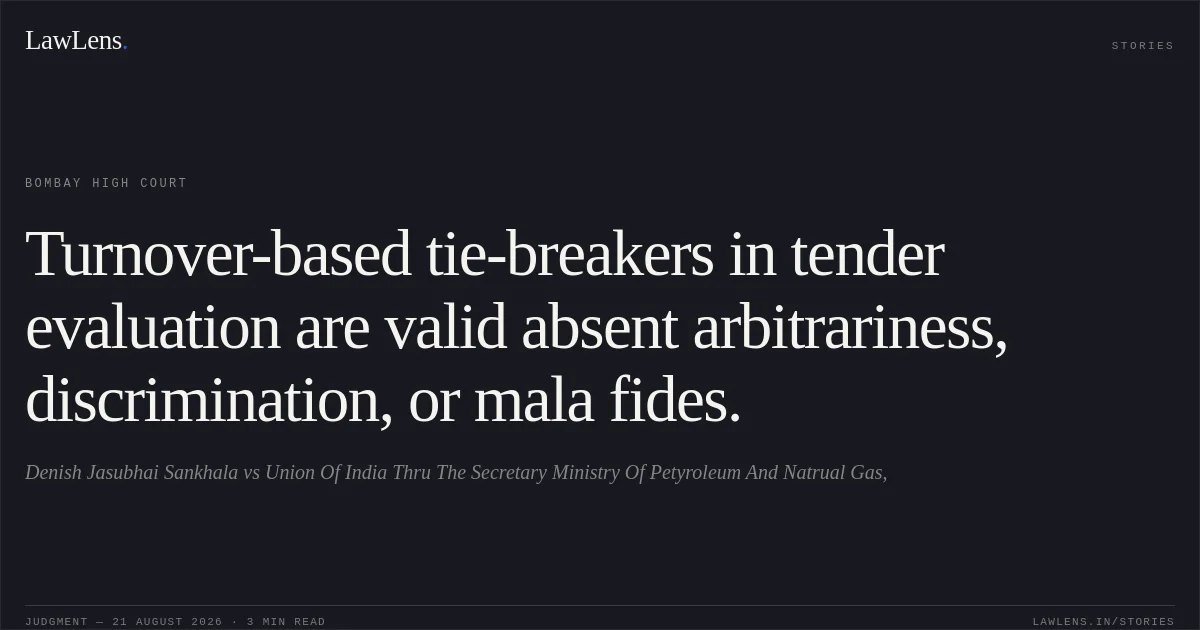
The Court held that the tender was not a single contract to be awarded to one bidder but a consolidated rate contract involving separate State Office-wise evaluation, empanelment and distribution of work. The tender prescribed technical experience, minimum turnover, factory infrastructure and machinery requirements before a bidder’s price bid could be opened. Accordingly, turnover did not determine entry into the competition; it operated only as a residual mechanism for ranking otherwise qualified bidders who had quoted identical rates.
Source reference: paras. 15–18The Court found this criterion rationally connected with the financial and operational capacity required for a large, geographically dispersed project and rejected the argument that a high-turnover bidder could monopolise the tender, since one bidder could receive only one work order in each State Office and 109 work orders were to be distributed among multiple vendors.
Source reference: para. 19The challenge based on the CVC Memorandum also failed because the 80% figure was guidance for framing eligibility criteria, not a mandatory requirement applicable mechanically to the aggregate value of a multi-State tender. The Rs. 37.50 lakh threshold promoted wider participation and could not be compared mechanically with the total estimated tender value.
Source reference: paras. 21–22Since no mala fides, discrimination, perversity or manifest arbitrariness was established, the limited scope of judicial review prevented interference.
Source reference: paras. 23, 25–26Holding
The Court rejected the maintainability objection to Writ Petition (L) No. 16159 of 2026 for the purpose of deciding the challenge, but dismissed both writ petitions on merits. It upheld the impugned turnover-based tie-breaking provisions and the requirement of one similar completed work valued at Rs. 37.50 lakhs or more.
Writ Petition (L) Nos. 16159 and 28202 of 2026 were dismissed; Interim Application (L) No. 27395 of 2026 was disposed of; Rule was discharged; and there was no order as to costs.
Source reference: paras. 27–28Original Court PDF
Denish Jasubhai SankhalavsUnion Of India Thru The Secretary Ministry Of Petyroleum And Natrual Gas,
Click to open original judgment
Original judgment, available to read, download and summarize on LawLens.in