Facts
The Appellant was convicted by the Trial Court on August 10, 2010, for offences under Sections 363, 366, and 376 of the IPC and sentenced to seven years of rigorous imprisonment.
Source reference: p. 1-2The prosecution alleged that on March 6, 2008, the Appellant kidnapped the prosecutrix, took her to Kangra, Himachal Pradesh, and raped her.
Source reference: p. 2The prosecutrix was recovered on March 12, 2008.
Source reference: p. 2During the trial, the prosecution relied on school records showing her date of birth as December 12, 1993 (~15 years old) and an ossification test placing her age between 15.3 and 16.4 years.
Source reference: p. 7-9Conversely, the Appellant contended that the relationship was consensual, the prosecutrix had insisted on marriage to avoid family scolding, and she had represented herself as 19 years old.
Source reference: p. 3In her Section 164 Cr.P.C. statement, the prosecutrix supported the Appellant's version, but she later turned hostile toward him during the trial.
Source reference: p. 3, 14Issues
1. Whether the prosecutrix was a minor at the time of the incident, thereby vitiating the element of consent.
Source reference: p. 5, para 102. Whether the testimony of the prosecutrix was of "sterling quality" and sufficiently reliable to sustain a conviction despite contradictions with her Section 164 Cr.P.C. statement.
Source reference: p. 5, para 10; p. 13, para 27Law Applied
The court applied Section 94 of the Juvenile Justice Act, 2015, and Rule 12 of the Juvenile Justice Rules, 2007, which establish a hierarchy for age determination, prioritizing matriculation certificates and "first attended" school records over medical tests.
Source reference: p. 5-6It relied on Jarnail Singh v. State of Haryana to extend these rules to child victims.
Source reference: p. 6Regarding medical evidence, the court cited Jyoti Prakash Rai @ Jyoti Prakash v. State of Bihar and Ram Suresh Singh v. Prabhat Singh, which mandate a margin of error of +/- 2 years in ossification tests, generally applied in favor of the accused.
Source reference: p. 10Furthermore, per Vijay v. State of M.P. and P. Yuvaprakash v. State of T.N., the court emphasized that while a victim's testimony can be the sole basis for conviction, it must be of "sterling quality" and that statements under Section 164 Cr.P.C. can be used to test the truthfulness of court testimony.
Source reference: p. 13-15Reasoning
The court found the school records unreliable as they did not originate from the "first attended school" and were based on an unproduced affidavit from the mother.
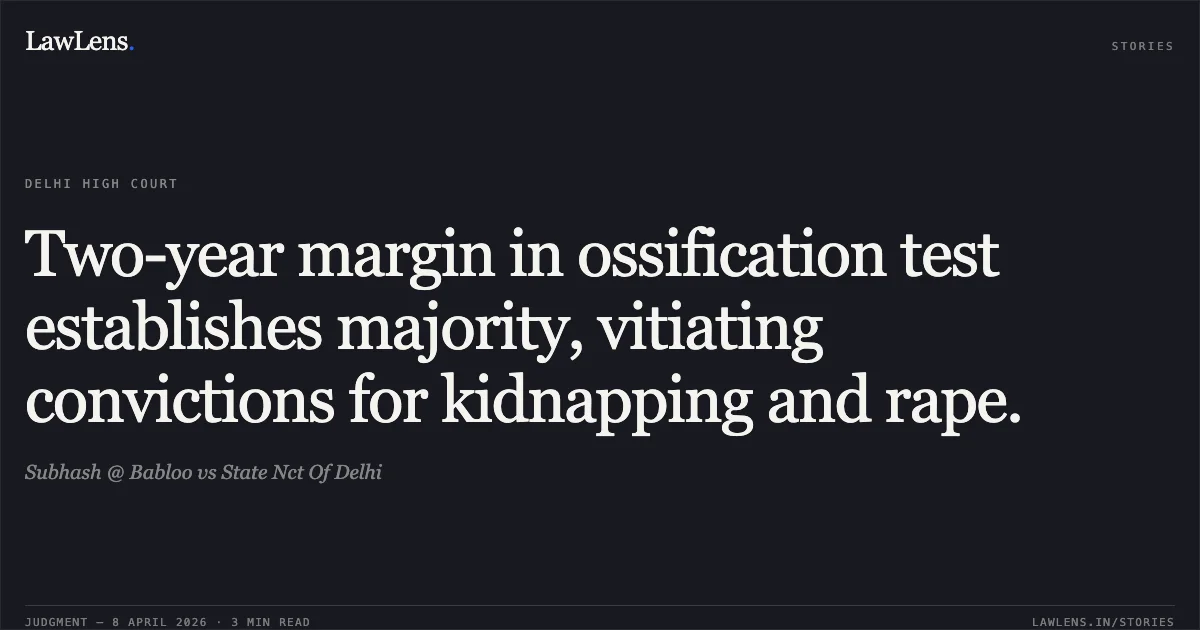
Source reference: p. 7, 9-10Applying the +/- 2-year margin of error to the ossification test (16.4 years upper limit), the court determined the prosecutrix could be treated as 18.4 years old, making her a major capable of consent.
Source reference: p. 11On the merits, the court noted the prosecutrix’s trial testimony—alleging she was transported to Himachal Pradesh while unconscious on a public bus—was "improbable" and lacked "sterling quality".
Source reference: p. 12-13, 16The court observed that her Section 164 Cr.P.C. statement, which admitted to voluntary elopement and marriage, was likely the truthful narrative.
Source reference: p. 15It rejected her claim that the 164 statement was made under pressure, noting she was in a secure shelter home ("Nirmal Chhaya") while the Appellant was in police custody at the time.
Source reference: p. 16Holding
The court held that the prosecutrix was likely a major at the time of the incident and that her testimony was untrustworthy and full of inherent contradictions.
Consequently, the prosecution failed to prove the charges of kidnapping, abduction, or rape beyond a reasonable doubt.
Source reference: no citationThe High Court set aside the Trial Court's judgment dated August 10, 2010, allowed the appeal, and ordered the immediate release of the Appellant.
Source reference: p. 16-17Acts & Sections Cited
6 provisions across 4 statutes referred to in this judgment. Each provision opens on LawLens.
Indian Penal Code, 18603
Juvenile Justice (Care and Protection of Children) Act, 2015.1
Protection of Children from Sexual Offences Act, 20121
Prohibition of Child Marriage Act, 20061
Original Court PDF
Subhash @ BabloovsState Nct Of Delhi
Click to open original judgment
Original judgment, available to read, download and summarize on LawLens.in


