Facts
The petitioners were Class-IV employees of the Collectorate, Gorakhpur, seeking promotion to the post of Junior Assistant under Rule 8(2) of the Uttar Pradesh Subordinate Offices Ministerial Group ‘C’ Posts of the Lowest Grade (Recruitment by Promotion) Rules, 2001 (“2001 Rules”).
Source reference: para. 5Pursuant to a circular dated 3 August 2017, eligible employees applied for promotion. The respondents conducted a Hindi typing test before the written examination and interview. The petitioners failed to attain the prescribed minimum speed of 25 words per minute and were consequently not permitted to proceed to the subsequent stages of selection.
Source reference: para. 6During the pendency of the petition, respondents 5 to 8, who had qualified the typing test and the remaining selection process, were promoted; their promotions were subsequently challenged by amendment.
Source reference: para. 6The claims of petitioners 1, 2, 3 and 8 became infructuous because petitioners 1 to 3 had retired and petitioner 8 had already been promoted. The petition therefore survived only with respect to petitioners 4 to 7.
Source reference: paras. 3–4Issues
Whether minimum Hindi typing proficiency of 25 words per minute was an essential eligibility condition for promotion to the post of Junior Assistant under the 2001 Rules read with the 2014 Rules.
Source reference: paras. 8–13Whether the respondents were legally entitled to conduct the typing test before the written examination, interview and evaluation of character roll, and to exclude candidates who failed the typing test from the remaining selection process.
Source reference: paras. 5–7, 11–14Whether the promotions granted to respondents 5 to 8 were liable to be set aside on the ground that the prescribed selection procedure had not been followed.
Source reference: paras. 6, 9, 14–15Law Applied
The Court applied Rule 8(2) of the 2001 Rules, which prescribes promotion on merit through a selection test comprising a written examination, interview and evaluation of character roll; its Note 2 requires a qualifying Hindi typing test, with a minimum speed of 25 words per minute, where Hindi typing is essential for the post.
Source reference: para. 11Rule 10 of the 2014 Rules prescribes, for Junior Assistant, minimum typing speeds of 25 words per minute in Hindi and 30 words per minute in English, along with computer knowledge, as essential qualifications.
Source reference: para. 12Rule 18 of the 2014 Rules preserves the applicability of the 2001 Rules, as amended, for promotion to Junior Assistant.
Source reference: para. 8The earlier decisions relied upon by the petitioners—Mukesh Kumar v. State of U.P., State of U.P. v. Narendra Kumar Mishra, State of U.P. v. Umesh Chandra Srivastava and the decision in Special Appeal (Defective) No. 550 of 2015—were held inapplicable because they did not consider the effect of the 2014 Rules.
Source reference: para. 14Reasoning
The Court read Rule 8(2) of the 2001 Rules together with Rules 10 and 18 of the 2014 Rules. Although Rule 8(2) identifies the written test, interview and character-roll evaluation as components of the selection process, Note 2 separately requires a qualifying typing test wherever typing is essential.
Source reference: paras. 12–13Since Rule 10 makes the prescribed typing speed an essential qualification for Junior Assistant, the Court treated typing proficiency as a preliminary eligibility requirement rather than merely a component for awarding selection marks.
Source reference: paras. 12–13Therefore, the respondents were entitled to assess typing eligibility first and to exclude candidates who failed to attain the minimum speed before conducting the written test and interview. The subsequent promotion of candidates who qualified the typing test and the remaining selection stages was consequently not unlawful.
Source reference: para. 14Holding
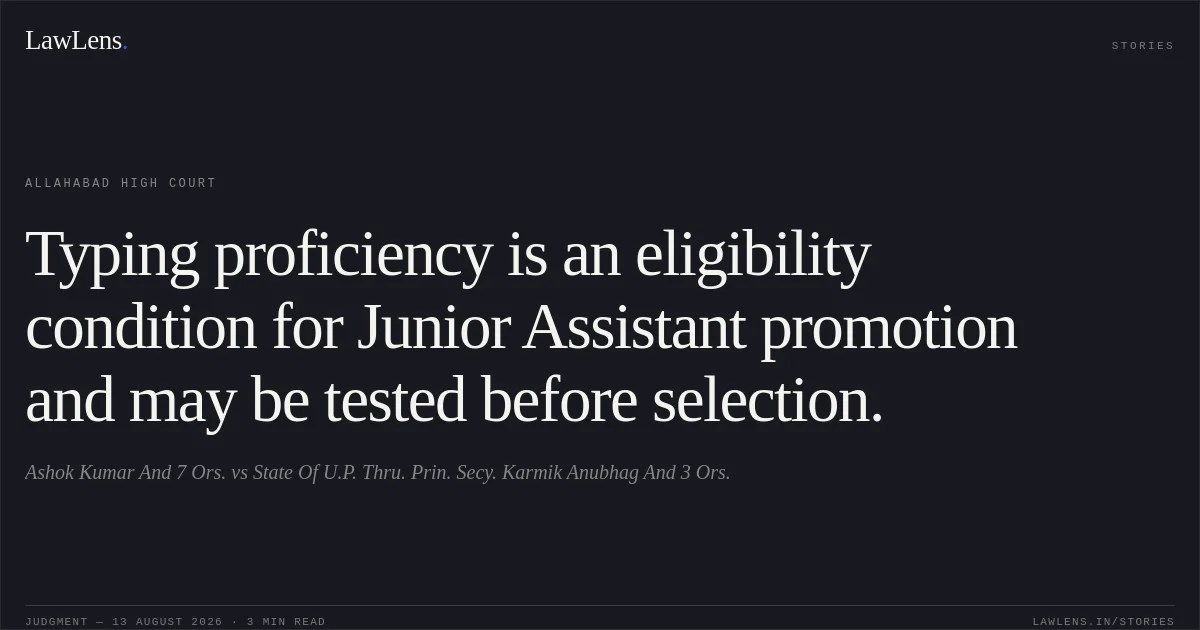
The Court held that the minimum Hindi typing speed of 25 words per minute was an essential eligibility condition for promotion to Junior Assistant and that conducting the typing test before the written examination and interview was permissible.
It found no illegality in the promotions granted to respondents 5 to 8 and dismissed the surviving claims of petitioners 4 to 7. The claims of petitioners 1, 2, 3 and 8 were separately dismissed as infructuous.
Source reference: paras. 4, 14–15The writ petition was accordingly dismissed in its entirety.
Source reference: para. 15Acts & Sections Cited
1 provisions across 1 statute referred to in this judgment. Linked provisions open on LawLens.
U.P. Public Services (Reservation For Scheduled Castes, Scheduled Tribes And Other Backward Classes) Act, 19941
Original Court PDF
Ashok Kumar And 7 Ors.vsState Of U.P. Thru. Prin. Secy. Karmik Anubhag And 3 Ors.
Click to open original judgment
Original judgment, available to read, download and summarize on LawLens.in