Facts
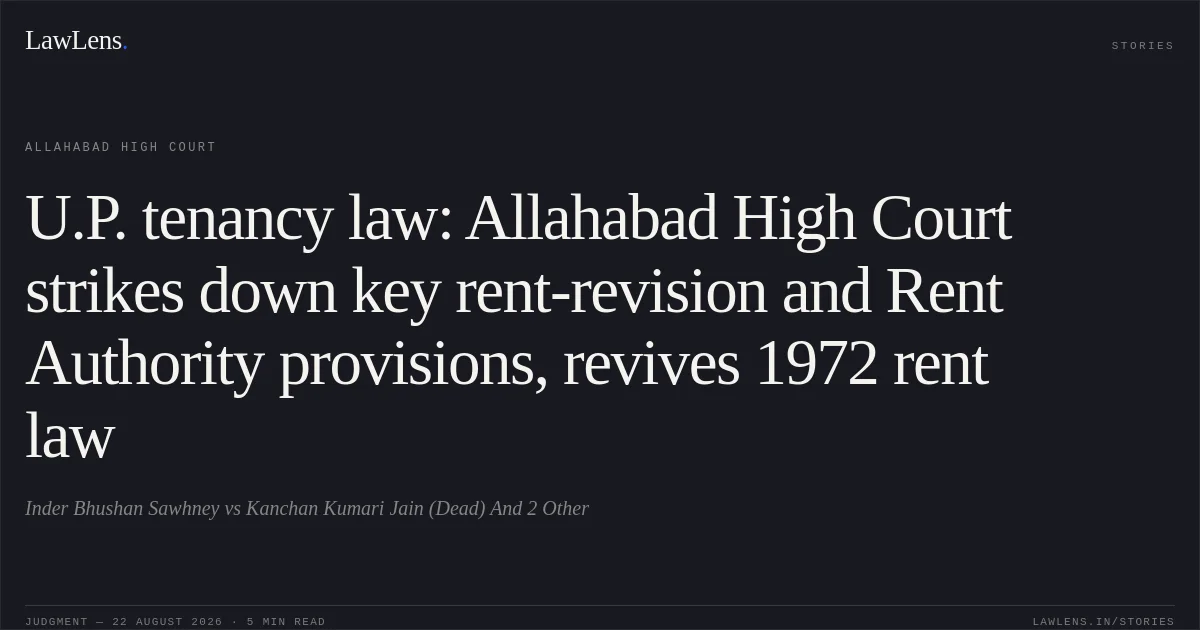
The batch of writ petitions challenged the constitutional validity of the Uttar Pradesh Regulation of Urban Premises Tenancy Act, 2021 (“Impugned Act”), particularly Sections 9 and 10 concerning revision and determination of rent, as well as orders passed by Rent Authorities and consequential execution and eviction proceedings under the Act.
Source reference: para. 2The principal petitioner was a tenant in premises at Agra. During the pendency of earlier eviction proceedings instituted in 2008, the Impugned Act came into force on 24 August 2021. The landlady thereafter applied under Section 10(4) for fixation of provisional rent. The Rent Authority passed an ex parte order enhancing the rent from ₹1,000 per month to ₹750 per square foot per month and subsequently reiterated that determination despite the petitioner’s objections regarding maintainability, documents and opportunity of hearing.
Source reference: paras. 6–13The petitioners contended that the Impugned Act, enacted without Presidential assent, was repugnant to the Transfer of Property Act, 1882 (“TPA”), the Provincial Small Cause Courts Act, 1887 (“SCC Act”) and the U.P. Civil Laws (Amendment) Act, 1972.
Source reference: paras. 14–20Issues
Whether the later decision in Rajendra Diwan v. Pradeep Kumar Ranibala was inconsistent with the earlier five-Judge decision in Indu Bhushan Bose v. Rama Sundari Devi on the legislative competence to enact tenancy legislation concerning buildings?
Source reference: paras. 50–68If the two decisions were in conflict, which decision was required to be followed by the High Court?
Source reference: paras. 50, 69–73Whether the Impugned Act was repugnant to the substantive provisions of the TPA and, in the absence of Presidential assent under Article 254(2), invalid to the extent of such repugnancy?
Source reference: paras. 50, 74–99Whether the Impugned Act was procedurally repugnant to the SCC Act read with the U.P. Civil Laws (Amendment) Act, 1972, particularly by creating a Rent Authority and Rent Tribunal with overriding jurisdiction?
Source reference: paras. 50, 100–106Whether the Impugned Act was otherwise constitutionally valid under Article 246, having regard to the distribution of legislative powers under the Seventh Schedule?
Source reference: paras. 50, 107Whether the U.P. Urban Buildings (Regulation of Letting, Rent and Eviction) Act, 1972, repealed by Section 46 of the Impugned Act, would revive if the Impugned Act or parts thereof were declared unconstitutional?
Source reference: paras. 50, 108Law Applied
The Court applied Article 246 and Entries 6, 7 and 13 of List III of the Seventh Schedule, holding that legislation governing leases, tenancy of buildings and the landlord–tenant relationship concerning non-agricultural property is primarily referable to the Concurrent List and not Entry 18 of List II.
Source reference: paras. 51–53, 73Under Article 254(1), repugnancy arises where State and Parliamentary enactments occupy the same Concurrent List field and cannot operate harmoniously; Presidential assent under Article 254(2) is necessary for a repugnant State law to prevail.
Source reference: paras. 24–25, 74–76The Court relied on Indu Bhushan Bose, Accountant & Secretarial Services (P) Ltd. v. Union of India, Hoechst Pharmaceuticals Ltd. v. State of Bihar, Deep Chand v. State of U.P., Kaisar-I-Hind Pvt. Ltd. v. National Textile Corporation and Forum for People’s Collective Efforts v. State of West Bengal. It applied the tests of direct inconsistency, occupation of the field and conflict over the same subject matter.
Source reference: paras. 34–35, 74–76The Court also applied the principles of precedent, including that a judgment is authority only for what it actually decides and that an earlier decision of an equal Bench strength is to be followed where the later decision does not directly decide the same issue.
Source reference: paras. 62–73Finally, the doctrines of severability and revival of the earlier law upon invalidation of an unconstitutional repealing enactment were applied under R.M.D. Chamarbaugwalla v. Union of India, Property Owners Association v. State of Maharashtra and State of Tamil Nadu v. K. Shyam Sunder.
Source reference: paras. 106, 108Reasoning
The Court held that Indu Bhushan Bose directly addressed the legislative field governing tenancy of houses and buildings and located it in Entries 6, 7 and 13 of List III. The observations in Rajendra Diwan concerning Entry 18 of List II arose in the narrower context of the State’s inability to confer appellate jurisdiction on the Supreme Court and did not decide the legislative source of general tenancy legislation; therefore, there was no conflict between the two decisions.
Source reference: paras. 51–68Applying Article 254, the Court found that the Impugned Act substantially altered the legal regime under the TPA by mandating written tenancy agreements irrespective of duration, permitting statutory revision and determination of rent beyond contractual terms, creating additional grounds for eviction, regulating post-tenancy occupation and imposing penal rent. These provisions could not be harmonised with the TPA’s rules concerning creation, determination and termination of leases. The Act also created a Rent Authority and Rent Tribunal and displaced the jurisdiction and procedure otherwise available under the SCC Act and the Civil Laws Act.
Source reference: paras. 78–104Since the Impugned Act had not received Presidential assent under Article 254(2), its inconsistent provisions could not prevail over the Parliamentary laws. The Court severed the unconstitutional provisions rather than invalidating the entire enactment and held that the repealed 1972 Rent Act would revive to the extent necessary to avoid a legal vacuum.
Source reference: paras. 106–108Holding
The writ petitions were allowed. Sections 8, 9, 10, 38 and 42 of the U.P. Regulation of Urban Premises Tenancy Act, 2021 were declared ultra vires with effect from 21 August 2026, principally because they were repugnant to the TPA, SCC Act and the U.P. Civil Laws (Amendment) Act, 1972 and lacked Presidential assent under Article 254(2).
The individual orders challenged in the connected writ petitions were quashed.
Source reference: para. 110Proceedings and rent agreements already concluded under the Impugned Act, where validity had not been challenged, were protected; revised or determined rents and other concluded terms were saved and made enforceable under the revived 1972 Rent Act, the TPA, the SCC Act and the Civil Laws Act, as applicable.
Source reference: para. 110There was no order as to costs.
Source reference: para. 111Acts & Sections Cited
64 provisions across 13 statutes referred to in this judgment. Linked provisions open on LawLens.
U.P. Regulation of Urban Premises Tenancy Act, 2021
Transfer of Property Act, 1882
Provincial Small Causes Courts Act, 18875
U.P. Civil Laws (Amendment) Act, 19721
U.P. Urban Buildings (Regulation of Letting, Rent and Eviction) Act, 1972
Government of India Act, 19351
Code of Civil Procedure, 19082
Chhattisgarh Rent Control Act, 20111
U.P. (Temporary) Control of Rent and Eviction Act, 19471
Essential Commodities Act, 19551
Industries (Development and Regulation) Act, 19511
Chit Funds Act, 19821
Kerala Chitties Act, 19754
Original Court PDF
Inder Bhushan SawhneyvsKanchan Kumari Jain (Dead) And 2 Other
Click to open original judgment
Original judgment, available to read, download and summarize on LawLens.in