Facts
An explosion occurred at Gate No. 4, Lal Qila Metro Station, Delhi, on 10 November 2025.
Source reference: paras. 4–13The case was registered by the NIA under provisions of the Bharatiya Nyaya Sanhita, 2023, the Unlawful Activities (Prevention) Act, 1967 (“UAPA”), and the Explosive Substances Act, 1908.
Source reference: paras. 4–13The Appellant was arrested on 17 November 2025 and initially granted 24 days of police custody, followed by judicial custody.
Source reference: paras. 4–13On 13 February 2026, the Trial Court, acting under Section 43D(2) of the UAPA read with Section 187 of the Bharatiya Nagarik Suraksha Sanhita, 2023 (“BNSS”), extended the detention period by 45 days, up to 135 days from arrest.
Source reference: paras. 4–13The Appellant applied for default bail on 15 February 2026.
Source reference: paras. 4–13A further extension up to 180 days was granted on 27 March 2026, and the default-bail application was dismissed on 30 March 2026.
Source reference: paras. 4–13The NIA filed the charge-sheet on 14 May 2026, during the pendency of the appeal.
Source reference: paras. 4–13Issues
Whether the reference to Section 167 of the repealed Code of Criminal Procedure, 1973 (“Cr.P.C.”) in Section 43D(2) of the UAPA must be construed as a reference to the corresponding Section 187 of the BNSS by virtue of Section 8(1) of the General Clauses Act, 1897?
Source reference: paras. 29, 45–49, 67–74Whether, after the enactment of the BNSS, an accused prosecuted under the UAPA becomes entitled to default bail upon expiry of 90 days, or whether the detention period may still be extended up to 180 days under the first proviso to Section 43D(2)(b) of the UAPA?
Source reference: paras. 29–30, 70–74Whether the Appellant could belatedly challenge the orders extending the investigation and detention period after failing to contest them promptly and after filing of the charge-sheet?
Source reference: paras. 75–78Whether the Public Prosecutor’s report seeking extension of the investigation period was required to be supplied to the accused?
Source reference: paras. 79–82Law Applied
The Court applied Section 43D(2) of the UAPA, which modifies the ordinary remand periods under Section 167 of the Cr.P.C. and permits extension of detention from 90 days up to 180 days where the Public Prosecutor’s report discloses the progress of investigation and specific reasons for continued detention.
Source reference: paras. 30–36Section 187(2)–(3) of the BNSS was treated as the corresponding re-enacted provision to Section 167 of the Cr.P.C., with the BNSS’s principal procedural change concerning the manner in which 15 days of police custody may be availed.
Source reference: paras. 38–43Under Section 8(1) of the General Clauses Act, 1897, a reference to a repealed provision is ordinarily construed as a reference to the corresponding re-enacted provision, unless a contrary legislative intention appears.
Source reference: paras. 53–55, 63–65The Court distinguished “legislation by reference” from “legislation by incorporation,” relying principally on Mahindra & Mahindra Ltd. v. Union of India, (1979) 2 SCC 529, and held that Section 43D(2) merely refers to, rather than bodily incorporates, Section 167 of the Cr.P.C.
Source reference: paras. 58–69It also relied on Syed Shahid Yousuf v. National Investigation Agency, 2018 SCC OnLine Del 9329, regarding the requirements for extension under Section 43D(2), and Javed Siddiqui v. State of Uttarakhand, SLP (Crl.) No. 908/2026, for the principle that failure to promptly challenge extension orders may amount to acquiescence.
Source reference: paras. 35, 77–78Following Zeeshan Qamar v. State (NCT of Delhi), (2023) 1 HCC (Del) 720, the Court held that the Public Prosecutor’s report need not be furnished to the accused at the extension stage, although the accused must receive notice and an opportunity to make submissions.
Source reference: paras. 80–82Reasoning
The Court held that Section 43D(2) of the UAPA did not bodily incorporate the text of Section 167 of the Cr.P.C.; it only referred to that procedural provision and modified certain periods for UAPA prosecutions.
Source reference: paras. 56, 67Consequently, Section 8(1) of the General Clauses Act operated to substitute the corresponding Section 187 of the BNSS for the reference to Section 167 of the Cr.P.C.
Source reference: paras. 64–71The changes introduced by Section 187 of the BNSS—particularly permitting 15 days of police custody in parts during the initial period—did not disclose any intention to remove the UAPA’s special extension mechanism.
Source reference: paras. 70–74Since Section 43D(2) expressly preserves the power to extend detention beyond 90 days up to 180 days, and the UAPA is a special enactment dealing with terrorism-related offences, the Court held that the BNSS did not impliedly restrict the UAPA period to 90 days.
Source reference: paras. 70–74The Appellant had also participated in the proceedings on the first extension application but did not challenge the order dated 13 February 2026 promptly.
Source reference: paras. 75–78, 83–84Applying the principle of acquiescence, the Court held that he could not later challenge that order as a basis for claiming default bail, particularly after the subsequent extension and filing of the charge-sheet.
Source reference: paras. 75–78, 83–84As to the Public Prosecutor’s report, the Court held that notice of the extension application and an opportunity of hearing were sufficient; disclosure of the report itself was not mandatory at that stage, provided the Special Court considered the accused’s submissions.
Source reference: paras. 79–82Holding
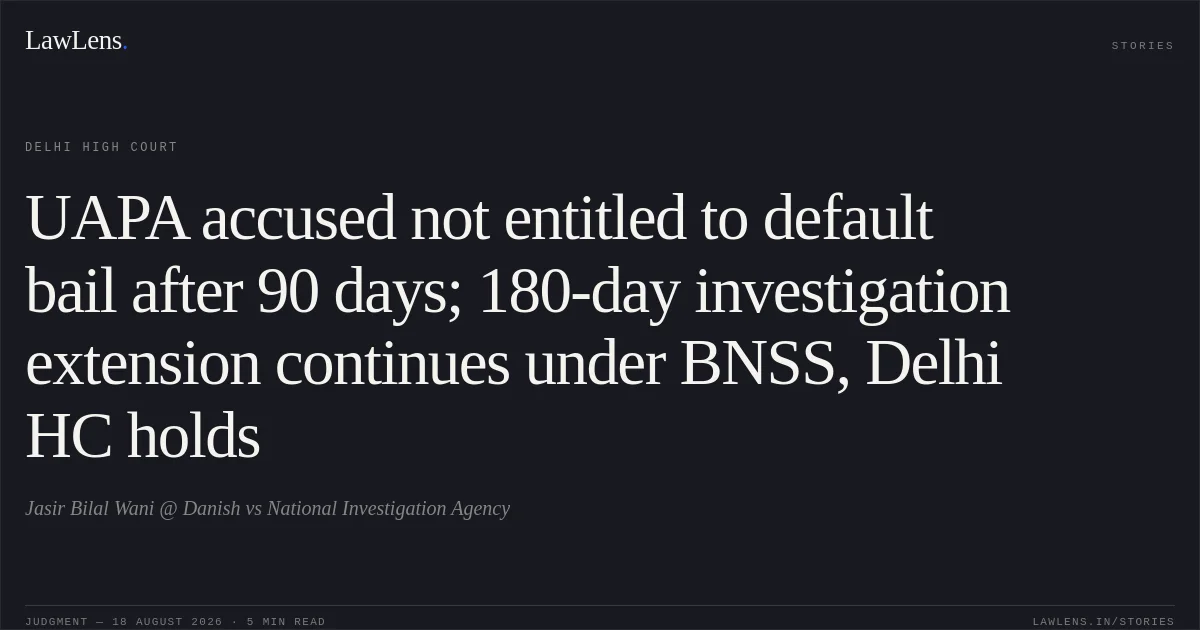
The Court held that the reference to Section 167 of the Cr.P.C. in Section 43D(2) of the UAPA must be read as a reference to Section 187 of the BNSS under Section 8(1) of the General Clauses Act.
The first proviso to Section 43D(2)(b) therefore continued to permit extension of the investigation and detention period up to 180 days in UAPA cases; the Appellant was not entitled to default bail merely upon expiry of 90 days.
Source reference: para. 74The Court further held that the delayed challenge to the first extension order was barred by acquiescence and that the Public Prosecutor’s report was not required to be supplied to the accused.
Source reference: paras. 78, 82The appeal challenging the extension orders and rejection of default bail was dismissed, with pending applications also disposed of; the Appellant was left free to pursue any other remedy available in law.
Source reference: paras. 83–86Acts & Sections Cited
24 provisions across 8 statutes referred to in this judgment. Each provision opens on LawLens.
Bharatiya Nagarik Suraksha Sanhita, 20233
Bharatiya Nyaya Sanhita, 20233
Code of Civil Procedure, 19081
Code of Criminal Procedure, 19737
General Clauses Act, 18971
National Investigation Agency Act, 20081
Unlawful Activities (Prevention) Act, 19676
Original Court PDF
Jasir Bilal Wani @ DanishvsNational Investigation Agency
Click to open original judgment
Original judgment, available to read, download and summarize on LawLens.in