Facts
The petitioners, a private unaided recognised school and another, challenged the Education Tribunal, Sonepat’s order dated 04.05.2024, which allowed the employee’s appeal and declared his termination order dated 14.05.2022 void ab initio, illegal, non-est and without jurisdiction.
Source reference: para. 2The school had issued a show-cause notice dated 24.02.2022, considered the employee’s reply, and thereafter issued a charge-sheet dated 08.03.2022 and placed him under suspension pending inquiry.
Source reference: paras. 3–4However, despite the school’s Service Rules, 2012 contemplating a regular departmental inquiry for major penalties, no inquiry was conducted before the employee’s termination.
Source reference: paras. 4, 6.1, 7The school contended that the misconduct was apparent and incontrovertible, making an inquiry unnecessary, whereas the employee relied on the statutory rules and the school’s own service regulations requiring an inquiry.
Source reference: paras. 3–4Issues
1. Whether the Education Tribunal had jurisdiction to adjudicate the employee’s challenge to his termination from a private unaided recognised school.
Source reference: paras. 5–62. Whether the school could terminate the employee for alleged apparent misconduct without conducting the regular departmental inquiry mandated by its Service Rules, 2012.
Source reference: paras. 3–4, 6.1, 73. Whether the Tribunal’s order warranted interference under the High Court’s certiorari and supervisory jurisdiction under Articles 226/227 of the Constitution.
Source reference: paras. 7–10Law Applied
Private unaided recognised schools are governed by the Haryana School Education Act, 1995 and the Haryana School Education Rules, 2003.
Source reference: para. 6Rule 161 requires every recognised private school to execute a written contract of service in the prescribed form, while Rule 162 requires the management to frame service rules governing service conditions, disciplinary procedure, code of conduct, penalties and the constitution of the disciplinary committee.
Source reference: para. 6Once such service rules are framed, the school is bound to follow the prescribed procedure and cannot depart from it; where a power is required to be exercised in a particular manner, it must be exercised in that manner or not at all, as recognised in Anuradha Bhasin v. Union of India, (2020) 3 SCC 637.
Source reference: para. 6.1The Education Tribunal is competent to adjudicate service disputes involving employees of private unaided schools, except matters relating to gratuity, as held in Management of S.D. Model Sr. Sec. School v. District Judge-cum-Service Tribunal, 2014(1) SCT 652.
Source reference: para. 5Under Syed Yakoob v. K.S. Radhakrishnan, AIR 1964 SC 477, and General Manager, Electrical Rengali Hydro Electric Project, Orissa v. Sri Giridhari Sahu, (2019) 10 SCC 695, certiorari is supervisory, not appellate; interference is justified for jurisdictional error, breach of natural justice, or an error of law apparent on the face of the record, but not for reassessment of evidence or correction of ordinary factual errors.
Source reference: paras. 8–9Reasoning
The Court held that the school, being a recognised private unaided institution, was subject to Rules 161 and 162 of the Haryana School Education Rules, 2003.
Source reference: para. 6Its own Service Rules, 2012 prescribed a disciplinary mechanism, including a regular inquiry before imposition of a major penalty, unless the employee admitted the charges.
Source reference: para. 4The school issued a charge-sheet, proposed a major penalty and suspended the employee pending inquiry, thereby demonstrating that an inquiry was contemplated; nevertheless, it terminated him without holding one.
Source reference: paras. 4, 7The plea that the misconduct was self-evident and that an inquiry would be an empty formality was rejected because no exceptional circumstances rendering an inquiry meaningless were established on the record.
Source reference: para. 7The Tribunal therefore acted within its jurisdiction in setting aside the termination.
Source reference: para. 7Since the petitioners failed to demonstrate jurisdictional error, violation of natural justice, or any other error apparent on the face of the record, the High Court declined to reappreciate the evidence or interfere under Articles 226/227.
Source reference: paras. 8–10Holding
The Court answered the issues against the school.
It held that the Education Tribunal had jurisdiction over the employee’s service dispute and that the school was bound to conduct the regular departmental inquiry prescribed by its statutory framework and Service Rules before imposing the major penalty of termination.
Source reference: paras. 5–7Finding no ground for certiorari or supervisory interference, the High Court dismissed both writ petitions, CWP-13775-2024 (O&M) and CWP-13796-2024, and disposed of any pending miscellaneous applications.
Source reference: paras. 10–13Original Court PDF
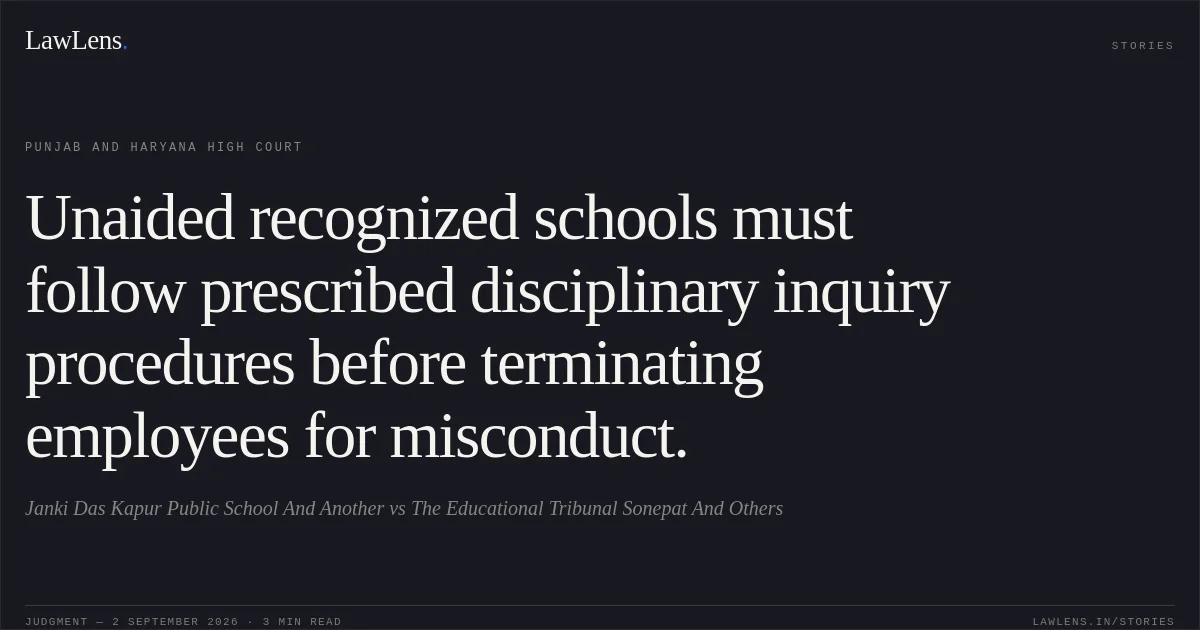
Janki Das Kapur Public School And AnothervsThe Educational Tribunal Sonepat And Others
Click to open original judgment
Original judgment, available to read, download and summarize on LawLens.in